From Near Extinction to the Championship: Lincoln City's 20-Year Miracle
Lincoln City's promotion to the Championship is no overnight success story. It's the result of two decades of survival, rebuilding, and relentless ambition.
From Near Extinction to the Championship: Lincoln City's 20-Year Miracle
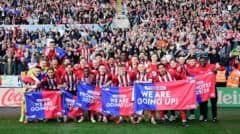
When Jack Moylan rifled home a 96th-minute winner at Reading to seal a 2-1 victory, Lincoln City did more than secure promotion — they completed one of English football's most remarkable long-term transformations. That single goal, needed only to confirm what was already mathematically close, sent the Imps into the Championship for the first time in 65 years.
With five games still to play, Lincoln now have their sights set on claiming the League One title outright and giving Sincil Bank the historic send-off this campaign truly deserves.
But how exactly does a club operating on one of the slimmest budgets in the third tier achieve something this extraordinary? The answer, according to those who lived through every chapter of it, stretches back a full two decades.
The Foundation: Keith Alexander and the Club's Darkest Hour
To understand Lincoln City's rise, you first need to understand how far they once fell.
John Pakey, a former sports editor at the Lincolnshire Echo, has spent years tracking this club's fortunes. He spoke with former colleagues to piece together the full picture — and the story begins long before Danny Cowley ever set foot in Lincolnshire.
In the early 2000s, the collapse of ITV Digital left clubs across the Football League financially crippled. Lincoln City was no exception. The club tumbled into administration, and matchday attendances withered to as few as 2,500 supporters.
"What Keith did saved the club," said Leigh Curtis, who began covering Lincoln for the Echo in 2005.
Keith Alexander arrived as manager and immediately set about rebuilding — not just the squad, but the soul of the club. His greatest skill was unearthing talent from the non-league game and transforming raw potential into competitive footballers. Among his discoveries were Gareth McAuley and Gary Taylor-Fletcher, both of whom went on to reach the Premier League.
"His eye for a player was amazing," Curtis recalled. "But he also understood team spirit. He believed it was worth 50 points in a season. He'd encourage the players to socialise, to bond. On the pitch, that produced a group who worked tirelessly for each other."
Alexander guided Lincoln to back-to-back play-off campaigns in League Two before departing for Peterborough United in the summer of 2006. He passed away in 2010 at just 53 years old. So profound was his impact that his funeral was held at Lincoln Cathedral — a fitting tribute to a man who had given the city's football club its heartbeat back.
The Slide and the Saviour in the Boardroom
After Alexander's departure, Lincoln City struggled to replicate his recruitment instincts. A succession of managers failed to maintain standards, and in 2011, under Steve Tilson, the club suffered the humiliation of relegation from the Football League entirely.
"Horrific," was how Curtis described that day.
Yet even in non-league football, Lincoln City did not collapse. The man most responsible for keeping the lights on was chairman Bob Dorrian — a figure Curtis believes has never received adequate recognition for his contribution.
"Dorrian doesn't get enough credit for what he did," he said.
Dorrian not only backed the club financially during the wilderness years but also restructured its ownership model to make a future takeover more straightforward. His patience and perseverance eventually bore fruit in 2016, when South African businessman Clive Nates arrived as an investor, later assuming the chairmanship in 2018.
Nates was not your typical football club benefactor. Understated and quietly passionate, he was more likely to be found standing on the terraces during away trips than occupying a seat in the directors' box.
When asked why he chose to invest in a struggling non-league club, his answer was disarmingly simple.
"I have friends who spend money on paintings, on cars," he said. "But I like football, and that's what I want to put my money in."
The Cowleys Arrive — and Everything Changes
Nates wasted little time in identifying his first major priority: appointing the right manager. His attention turned to Danny and Nicky Cowley, a pair of progressive non-league coaches who had built an impressive reputation guiding Essex club Concord Rangers up the divisions.
On the day Danny Cowley was confirmed as Lincoln City manager — 11 May, 2016 — Pakey, then still at the Echo, took the call directly from the new boss.
"We look at Lincoln City as a sleeping giant, is that fair?" Cowley asked him.
"Nicky and I really think that if we can get the city behind us, if we can connect, then it has real potential," Danny continued.
It was a belief that would be vindicated spectacularly. Within four years of the Cowleys' arrival, Lincoln City had set a new FA Cup record as the first non-league side to reach the quarter-finals, won promotion back into the Football League, climbed again into League One, and celebrated a Wembley final victory.
Mark Whiley, who took over Lincoln City coverage at the Echo when Pakey departed — coincidentally on the very day the Cowleys were appointed — was on hand to report every milestone of that remarkable era.
A Championship Club, 20 Years in the Making
Lincoln City's promotion to the Championship is not the product of a wealthy takeover or a sudden injection of elite-level spending. It is the culmination of twenty years of survival, smart recruitment, boardroom stability, and a community that refused to let its club disappear.
From Keith Alexander pulling a club out of administration, to Bob Dorrian holding the ship steady through the non-league years, to Clive Nates providing the financial platform, to the Cowley brothers reshaping the club's identity — every piece of the puzzle was necessary.
Now, as Lincoln City prepare to compete at the second tier of English football for the first time since 1961, the sleeping giant has most emphatically woken up.