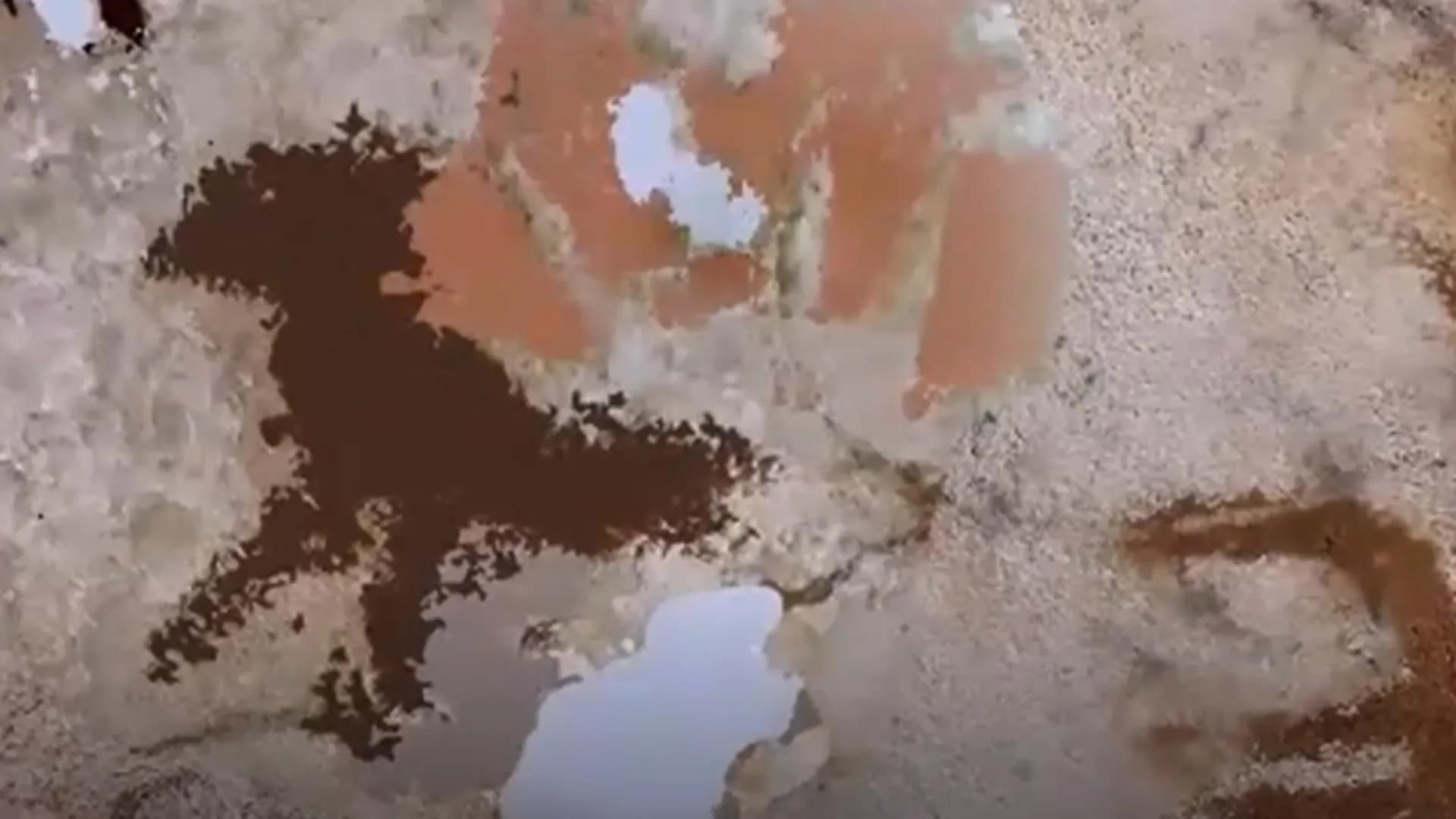
World's Oldest Cave Art Discovered: A 67,800-Year-Old Hand Stencil in Indonesia
A hand stencil found in an Indonesian cave has been confirmed as the oldest known cave art on Earth, shedding light on early human creativity and migration.

A Cave Wall in Indonesia Rewrites the History of Human Art
Deep within the limestone caves of Sulawesi, Indonesia, scientists have uncovered something extraordinary — a hand stencil etched onto cave walls approximately 67,800 years ago. This remarkable find has officially claimed the title of the oldest known cave art ever discovered, surpassing previous records from the same region by more than 15,000 years.
The discovery was made by an international research team representing Griffith University, Indonesia's national research and innovation agency (BRIN), and Southern Cross University. Their findings not only reshape our understanding of prehistoric art but also provide compelling new evidence about when and how early humans first migrated to Australia.
Uncovering the Ancient Stencil
The artwork was found preserved on the walls of Liang Metanduno cave on Muna, a small island near Sulawesi in southeastern Indonesia. Among a collection of much younger paintings, researchers identified a partial hand stencil that stood apart from the rest — both in age and in its unusual appearance.
To accurately date the stencil, the team employed uranium-series dating, a highly precise technique that analyzes thin mineral deposits that form over and beneath cave paintings over time. These tiny calcite layers act as natural timestamps, allowing scientists to pinpoint when the artwork was created with remarkable confidence.
The results were clear: the hand stencil is at least 67,800 years old, making it the most ancient reliably dated example of rock art in the world.
A Stencil Unlike Any Other
What makes this particular piece even more fascinating is its distinctive, claw-like design. Unlike typical hand stencils found at prehistoric sites around the world, this one appears to have been deliberately altered after its initial creation. The outlines of the fingers were narrowed over time, transforming the image into something that resembles an animal claw rather than a human hand.
Professor Adam Brumm of Griffith University's Australian Research Centre for Human Evolution, who co-led the study, acknowledged that the exact meaning behind this modification remains a mystery. However, he offered a thought-provoking interpretation.
"This art could symbolize the idea that humans and animals were closely connected — something we already seem to see in the very early painted art of Sulawesi, with at least one instance of a scene portraying figures that we interpret as representations of part-human, part-animal beings," Professor Brumm said.
This blending of human and animal imagery suggests that early symbolic and possibly spiritual thinking was already present among these ancient people.
Tens of Thousands of Years of Continuous Art
Perhaps equally remarkable is the sheer span of artistic activity documented within the cave. Evidence suggests that humans continued creating art in Liang Metanduno for at least 35,000 years, with activity persisting until roughly 20,000 years ago.
Professor Maxime Aubert, an archaeologist and geochemist from Griffith University's Centre for Social and Cultural Research who co-led the research, described the significance of this finding.
"It is now evident from our new phase of research that Sulawesi was home to one of the world's richest and most longstanding artistic cultures, one with origins in the earliest history of human occupation of the island at least 67,800 years ago," Professor Aubert said.
This extraordinary timeline positions Sulawesi not merely as an isolated site of ancient art but as a thriving center of early human creative expression spanning tens of millennia.
Implications for the First Migration to Australia
Beyond its artistic significance, the discovery carries profound implications for the story of human migration into the ancient landmass known as Sahul — the prehistoric supercontinent that once united present-day Australia, Tasmania, and New Guinea.
Dr. Adhi Agus Oktaviana, a rock art specialist at BRIN whose doctoral research at Griffith University contributed directly to this study, explained why the find matters for understanding Australian Aboriginal heritage.
"It is very likely that the people who made these paintings in Sulawesi were part of the broader population that would later spread through the region and ultimately reach Australia," Dr. Oktaviana said.
Settling a Long-Standing Debate
For decades, archaeologists have been divided over when humans first set foot on Sahul. One school of thought places their arrival at around 50,000 years ago, while another argues for a longer chronology of at least 65,000 years. The Sulawesi discovery lends powerful support to the latter.
"This discovery strongly supports the idea that the ancestors of the First Australians were in Sahul by 65,000 years ago," Dr. Oktaviana noted.
Mapping the Northern Migration Route
Researchers have long theorized about two possible pathways into Sahul. The northern route would have taken early humans through Sulawesi and the Spice Islands toward New Guinea, while the southern route would have carried seafarers directly toward Australia via Timor or neighboring islands.
Professor Renaud Joannes-Boyau of the Geoarchaeology and Archaeometry Research Group at Southern Cross University said the new evidence firmly supports the northern corridor as a key migration pathway.
"With the dating of this extremely ancient rock art in Sulawesi, we now have the oldest direct evidence for the presence of modern humans along this northern migration corridor into Sahul," Professor Joannes-Boyau said.
Professor Aubert added that these findings highlight the broader archaeological importance of the many Indonesian islands situated between Sulawesi and western New Guinea — regions that may hold further undiscovered evidence of early human activity.
A Collaborative Effort With Global Support
The research received significant backing from the Australian Research Council (ARC), including funding channeled through the ARC Centre of Excellence for Transforming Human Origins Research, led by Griffith University, and the ARC Training Centre for Advancing Archaeology in the Resources Sector at Southern Cross University. Both institutions are committed to advancing knowledge of human evolution and safeguarding cultural heritage worldwide.
Additional support came from Google Arts & Culture and the National Geographic Society. The Sulawesi discoveries have also been featured in a European documentary titled Sulawesi l'île des premières images, produced by ARTE.
The full study, titled Rock art from at least 67,800 years ago in Sulawesi, was published in the prestigious journal Nature.
A Window Into the Minds of Our Earliest Ancestors
This 67,800-year-old hand stencil is far more than a fascinating archaeological curiosity. It is a direct line of communication across tens of thousands of years — a signal from some of the earliest humans that they were thinking symbolically, expressing themselves creatively, and perhaps even contemplating their place in the natural world.
As researchers continue to explore the caves and islands of Indonesia, the full story of humanity's earliest artistic traditions and the epic journey that brought our ancestors to the far reaches of the globe is only beginning to come into focus.