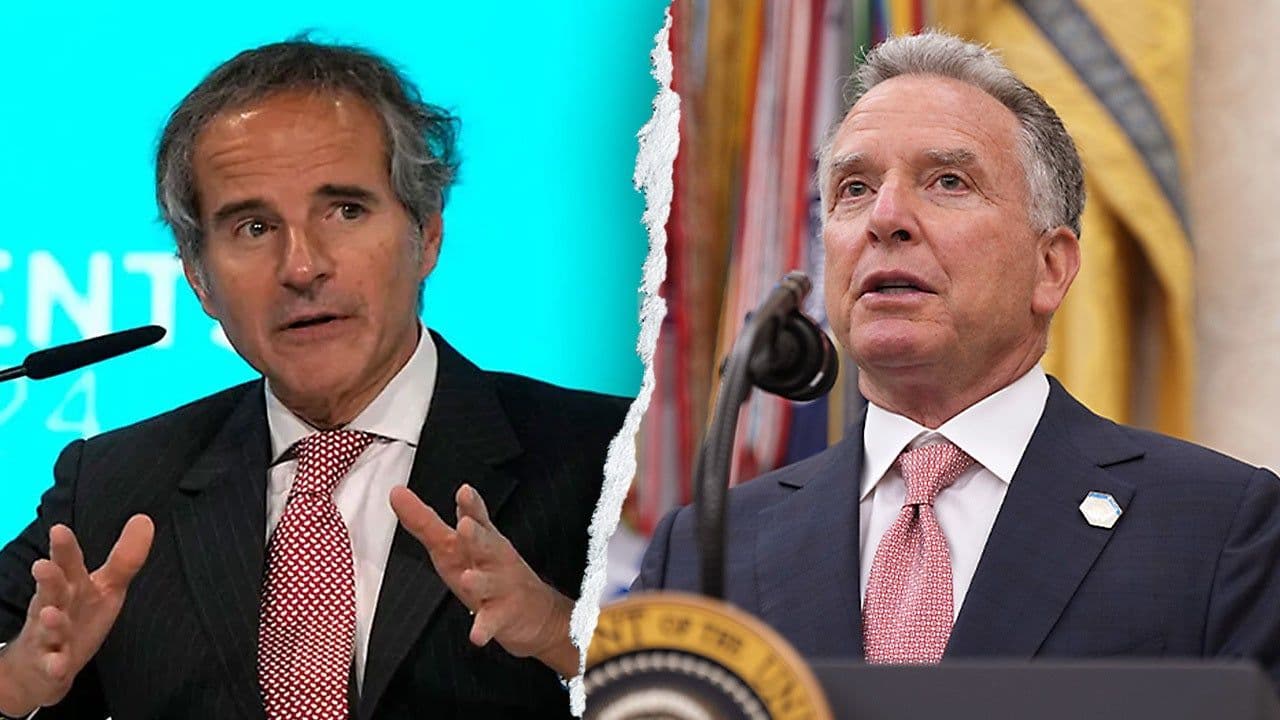
Witkoff Exposes Iran's Nuclear Arrogance as IAEA Sends Contradictory Signals
Steve Witkoff revealed Iran's negotiators boasted openly about their nuclear capabilities, while the IAEA struggles to provide clear answers on Tehran's true intentions.

Iran's Nuclear Boasts Meet International Ambiguity
Revelations made by U.S. Special Envoy Steve Witkoff about his direct negotiations with Iranian officials have cast a harsh light on the regime's nuclear ambitions — and on the contradictory messaging coming from the world's leading nuclear watchdog.
While Witkoff described Iranian negotiators who spoke with undisguised pride about their capacity to produce nuclear weapons, the International Atomic Energy Agency (IAEA) Director General Rafael Grossi posted a statement to X asserting that no evidence existed of Iran constructing a nuclear bomb. Critics and security experts were quick to question how such a determination could be made given that Iran has blocked full inspector access to its nuclear facilities.
Fox News Digital reached out to the IAEA seeking clarification on how it could evaluate Iran's nuclear weapons development without unrestricted facility access. No response was received before publication.
What Witkoff Heard at the Negotiating Table
Speaking with Fox News anchor Sean Hannity earlier this week, Witkoff offered a detailed and troubling account of pre-military-operation talks he held with the Iranian regime — conversations that took place before the United States and Israel launched their joint military campaign against Tehran.
According to Witkoff, Iranian negotiators flatly declared they possessed an "inalienable right" to enrich uranium. When he pushed back, stating that the Trump administration held an equally "inalienable right to stop them," the Iranians coolly responded that this was merely their opening negotiating position.
The envoy went on to describe Iran's nuclear inventory in striking detail:
- Approximately 10,000 kilograms of total fissionable material
- Roughly 460 kilograms of uranium enriched to 60%
- Around 1,000 kilograms enriched to 20%
- Domestically manufactured centrifuges capable of continuous enrichment
"The 60% material can be brought to 90% — that's weapon grade — in roughly one week, maybe 10 days at the outside," Witkoff explained. "The 20% can be brought to weapons grade inside of three to four weeks."
Pride Without Shame
Perhaps most alarming was the tone Witkoff described from Iran's negotiators. During his initial meeting, representatives openly acknowledged their 460 kilograms of 60%-enriched uranium and stated they understood it was sufficient to produce 11 nuclear bombs.
"They were proud of it," Witkoff said. "They were proud that they had evaded all sorts of oversight protocols to get to a place where they could deliver 11 nuclear bombs, and that was the beginning of their negotiating stance."
The IAEA's Uncomfortable Admission
Despite his headline assertion, Grossi — who is currently a candidate for the position of United Nations Secretary General — did acknowledge in the same post that Iran holds "a large stockpile of near-weapons grade enriched uranium" and has denied inspectors comprehensive access to its program.
Grossi conceded that the IAEA would not be able to confirm Iran's nuclear activities were "exclusively peaceful" until Tehran fully cooperated with outstanding safeguards investigations.
Experts Weigh In on the Nuclear Threat
A Pattern of Ignored Warnings
Richard Goldberg, a senior advisor at the Foundation for the Defense of Democracies (FDD) and a former Trump administration official, told Fox News Digital that Grossi's warnings about Iran had gone largely unheeded for years.
"No one paid much attention to Rafael Grossi throughout the Biden years when he repeatedly warned publicly that Iran was refusing to cooperate with and providing false statements to the IAEA," Goldberg said.
He stressed that unlike the lead-up to the Iraq War, Iran's nuclear weapons program had been built out in plain view. "Iran had built out nearly every part of its nuclear weapons program in plain sight, with the weaponization work moving forward at undeclared sites," he said, adding that President Trump was "fully justified" in enforcing his red line following Operation Midnight Hammer.
Calculating Iran's Nuclear Capacity
Spencer Faragasso, a senior fellow at the Institute for Science and International Security (ISIS), said his organization had calculated that prior to the June 2025 conflict — sometimes referred to as the 12 Day War — Iran possessed approximately 440.9 kilograms of 60%-enriched uranium. Given that roughly 24 to 25 kilograms of 90%-enriched uranium are needed per weapon, Iran had the raw material capacity to produce 11 nuclear weapons within a single month.
However, Faragasso noted that key questions remain unanswered. It is still unclear whether Iran can physically access its enriched stockpiles, or whether additional centrifuges exist that were not housed in the facilities that were struck.
"Being able to enrich uranium up to weapon grade is actually a tall order," he acknowledged, noting that doing so would require a new enrichment site along with components that Iran would need to either salvage from destroyed facilities or illicitly source from abroad.
Gains Are Not Permanent
Faragasso was unambiguous about the long-term picture, warning that the military successes of the recent campaign were not a lasting solution.
"The more time that goes on, the worse the situation will get. It's not going to get better, especially regarding the ballistic missile program," he said.
He also noted that Iran had previously expressed interest in establishing a fourth enrichment site, with the IAEA identifying Esfahan as a possible location, though no confirmation of its exact whereabouts or construction status was ever made public.
Additionally, Faragasso's group has been monitoring the aftermath of an Israeli strike on March 3 targeting a site called Min-Zadayi — a facility previously unknown to nuclear analysts. The Israel Defense Forces stated on X that the location had been used by nuclear scientists working to develop a key component for nuclear weapons.
The U.S. Government's Position
The State Department directed Fox News Digital to public remarks delivered by Secretary of State Marco Rubio, who made clear where the Trump administration stands.
"This terroristic, radical, cleric-led regime cannot ever be allowed to have nuclear weapons," Rubio said. Noting Iran's history of brutally suppressing its own citizens, Rubio urged the public to consider what such a regime might do with nuclear capability on a global scale. "Under President Trump, that will never, ever happen," he affirmed.
Conclusion
The gap between the IAEA's hedged public statements and the on-the-ground realities described by Witkoff and confirmed by independent nuclear analysts raises serious questions about international oversight mechanisms. As Iran continues to reconstitute elements of its nuclear infrastructure following recent strikes, the window for diplomatic and military options remains a subject of urgent debate among policymakers and security experts alike.

