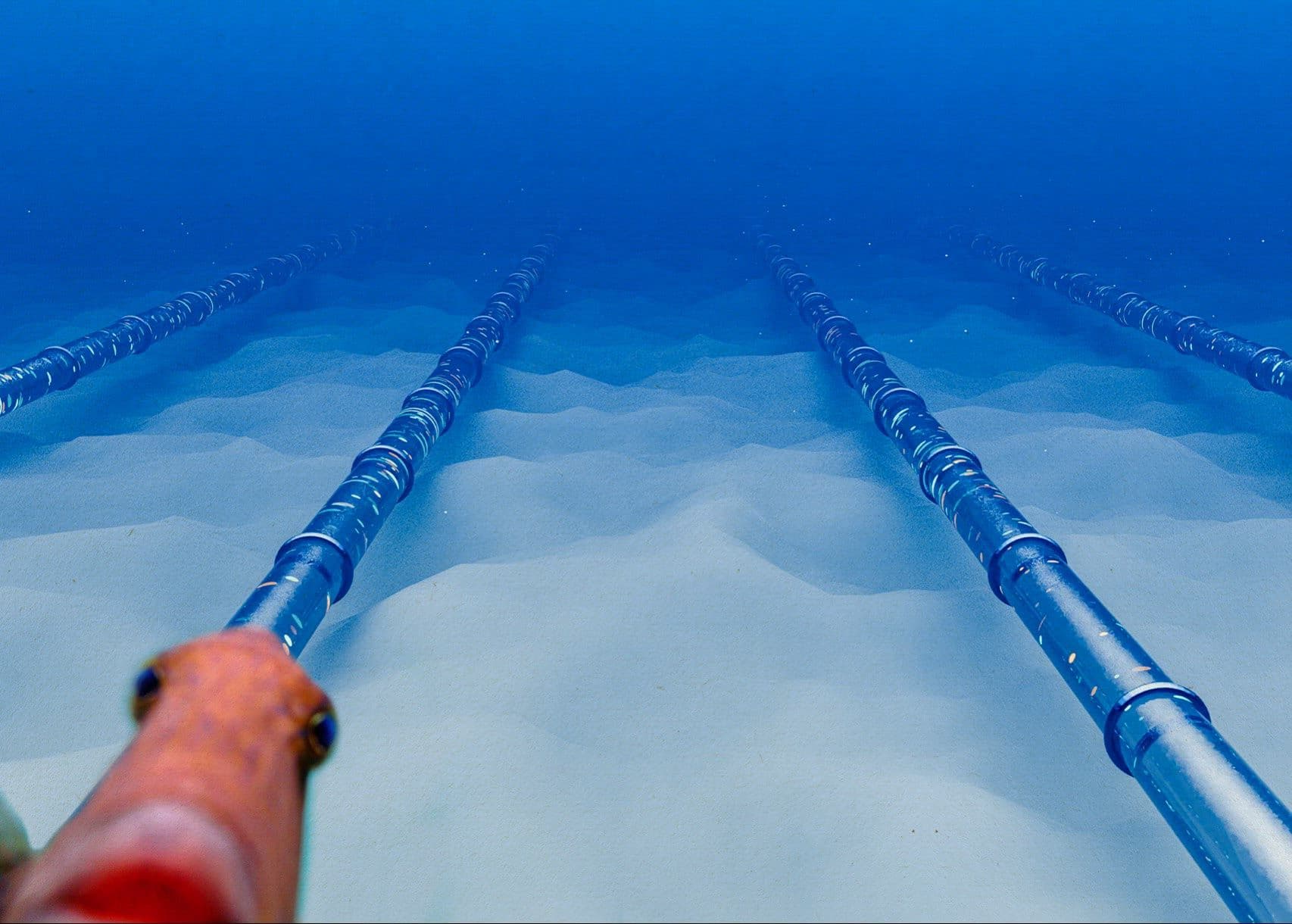
Why Undersea Cables Are the Achilles' Heel of the Gulf's AI Ambitions
Gulf nations have invested billions in AI infrastructure, but the undersea cables carrying that data are emerging as a dangerous strategic vulnerability.
The Gulf's Digital Transformation Rests on a Fragile Foundation
Saudi Arabia and the United Arab Emirates have poured staggering sums into artificial intelligence infrastructure, courting global hyperscalers and positioning themselves as future exporters of raw computing power. The vision is bold: replace oil-dependent economies with AI-driven ones. Yet beneath that ambition lies a critical weakness — the undersea cables responsible for moving that data are increasingly exposed to geopolitical risk.
Undersea cables have quietly underpinned the global internet for decades. Today, they are becoming something far more consequential: instruments of geopolitical leverage.
A Region at the Crossroads — and Under Pressure
When tensions between the United States, Israel, and Iran escalated earlier this year, security experts raised urgent warnings about the vulnerability of cable infrastructure throughout the Gulf. Reports emerging in May suggested Iran had contemplated seizing control of all seven undersea cables running through the Strait of Hormuz — a move that would have been catastrophic for regional connectivity.
The stakes are enormous. Undersea cables currently carry an estimated 95 percent of all international data traffic. For the Gulf specifically, the danger lies in concentration: the majority of the region's connectivity to Europe and North America still flows through just a handful of routes threading the Red Sea and the Strait of Hormuz.
Geographically, the Middle East occupies one of the most strategically significant positions on Earth, sitting at the junction of Europe, Asia, and Africa. That geography makes it a critical transit zone for global internet traffic — and a high-value target.
AI Infrastructure Demands Far More Than Traditional Connectivity
A severed cable today is no longer merely an inconvenience that slows download speeds. For Gulf nations building out AI ecosystems, it could unravel an entire commercial model.
These countries are effectively attempting to convert energy wealth into computational infrastructure, exporting cloud capacity and processing power much as they once exported crude oil. That transition demands unprecedented levels of connectivity resilience.
Unlike conventional internet traffic, AI systems require massive, uninterrupted data flows between hyperscale data centers, cloud platforms, and enterprise clients. Even brief outages can trigger serious operational and financial consequences, making robust fiber infrastructure a commercial necessity rather than an optional upgrade.
"Hyperscalers and regional carriers are pushing diversification because their requirements have moved beyond bandwidth. They now need multiple independent paths, predictable latency, and survivability during geopolitical stress," explains Imad Atwi, partner at management consulting firm Strategy& Middle East.
Recent Disruptions Have Already Exposed the Risk
The vulnerability is not theoretical. In 2025, two cables connecting Europe to the Middle East and Asia were severed in the Red Sea, degrading internet connectivity across the Gulf for several days and generating an estimated $3.5 billion in losses from disrupted services.
Critically, that incident occurred before the current wave of AI deployment and data center construction gained full momentum. Now, hyperscalers operating in the region are demanding the same resilience standards they rely on across transatlantic and transpacific corridors — markets that typically maintain four or five physically separate network paths to mitigate disruption risk.
The Gulf, by contrast, remains heavily concentrated along a narrow set of routes.
"Hyperscalers now want similar route diversity across the Middle East, both for Gulf-Europe connectivity and for Europe-Asia traffic transiting the region," says Bertrand Clesca, partner at subsea cable specialists Pioneer Consulting.
A Multi-Layered Strategy Is Taking Shape
For years, alternative terrestrial and subsea routes across the Middle East stalled due to regulatory obstacles, political instability, and active conflict. Now, many of those same corridors are being reconsidered as essential digital infrastructure.
Atwi describes a three-layered strategic approach emerging across the Gulf:
Layer One: Regional Terrestrial Corridors
Gulf landing stations connected through overland fiber networks spanning Saudi Arabia, the UAE, and Oman, extending toward Europe and Asia via Jordan and the Levant.
Layer Two: New Subsea-Terrestrial Hybrid Systems
Alternative routes designed to bypass maritime chokepoints around Egypt and Bab el-Mandeb.
Layer Three: Northern Overland Corridors
Land-based routes cutting through Iraq, Syria, and Turkey, offering vast capacity potential.
Terrestrial systems can support up to 144 fiber pairs, compared to the 24 typically found in subsea cables — representing enormous capacity advantages. The tradeoff is physical exposure; above-ground cables are far more susceptible to deliberate or accidental damage.
Ambitious Projects in Unlikely Places
Some of the Gulf's most consequential connectivity projects are unfolding in countries once defined primarily by conflict.
The JADI corridor — connecting Jeddah, Amman, Damascus, and Istanbul — launched just months before Syria plunged into civil war in 2011, was severed during the fighting, and was never fully restored. With Syria now experiencing relative stability, Saudi Arabia's state telecommunications company, stc Group, is committing $800 million to revive the link under the name SilkLink.
Meanwhile, a consortium of Iraqi and Emirati firms is developing the $700 million WorldLink cable, which will travel underwater through the Strait of Hormuz from the UAE to Iraq before transitioning to land-based infrastructure extending into Turkey.
"Projects such as WorldLink and SilkLink are strategically important because they create additional East-West connectivity corridors that reduce reliance on maritime chokepoints," notes Carl Sykes of maritime risk consultants Neptune P2P Group.
Satellites Offer Support, But Not Solutions
Satellite connectivity is attracting growing attention as part of broader resilience planning. Satellites carry an inherent advantage — they cannot be physically sabotaged or accidentally struck by a ship's anchor. However, they fall well short of fiber infrastructure in both data capacity and latency performance.
"Satellite services continue to play an important supporting role for redundancy and continuity planning, but modern economies still depend on resilient fiber infrastructure," Sykes adds.
In practical terms, decades of seabed cable investment cannot be replaced overnight, regardless of how aggressively the region diversifies.
The Gulf Is Rewriting the Rules of Digital Infrastructure
What is emerging across the Gulf is a fundamental reframing of connectivity — from passive utility to active strategic asset. The region is among the first globally to confront the full implications of that shift and to begin redesigning its infrastructure accordingly.
How Gulf nations navigate this challenge — balancing geopolitical exposure, commercial ambition, and infrastructure investment — may well serve as a blueprint for other AI-driven economies grappling with the same questions in the years ahead.
