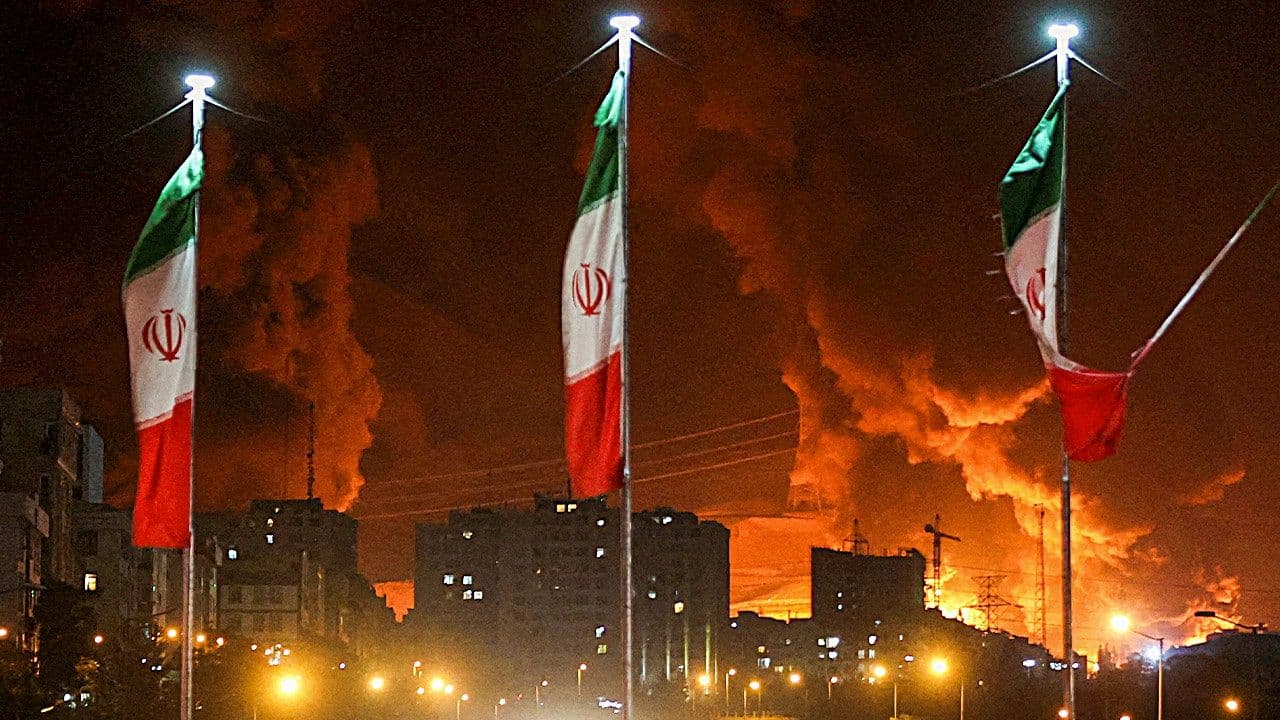
Why Trump Must See the Iran Conflict Through to the End
History warns that ending a war too soon can cost more lives than finishing it. Trump faces that same crossroads with Iran today.

The Weight of History on a Presidential Decision
President Donald Trump has repeatedly demonstrated a command of strategic and tactical surprise in military conflicts, drawing heavily on the guidance of experienced military advisors. Yet the most consequential decision he now faces is not when to strike — it is when, and whether, to stop. As the Islamic Republic of Iran teeters under mounting pressure, the question of how this confrontation concludes carries enormous historical weight.
To understand what is at stake, one must look back 35 years to a decision that shaped the entire trajectory of the modern Middle East.
The 100-Hour War and Its Unfinished Business
In January 1991, an American-led international coalition launched a sweeping aerial and naval assault against Saddam Hussein's Iraqi forces occupying Kuwait. The bombardment began on January 17, 1991, and continued for five weeks before transitioning to a ground invasion on February 24, 1991. That ground campaign — one of the most efficient military operations in modern history — concluded in just 100 hours.
President George H.W. Bush, Secretary of Defense Dick Cheney, and Joint Chiefs Chairman Colin Powell made the call to halt operations. The tactical achievement was undeniable, and the overwhelming show of force sent a clear message to the world. Undoubtedly, halting the campaign spared American lives that would have been lost in a prolonged push to Baghdad.
But the decision came with a devastating cost that unfolded slowly in the years that followed.
The Massacre the World Forgot
Following the ceasefire, Iraq's Shi'a Muslim population — particularly the Marsh Arabs inhabiting the wetlands near the confluence of the Tigris and Euphrates rivers in southern Iraq — rose up against Saddam's weakened but still operational regime. They believed liberation was within reach.
They were wrong.
A 1992 Human Rights Watch report documented the brutal aftermath: loyalist forces fired indiscriminately into civilian neighborhoods, executed young men in their homes and in hospitals, conducted mass arrests during house-to-house raids, and deployed helicopters to gun down unarmed civilians attempting to flee. Thousands died.
The atrocities did not end there. Saddam Hussein continued his campaign of violence against his own people for another decade, until a second invasion — led by President George W. Bush, with Cheney now serving as vice president and Powell as secretary of state — finally removed him from power in 2003.
The Hidden Costs of an Incomplete Victory
The years between the two Gulf Wars were far from peaceful for the United States. The international community authorized two no-fly zones over Iraq, which American forces bore the primary burden of enforcing. The human and financial toll was real and ongoing.
A tragic friendly fire incident claimed 26 military and civilian lives when U.S. F-15s mistakenly shot down two American Black Hawk helicopters. The prolonged stationing of American troops in Saudi Arabia is widely believed to have contributed to the terrorist bombing of Khobar Towers in Dhahran on June 25, 1996. That attack killed 19 U.S. Airmen and wounded more than 400 military personnel and civilians. The facility housed troops supporting Operation Southern Watch, the southern Iraq no-fly zone mission. Responsibility for the bombing has been attributed to al-Qaeda, the Islamic Republic of Iran, or both.
These were not abstract policy consequences. They were flag-draped coffins and shattered lives — the direct result of a conflict left unresolved.
What the Past Should Teach Trump About Iran
Counterfactual history is a dangerous game. We cannot know with certainty what would have happened had the first Gulf War extended into a full ground campaign to remove Saddam Hussein in 1991. The coalition assembled by President Bush might have fractured. American casualties would have climbed well beyond the approximately 300 killed and 450 wounded. The geopolitical fallout could have been severe.
But the actual history that did unfold — the massacres, the no-fly zones, the Khobar bombing, the second Gulf War — offers a sobering lesson about the price of incomplete action.
Now, with the Islamic Republic of Iran severely degraded militarily but still possessing meaningful offensive capabilities, President Trump and his national security team face a strikingly similar crossroads. The regime has been struck hard. But it has not been replaced.
A Regime Incapable of Reform
The evidence that this regime cannot be trusted to change its behavior is not speculative — it is documented. After President Trump ordered the killing of Iranian General Qassem Soleimani in January 2020, the regime did not moderate. After Operation Midnight Hammer dismantled Iran's nuclear weapons infrastructure, the regime did not stand down. Instead, it began rebuilding its military capabilities.
The January massacre of more than 35,000 Iranian citizens by the regime's own forces revealed the true character of those in power. This is not a government capable of self-correction. It is a government that must be replaced.
Since 1979, Americans have been dying at the hands of this regime — through terrorism, proxy warfare, and direct aggression. That toll grew again this week.
The Case for Perseverance
The lesson of 1991 is not that military action is always the answer. It is that a war ended prematurely — for political, coalition, or strategic reasons — can give rise to far greater suffering than the original conflict ever caused.
With Iran's clerical regime on its back, leaderless following the death of Ayatollah Khamenei, and exposed by the stunning success of recent strikes, the United States holds a position of rare advantage. Walking away now risks allowing the same ideological forces to reconstitute, rearm, and return — possibly without the element of surprise that made recent operations so effective.
Presidents are not war planners. But they are students of history — or they should be. The decision facing Trump is not simply a military one. It is a historical one. And history suggests that finishing the job, as difficult and costly as that may be, is almost always less expensive than fighting the same enemy twice.
The regime must change. The only question is whether America sees that through now, or pays a far steeper price later.