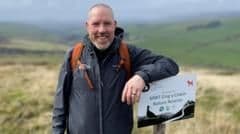
Why the Isle of Man Could Become Britain's Next Great Rainforest
Wildlife experts say the Isle of Man's geography and climate make it nearly perfect for growing temperate rainforests — and restoration is already underway.

The Isle of Man's Surprising Potential as a Rainforest Hub
When most people picture a rainforest, the Isle of Man rarely comes to mind. Yet conservation experts are making a compelling case that this small Celtic island sits at the heart of one of Europe's most promising zones for temperate rainforest restoration — and ambitious tree-planting efforts are already delivering impressive early results.
A Climate Tailor-Made for Woodland Restoration
Graham Makepeace-Warne, chief executive of the Manx Wildlife Trust (MWT), has described the Isle of Man as "100% suitable" for temperate rainforest development. The island's position — nestled between the western coastlines of England, Scotland, and Wales and the eastern shores of Ireland — places it "slap bang in the middle" of a naturally rainforest-friendly climate band.
The island's consistently mild temperatures and high rainfall create the precise conditions that temperate rainforests demand. Conservationist Carl Rowlinson, who leads the Plant One woodland restoration initiative in Cornwall, described the region as a "Goldilocks zone" — an environment that never swings to damaging extremes of heat or cold, providing ideal growing conditions year-round.
Early indicators of suitability are already visible across the landscape. Mosses, lichens, and ferns colonising existing trees are, according to Makepeace-Warne, a "really good indicator" that the ecosystem is ready to support dense woodland. As he put it, someone once described temperate rainforests as "plants growing on plants growing on plants" — a layered, thriving biological community that the Isle of Man appears well equipped to nurture.
30,000 Trees and Counting at Creg y Cowin
The MWT's flagship restoration project is centred on Creg y Cowin, a 105-acre (42-hectare) reserve acquired by the charity in 2023. Previously used for low-grade livestock grazing, the site was identified as an ideal candidate for rewilding due to its position between two rivers and its limited agricultural productivity.
Over the course of three years, hundreds of volunteers joined the effort to plant 30,000 trees across the site. The results have been remarkably encouraging — survival rates have reached as high as 98% in some areas, a figure Makepeace-Warne credits to both the site's natural suitability and the dedication of the volunteer community.
The project operates within a 100-year vision. Trees at Creg y Cowin are expected to take between 50 and 75 years to fully mature, meaning the benefits will be realised by future generations rather than those planting today. "Some of us won't be around then," Makepeace-Warne acknowledged, but stressed that meaningful environmental change requires long-term thinking. "We've got to think like nature," he said.
From Woodland to Ocean: A Connected Ecosystem
Beyond simply planting trees, the project reflects a broader philosophy about how conservation should work. Rowlinson, who visited the island to exchange ideas and expertise, argued that traditional conservation has too often treated natural habitats as isolated units — separating rivers, land, and marine environments from one another.
He advocates instead for an approach that moves "from conservation to restoration", one that recognises the deep interconnections between terrestrial and marine ecosystems. Healthy woodland, he explained, improves soil quality, reduces surface water runoff, and limits the volume of pollutants entering waterways — effects that ultimately ripple outward to benefit coastal and marine environments.
"They're all connected," Rowlinson said. "It's kind of one ecosystem rather than a load of fragmented ecosystems."
Looking Back — and Forward
Historically, temperate rainforest once blanketed much of the Isle of Man and surrounding Celtic lands. Centuries of human activity — including farming, timber harvesting, and land clearance — stripped much of that cover away, leaving some areas with less than 1% woodland remaining.
The MWT is working to reverse that trajectory. Alongside the ongoing work at Creg y Cowin, the trust has recently acquired land at Glen Auldyn, a site described by Makepeace-Warne as similar in character but far larger in scale — signalling that the ambitions of the rainforest restoration movement on the island are only growing.
The long-term vision for Creg y Cowin extends beyond environmental restoration alone. Once the woodland is firmly established, the plan is to reintroduce livestock to the land, creating a functioning ecosystem that balances ecological health with practical agricultural use — proof that nature and human activity need not always be in conflict.

