Why Does the UK Keep Failing at Eurovision? The Hard Truth Behind Another Last-Place Finish
Sam Battle scored just one point at Eurovision 2025, marking yet another humiliating defeat. Why does the UK keep getting it so wrong?

Another Year, Another Eurovision Disaster for the UK
For the fourth consecutive year, the United Kingdom has walked away from Eurovision with its tail between its legs. Sam Battle, the quirky musician better known as Look Mum No Computer, managed to scrape together just a single point — finishing dead last in this year's competition held in Vienna.
It's a painful pattern that's becoming impossible to ignore. The UK has propped up the scoreboard three times since 2020, and has only cracked the top 10 once in the past 15 years. The question everyone is asking isn't just what went wrong this time — it's why Britain can't seem to crack the code that the rest of Europe appears to have mastered effortlessly.
What Sam Battle Actually Brought to the Stage
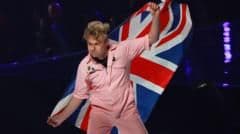
To his credit, Sam Battle didn't play it safe. Dressed in a vivid pink boiler suit and armed with a chaotic, distortion-heavy synth-pop track called Eins, Zwei, Drei — a song literally about quitting a desk job to travel to Germany and count to three — he threw himself into the performance with infectious, unhinged energy.
Commentator Graham Norton aptly described it as "a big swing," and few would disagree. Unlike previous UK entries that leaned heavily on polished, radio-friendly electro-pop, Battle's entry had a distinctly eccentric, unmistakably British character — complete with references to jam roly poly and custard.
Adrian Bradley, host of the Euro Trip podcast, acknowledged the BBC's boldness: "They took a risk on something that maybe people won't like, but which some people might pick up the phone and vote for."
Even Satoshi, who represented Moldova at this year's contest, admitted the track had genuine artistic merit. "The distortion on the voice, the synths — everything has that British imprint," he said, before adding the critical caveat: "But I can definitely see that it's not everyone's cup of tea."
Europe, it seems, agreed. The professional juries awarded the entry a single point. The public gave it nothing at all.
Is the Song to Blame, or Is There a Bigger Problem?
Filippo Baglini, a journalist with London One Radio in Italy, didn't mince words. "The UK is the best at music all around the world — you have the Beatles and everything. So this is not good enough."
Austrian Eurovision enthusiast Thomas Tammegger, based in Denmark, pointed to a deeper cultural issue within the BBC itself. "They look at it through a lens of it being a funny event, and then they send novelty entries or joke entries — and it never really does well."
His point carries weight. When the UK genuinely invested in Eurovision — most notably in 2022 with Sam Ryder and his accomplished glam-rock anthem Space Man — the results spoke for themselves: a second-place finish that reminded Europe the British music industry still has firepower.
But that approach has proven frustratingly rare.
The 'Poisoned Chalice' Problem
One of the most significant obstacles facing the UK's Eurovision ambitions is the reluctance of established artists to get involved. As singer Will Young — who turned down the opportunity to represent Britain in 2015 — once put it, Eurovision is seen as a "poisoned chalice" for any artist with a reputation to protect.
The experience of Olly Alexander in 2024 didn't help matters. The prominent pop act went into personal debt to fund his staging, ultimately describing the entire experience as "brutal" and urging any future UK representative to "get a good therapist" before signing on.
With major recording artists keeping their distance, the BBC has increasingly turned to independent, unsigned, or lesser-known talent. Both Look Mum No Computer and Remember Monday — the UK's 2025 entry — fall into this category, competing without the financial or promotional muscle of a major label behind them.
When this dynamic was explained to fellow Eurovision contestants in Vienna, the reaction was one of genuine disbelief.
"In the UK there's a bad perception of representing your country at Eurovision?" asked a stunned Satoshi. "Well, that's not good. I think it's a wonderful contest to emphasise your musical potential."
What Needs to Change Before 2027
Dara, who claimed this year's Eurovision crown with her winning song Bangaranga, echoed that sentiment. A seasoned pop performer with a decade of chart success behind her, she argued that high-profile artists need to fundamentally rethink their attitude toward the competition.
The BBC now faces a genuine reckoning. With two years until the next opportunity to make things right, the broadcaster must ask some uncomfortable questions about its entire approach — from artist selection and song quality to staging investment and cultural attitude.
Bringing home one point in a continent-wide music competition is not an amusing quirk. For a country with Britain's musical heritage, it's an embarrassment that demands a serious, strategic response.