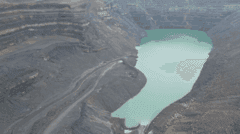
Welsh Government Steps In to Decide Fate of UK's Largest Former Opencast Mine
The Welsh government has taken control of a controversial restoration plan for the Ffos-y-Fran opencast mine site, after the operator proposed a drastically cheaper cleanup that would leave coal tips

Welsh Government Takes Over Ffos-y-Fran Mine Restoration Decision
The Welsh government has intervened to determine the outcome of a deeply contested restoration plan for the site of the UK's last and largest opencast coal mine, located near Merthyr Tydfil in South Wales.
The decision to "call in" the application means that Welsh ministers — rather than Merthyr Tydfil County Borough Council — will have the final say over how the former Ffos-y-Fran mine site is cleaned up and returned to its natural state.
A Cheaper Plan That Has Sparked Outrage
At the center of the dispute is Merthyr South Wales Ltd (MSW), the company responsible for operating the mine. MSW has put forward a scaled-back restoration proposal that would cost significantly less than the original agreement, warning that it lacks sufficient funds to carry out the full cleanup that had previously been committed to.
Under the revised plan, MSW proposes to reduce the height of one coal tip while leaving two others entirely in place — a far cry from the original scheme, which required all tips to be used to fill the mine's main void, a cavity stretching 175 metres (574 feet) deep.
The three remaining coal tips collectively contain an estimated 37 million cubic metres of material excavated during the mine's operational years.
Background: A Mine Built on Promises
Ffos-y-Fran was granted approval in 2005 and was officially designated a "land reclamation scheme" — a classification that required a portion of profits generated from coal sales to be reinvested in restoring the land to green hillside upon closure. Over its 15-year lifespan, the mine produced approximately 11 million tonnes of coal, accounting for 86% of the UK's total coal output before it ceased operations.
Estimates for completing the full restoration vary considerably, with figures ranging from £50 million to as high as £175 million. MSW's newly proposed budget of just £15 million falls dramatically short of even the most conservative projections, which place a proper restoration at between £75 million and £120 million.
The company's most recently filed accounts do show a provision of approximately £91.2 million set aside for restoration obligations. However, correspondence from the local council to MSW has raised concerns that the company now appears to be banking on a £15 million emergency fund — originally established as a joint safety net in the event of insolvency — to cover the bulk of the costs.
MSW's consultants acknowledged the concerns, stating that detailed financial costings are currently being prepared.
Local Campaigners Welcome Government Intervention
Residents living near the former mine have long opposed both its operation and the prospect of an inadequate restoration. Chris and Alyson Austin, who have campaigned on the issue for years, expressed relief at the Welsh government's involvement.
"We are really, really pleased," said Alyson Austin. "We've always felt the local authority lacked the capacity or resources to deal with a complex and controversial plan of this nature."
Her husband Chris echoed the sentiment, arguing that the issue carries national significance and demands a broader perspective than local government can provide.
"This plan isn't like approving an extension on Mrs Jones' house — it's much wider. The local authority has been too close to this for too long and doesn't have the breadth of resources the Welsh government will have," he said.
Safety Concerns and Accusations of Profit-Grabbing
Critics have raised serious alarm over the safety implications of leaving the coal tips in place. A geotechnical assessment commissioned by the council warned of a "significant risk of slope instability" at the Ffos-y-Fran site.
Daniel Therkelsen, campaigns manager at Coal Action Network, was blunt in his assessment of MSW's motives.
"What we're talking about here is a very dangerous landscape," he said. "They talk about erecting fences to discourage people from going near the cliff edge, swimming in the void, or riding dirt bikes on the slopes. We've seen at other under-restored opencast sites that these kinds of measures simply haven't worked."
Therkelsen accused the company of a deliberate "profit grab," arguing that the reduced restoration budget represents an attempt to walk away from its obligations while extracting maximum financial benefit from the area.
MSW pushed back against the safety characterisations, insisting that comparing its "purpose-built, engineered structures" to historically unstable coal tips was "incorrect and misleading."
Political Pressure Mounts
The Welsh Conservatives have criticised the Labour-led Welsh government over the timing of its intervention, alleging that ministers acted "far too late on Ffos-y-Fran" and suggesting the move was politically motivated ahead of an upcoming election.
The Welsh government declined to elaborate on its decision, stating only that it would be "inappropriate to comment further at this time" while the process is ongoing.