Webb Telescope Uncovers a Bizarre Hydrogen-Rich Atmosphere on a Molten Lava World
NASA's James Webb Space Telescope has uncovered startling new details about 55 Cancri e, a scorching lava planet where rocks melt and volcanoes may shape the sky.

Webb Telescope Peers Into the Hellish Skies of a Lava Planet
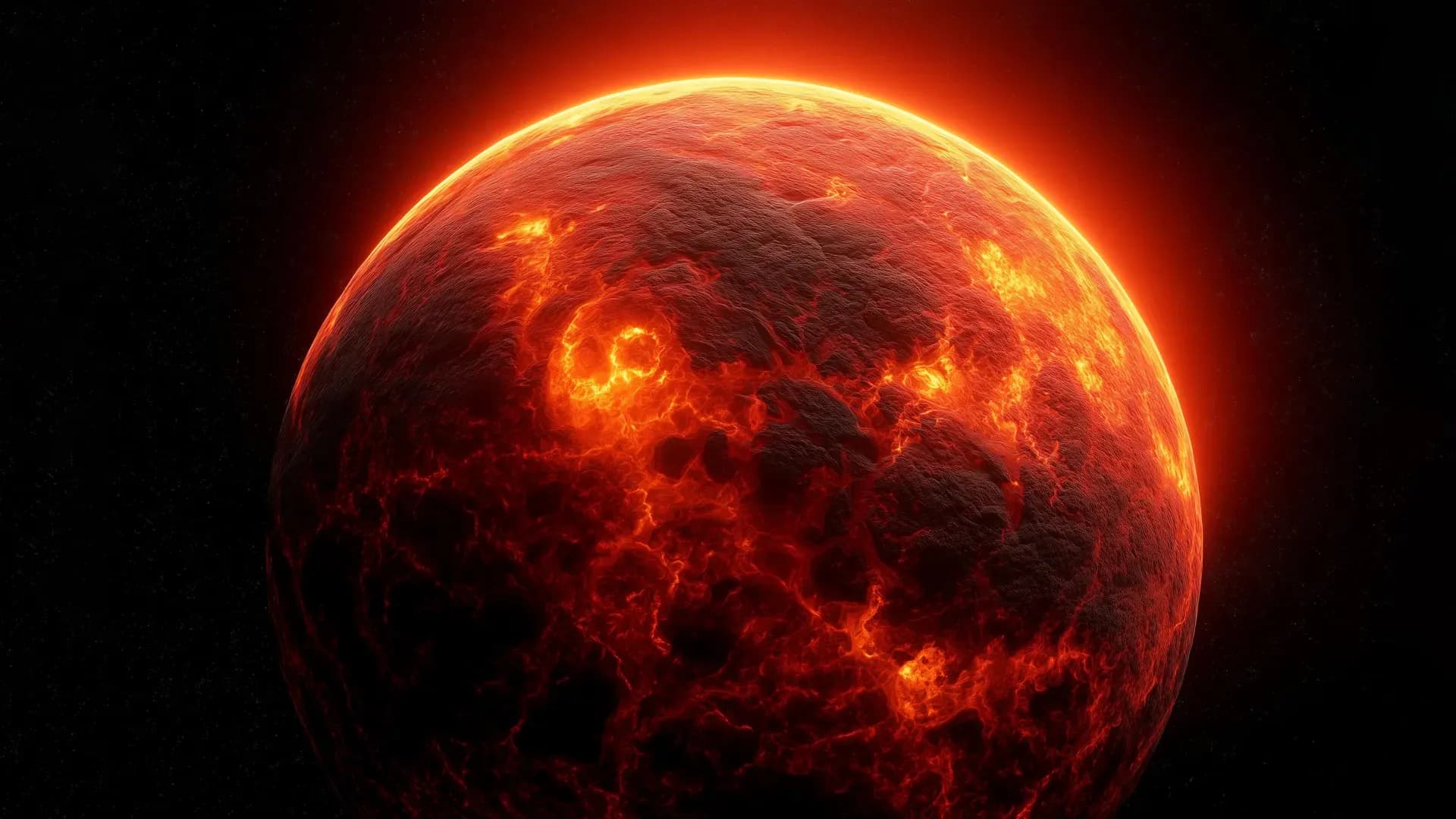
NASA's James Webb Space Telescope (JWST) has pulled back the curtain on one of the most extreme planets ever studied — a molten, lava-covered world where temperatures soar high enough to liquefy rock. The findings paint a striking picture of a planet whose atmosphere is actively being sculpted by its own volcanic interior, and where temporary clouds may form and dissolve as gases bubble up from deep below the surface.
Meet 55 Cancri e: A World Unlike Anything in Our Solar System
Located approximately 41 light-years from Earth, 55 Cancri e is classified as a super-Earth — a rocky planet measuring about 1.88 times the radius and roughly 8 times the mass of our own world. What makes it truly extraordinary, however, is its orbit. This planet completes a full revolution around its Sun-like host star in just 0.7 Earth days. To put that in perspective, Mercury — the closest planet to our Sun — takes 88 days to complete a single orbit.
Because 55 Cancri e sits so impossibly close to its star, scientists believe its entire surface exists in a permanent state of melt. The planet was first identified back in 2004, but new observations from JWST have now delivered some of the most detailed atmospheric data ever collected on a lava world. The results have been submitted for publication in Nature Astronomy.
A Surprising Atmospheric Composition
To study the planet's atmosphere, the research team analyzed five separate eclipses of 55 Cancri e using JWST. Scientists traditionally expected lava planets like this one to host atmospheres dominated by carbon monoxide (CO) and carbon dioxide (CO₂) — a prediction long supported by established planetary evolution models.
The actual observations told a very different story.
While carbon monoxide was indeed detected in abundance, carbon dioxide appeared in far smaller quantities than anticipated. More surprisingly, hydrogen was found to be a dominant component of the atmosphere — a result that caught researchers off guard.
Volcanic Outgassing and Shifting Clouds
The team also noticed measurable differences between the five eclipse observations, suggesting that the atmosphere of 55 Cancri e is not static. Researchers propose that volcanic outgassing — the release of gases from the planet's molten interior — could be responsible for these variations. In certain conditions, material expelled from the interior may condense into clouds that temporarily lower surface temperatures before being dispersed by continued volcanic activity.
As the study notes, the strong preference for hydrogen-rich atmospheric models points to an interior with relatively low oxygen levels, consistent with outgassing from what scientists call a "reduced magma ocean." In planetary science, this refers to the chemical balance — known as redox state — between oxygen and hydrogen or iron within a planet's interior. For 55 Cancri e, hydrogen clearly dominates, and that imbalance appears to be directly reflected in the atmosphere above.
This means the atmosphere itself may serve as a diagnostic tool — offering astronomers a rare and indirect glimpse into the deep chemical workings of an alien world's interior.
The Growing Family of Lava Exoplanets
Interest in lava worlds has surged over the past decade as astronomers have catalogued a growing number of these scorched planets. Known examples now include K2-141 b, L 98-59 d, TOI-561 b, HD 63433 d, and CoRoT-7 b — each with orbital periods ranging from as little as 6.7 hours to just over 10 days.
Like 55 Cancri e, these planets are tidally locked to their host stars, meaning one side permanently faces the stellar heat while the other remains in perpetual darkness. On 55 Cancri e, the molten rock is believed to pool on the sun-facing hemisphere. Some worlds, such as L 98-59 d, may be draped in a global magma ocean reminiscent of Jupiter's volcanic moon Io.
Lava Planets vs. Io: Same Volcanism, Different Engines
While both Io and lava exoplanets are characterized by intense volcanic activity, the forces driving that activity are fundamentally different. Io's volcanoes are powered by tidal heating — Jupiter's colossal gravitational pull continuously flexes and squeezes the small moon, generating tremendous internal heat that fuels its eruptions.
Lava exoplanets, by contrast, are primarily heated by the intense radiation of their nearby host stars. That relentless stellar energy melts the surface from the outside in, and because these worlds are tidally locked, the resulting magma remains concentrated on the permanently sun-baked side.
What This Means for Planetary Science
The study of 55 Cancri e represents a significant leap forward in our understanding of how rocky planets form, evolve, and maintain their atmospheres under the most extreme conditions imaginable. As JWST continues to observe lava worlds across our galactic neighborhood, each new data set brings scientists closer to answering fundamental questions about planetary chemistry, interior geology, and the diverse ways in which rocky planets can develop across the universe.