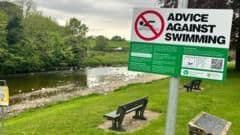
Warning Signs Posted at Nearly All of England's River Bathing Sites Due to Dangerous Bacteria Levels
Twelve of England's 14 designated river bathing sites are currently rated 'poor' for water quality, with signs urging people to stay out of the water.

'Do Not Swim' Warnings Issued at 12 of England's 14 Designated River Bathing Sites
Almost every official inland river bathing site in England is currently displaying warning signs urging people not to enter the water, following concerns over dangerously high levels of bacteria linked to human and animal waste. The alarming situation comes just as the government has confirmed six new river bathing sites will be monitored for the first time this summer — including the first designated location on the River Thames in London.
The BBC recently visited all 14 existing inland bathing sites that were tested by the Environment Agency last year. Of those, only two — the River Stour in Suffolk and the River Thames in Oxfordshire — recorded acceptable water quality levels. The remaining 12 were rated "poor," prompting official advice for swimmers to stay out.
England's Expanding Network of Monitored Bathing Sites
The government has announced 13 new bathing locations in total, six of which are on inland rivers. This brings the total number of regularly monitored sites across England to more than 460. While the vast majority remain coastal or tidal, the number of freshwater rivers and lakes being included in the testing programme is steadily growing. Results from water quality tests are published publicly on a government website.
To qualify as a designated bathing site, a location must satisfy certain criteria, including regular usage by a significant number of swimmers and the availability of nearby toilet facilities.
Water Minister Emma Hardy welcomed the expansion, stating: "The introduction of these new bathing sites means better monitoring of our waterways, a boost for local tourism, and greater confidence for local swimmers."
However, representatives from the water industry have pushed back on the approach. A spokesperson for Water UK, the body that represents water companies, warned: "Designating an area as a bathing water before it is suitable for bathing and without a plan in place to clean it up risks confusing the public, who will rightly believe it is safe to swim there."
Why Inland Rivers Struggle to Meet Safety Standards
Officials from the Department for Environment, Food & Rural Affairs explained that achieving safe bathing standards in freshwater rivers is significantly more difficult than at coastal locations. The sea benefits from the natural antibacterial properties of saltwater and far greater dispersion of any faecal matter that enters it. Rivers, by contrast, are more directly connected to sources of contamination such as sewage treatment plants and agricultural land, offering far less opportunity for natural dilution or purification.
Agricultural run-off and sewage discharges are among the leading causes of river pollution, and campaigners argue that the current designation system — despite its imperfections — has become one of the most powerful tools available for pressuring water companies into action.
The Catch-22 of Campaigning for Cleaner Rivers
The River Wharfe in Ilkley, Yorkshire, holds the distinction of being England's first designated inland river bathing site, earning that status back in 2020. Yet it has been rated "poor" every single year since. When it rains heavily, bacteria counts can soar to tens of thousands of E. coli units per 100ml — far beyond the threshold of 900 units per 100ml at which authorities advise the public to avoid the water entirely.
Local campaigner Karen Shackleton from the Ilkley Clean River Group explained the strategy behind pursuing bathing site designation: "This wasn't about wild swimming. It was actually about putting something in place so that the Environment Agency had to come and test the river, because they don't test rivers as standard. Then when they find the results that are poor, that drives the investment by the water company."
Fellow campaigner Di Leary, who continues to swim in the river despite the risks, described the situation bluntly: "We're basically swimming in other people's poo."
Both activists acknowledge the strange logic underpinning the system. "It's very much a Catch-22 situation," said Di. Karen agreed: "It's disgustingly bonkers."
Nevertheless, there is cautious optimism in Ilkley. Yorkshire Water is currently in the middle of a £60 million investment programme aimed at significantly reducing the volume of sewage flowing into the River Wharfe.
Shropshire Campaigners Take a Similar Approach
In Shropshire, local advocate Alison Biddulph has successfully secured bathing site designation for three locations — two on the River Severn at Ironbridge and Shrewsbury, and one on the River Teme at Ludlow. All three currently hold "poor" ratings, meaning swim advisory signs remain firmly in place.
Despite this, Alison continues to swim at these sites, exercising caution by avoiding the water after heavy rainfall, which can trigger the release of raw sewage into the river. She remains optimistic about the long-term impact of designation.
"I think it's probably going to take five years before you see any real difference, but we've already got a lot more focus on it," she said. "The Environment Agency has installed a water testing device just downstream that monitors quality every hour of every day. And for the water company, it unlocks a whole package of funding and specific objectives for them to work towards."
The broader picture remains troubling, but campaigners insist that pushing for bathing site designation — even when the water is far from safe — is currently one of the most effective levers available to communities fighting for cleaner rivers.

