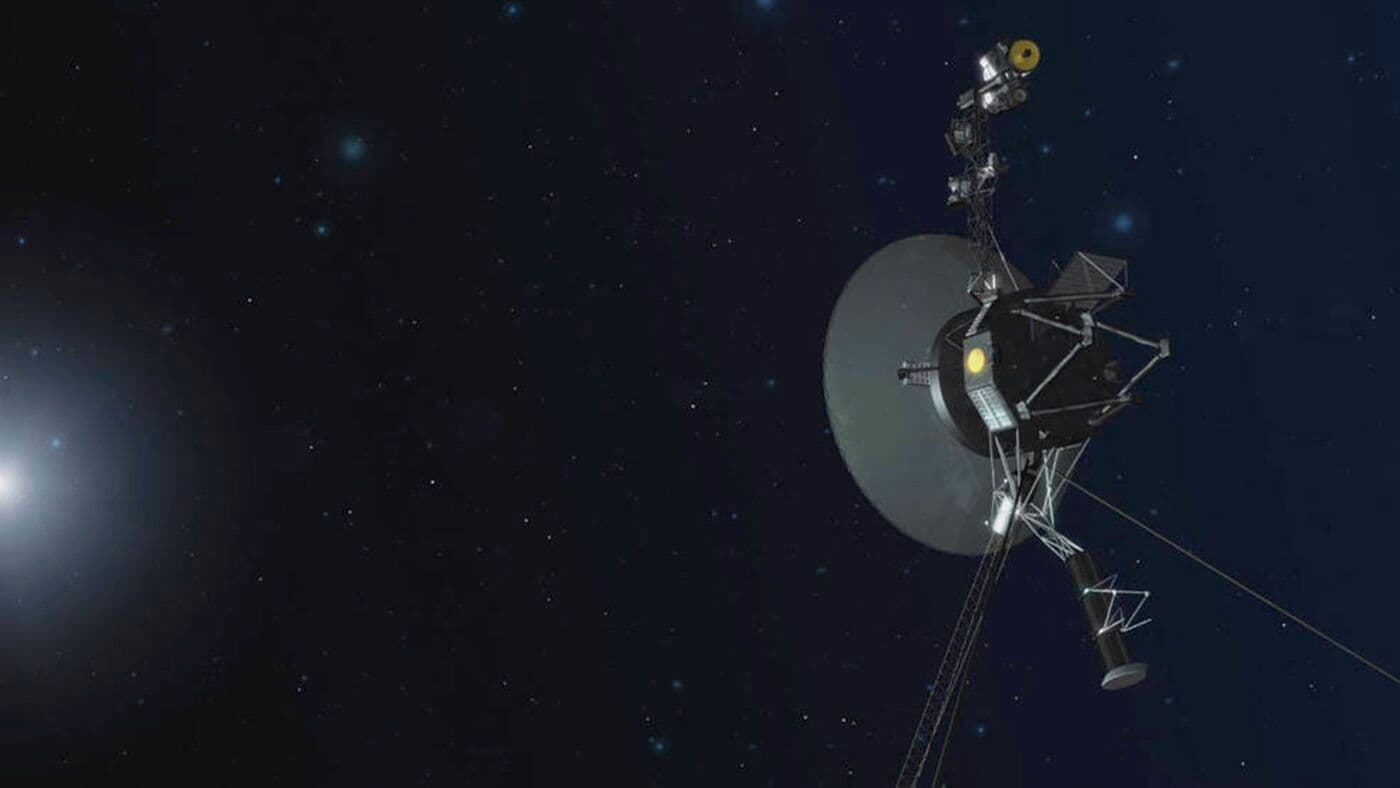
Voyager 1 at the Edge of Forever: Why NASA Powered Down One of Its Last Working Instruments
Launched in 1977, Voyager 1 is the farthest human-made object in existence. NASA just switched off another instrument to keep it alive a little longer.
The Spacecraft That Refused to Quit
More than four decades ago, a spacecraft no larger than a compact car thundered off a Florida launch pad on what was meant to be a five-year mission. This week, NASA confirmed it had deliberately shut down one of the last working science instruments aboard that same probe — not as a sign of defeat, but as a calculated move to extend one of humanity's greatest achievements just a little further into the future.
Voyager 1 — the most remote object ever constructed by human hands — is slowly losing power. The engineers who monitor it daily from NASA's Jet Propulsion Laboratory (JPL) in Southern California are fighting a quiet, methodical battle to keep it functional for as long as physically possible.
A Machine Born From a Once-in-175-Years Opportunity
Voyager 1 launched on September 5, 1977, from Cape Canaveral, riding a Titan-Centaur rocket into the void. The probe weighs approximately 1,797 pounds — comparable to a mid-size sedan — and features a 12-foot-wide dish antenna that keeps it locked in communication with Earth across unimaginable distances. It was designed and built at JPL, a federally funded research facility operated by the California Institute of Technology.
The mission itself was born from a rare astronomical window. In the late 1960s, scientists and engineers recognized that Jupiter, Saturn, Uranus, and Neptune were drifting into an alignment that occurs only once every 175 years. That positioning allowed a spacecraft to use each planet's gravitational field as a natural slingshot — gaining velocity and changing direction without burning additional fuel, a technique known as gravity assist.
NASA originally conceived an ambitious program called the "Grand Tour" to visit every outer planet. Budget pressures trimmed that vision down considerably, and the mission was refocused as the Voyager program — funded primarily for flyby encounters with Jupiter and Saturn, with the spacecraft expected to last five years. Nearly 49 years later, they are still transmitting.
Historic Discoveries Along the Way
Voyager 1 swept past Jupiter in March 1979, delivering one of the most astonishing surprises in the history of planetary science: active volcanoes on Jupiter's moon Io. It was the first time volcanic activity had ever been observed on a world other than Earth.
The probe then reached Saturn in November 1980, capturing unprecedented close-up detail of the planet's iconic ring system and its largest moon, Titan. The trajectory required for that close Titan encounter tilted Voyager 1's path sharply upward, pulling it out of the orbital plane of the solar system entirely and putting it on a course toward interstellar space.
In 1990, NASA formalized this new direction under the Voyager Interstellar Mission, with a redefined goal: travel to the outermost boundary of the Sun's influence and document what lies beyond it. On August 25, 2012, Voyager 1 crossed the heliopause — the frontier where the Sun's stream of charged particles gives way to the cold expanse between the stars — becoming the first human-made object to enter interstellar space. Its twin, Voyager 2, made the same crossing in 2018.
Now Over 15 Billion Miles Away
As of this spring, Voyager 1 sits more than 15 billion miles from Earth. A radio signal, even traveling at the speed of light, takes over 23 hours to reach the probe one way. Every command sent from JPL and every fragment of data received from the spacecraft must cross that staggering distance.
The probe generates electricity through a radioisotope thermoelectric generator — a system that transforms heat released by decaying plutonium into usable power. There are no solar panels, no rechargeable batteries. Just the gradual, steady output of nuclear decay, which drops by roughly 4 watts every year. After nearly five decades, that slow drain has become a genuine crisis.
Why NASA Switched the Instrument Off
During a routine maneuver in late February, Voyager 1's power levels dipped unexpectedly, pushing the spacecraft dangerously close to triggering its automatic fault-protection system — an onboard self-preservation response that would have forced engineers into a difficult and risky recovery operation. The team had to act decisively before that threshold was crossed.
On April 17, mission controllers transmitted a series of commands to deactivate the Low-energy Charged Particles experiment, or LECP — one of Voyager 1's remaining active science tools. Over the years, the LECP had measured ions, electrons, and cosmic rays from both within our solar system and the galaxy beyond, providing scientists with a unique map of interstellar space that no other instrument could replicate. Its counterpart on Voyager 2 had already been switched off in March 2025.
The decision did not come suddenly. Years ago, Voyager's science and engineering teams jointly established a priority-ordered shutdown list designed to conserve power while protecting the most scientifically valuable capabilities. The LECP was the next instrument on that list.
"While shutting down a science instrument is not anybody's preference, it is the best option available," said Kareem Badaruddin, Voyager mission manager at JPL, in an official NASA blog post published Friday.
What Remains — and What Comes Next
Voyager 1 now operates with just two functioning science instruments: one designed to detect plasma waves, and another that measures magnetic fields. Engineers estimate that the latest shutdown buys the mission roughly one additional year of operational life.
The team is also working on a more ambitious power conservation strategy, informally dubbed "the Big Bang" — a coordinated switch of several onboard components simultaneously, replacing older power-hungry systems with more efficient low-draw alternatives. Testing on Voyager 2 is planned for May and June 2026. If successful, the same procedure will be attempted on Voyager 1 no earlier than July. Engineers note that a positive outcome could even open the door to briefly reactivating the LECP once more.
Keeping the Signal Alive Into the 2030s
The team's ultimate goal is to maintain at least one operational instrument on each spacecraft into the 2030s — allowing both probes to continue sending back data from regions of space that no machine has ever explored before.
Voyager 1 began as a five-year mission. It has delivered nearly half a century of discovery. And somewhere beyond 15 billion miles of empty space, it is still listening — and still talking back.