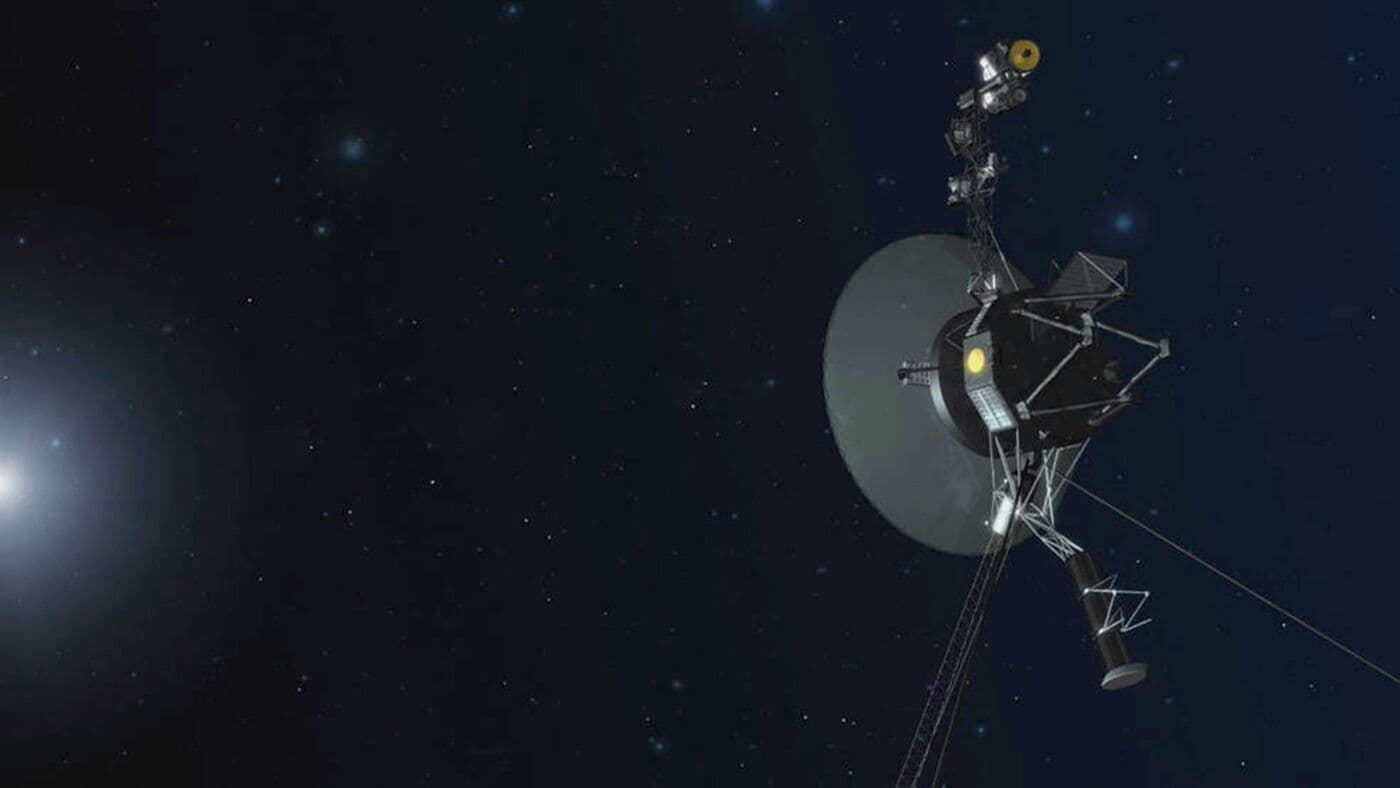
Voyager 1 at 49: NASA Powers Down Another Instrument to Keep the Legendary Probe Alive
NASA has shut down one of Voyager 1's last remaining science instruments — not as a sign of failure, but as a calculated move to extend the mission's extraordinary life.
The Spacecraft That Refused to Quit
Nearly five decades ago, a spacecraft no larger than a compact car blasted off from the Florida coast, originally designed to last just five years in the depths of space. This week, NASA quietly flipped a switch that turned off one of its final working science instruments — a bittersweet but deliberate act aimed at keeping the legendary probe functioning for as long as physically possible.
Voyager 1, the most distant human-made object in existence, is slowly losing power. The small team of dedicated engineers at NASA's Jet Propulsion Laboratory (JPL) in Southern California is doing everything within their means to postpone its eventual silence.
A Journey That Was Never Supposed to Last This Long
Launched on September 5, 1977, from Cape Canaveral aboard a Titan-Centaur rocket, Voyager 1 is a robotic space probe weighing approximately 1,797 pounds — comparable to a mid-size sedan. It features a 12-foot-wide dish antenna engineered to maintain communication with Earth across unimaginable distances. Built at JPL, a federally funded facility operated by the California Institute of Technology, the spacecraft has remained operational for nearly 49 consecutive years.
The mission's roots trace back to a remarkable astronomical opportunity identified in the late 1960s. Scientists and engineers noticed that Jupiter, Saturn, Uranus, and Neptune were drifting into a rare planetary alignment — one that would not occur again for approximately 175 years. This configuration allowed engineers to design a flight path that used each planet's gravitational pull as a natural slingshot, propelling the spacecraft forward without consuming additional fuel. This technique, known as a gravity assist, made an extraordinary multi-planet tour theoretically possible.
NASA initially envisioned a sweeping mission called the "Grand Tour" to visit all four outer planets, but budget limitations scaled back those ambitions. The restructured Voyager program was funded for targeted fly-bys of Jupiter and Saturn, with both spacecraft expected to survive just five years. They have since surpassed that estimate by nearly a factor of ten.
Milestones That Rewrote the History of Space Exploration
Voyager 1 made its closest approach to Jupiter in March 1979, and the discoveries were immediate and stunning. Scientists observed active volcanic eruptions on Jupiter's moon Io — marking the very first time volcanic activity had ever been detected on a world other than Earth. The probe then swept past Saturn in November 1980, delivering unprecedented close-up imagery of the planet's iconic ring system and its enigmatic moon Titan.
That close encounter with Titan had a lasting navigational consequence: it tilted Voyager 1's trajectory upward and out of the solar system's plane, effectively ending its planetary tour. But it also placed the spacecraft on a course that no machine had ever traveled before — toward interstellar space.
In 1990, NASA formally expanded the mission under the Voyager Interstellar Mission designation, tasking both spacecraft with studying the outermost boundaries of the Sun's influence. On August 25, 2012, Voyager 1 made history once again by crossing the heliopause — the boundary where the Sun's stream of charged particles gives way to the cold expanse of interstellar space — becoming the first human-made object ever to enter the space between the stars. Its companion spacecraft, Voyager 2, crossed the same threshold in 2018.
15 Billion Miles Away — and Still Listening
As of spring 2026, Voyager 1 is more than 15 billion miles from Earth. At that staggering distance, a radio signal traveling at the speed of light requires over 23 hours to reach the probe — one way. Every command transmitted by engineers, and every piece of data returned by the spacecraft, crosses that immense void before anyone on Earth receives a response.
The probe draws its power not from solar panels or conventional batteries, but from a radioisotope thermoelectric generator — a device that transforms heat produced by decaying plutonium into usable electricity. This system loses roughly 4 watts of output every year. After nearly five decades of continuous operation, that slow but relentless decline has reached a critical threshold.
Why NASA Shut Down the LECP Instrument
During a routine operational maneuver in late February, Voyager 1's power levels dipped unexpectedly, pushing the spacecraft dangerously close to triggering an automatic fault-protection response. Such a shutdown would have forced engineers into a time-consuming and high-risk recovery effort — a scenario the team was determined to avoid.
Acting decisively, mission engineers transmitted a series of commands on April 17 to deactivate the Low-energy Charged Particles experiment, commonly referred to as the LECP. This instrument had spent decades measuring ions, electrons, and cosmic rays from both within our solar system and the broader galaxy, providing scientists with an irreplaceable map of interstellar space. The LECP aboard Voyager 2 had already been switched off in March 2025.
The decision to deactivate the LECP was not made impulsively. Years ago, the Voyager science and engineering teams collaboratively agreed on a ranked order of instrument shutdowns, designed to conserve power while protecting the most scientifically valuable systems for as long as possible. The LECP was simply next in line.
"While shutting down a science instrument is not anybody's preference, it is the best option available," said Kareem Badaruddin, Voyager mission manager at JPL, in an official NASA blog post published on April 18.
What Remains — and What Comes Next
With the LECP offline, Voyager 1 now operates with just two functioning science instruments: a plasma wave detector that listens for activity in the surrounding environment, and a magnetometer that tracks magnetic field variations. Engineers estimate that this latest shutdown could extend the mission's operational window by approximately one additional year.
Looking further ahead, the JPL team is developing an ambitious power conservation plan they have informally nicknamed "the Big Bang." The strategy involves simultaneously swapping several active components for lower-power alternatives — a coordinated overhaul designed to squeeze out as much operational life as possible. Testing on Voyager 2 is currently scheduled for May and June 2026. If those tests succeed, the same procedure will be applied to Voyager 1 no earlier than July 2026. There is even a possibility, however slim, that a successful implementation could restore limited functionality to the LECP.
The mission team remains cautiously optimistic. Their goal is to keep at least one science instrument active aboard each spacecraft well into the 2030s — ensuring that both probes continue transmitting data from regions of the universe no human machine has ever explored before.