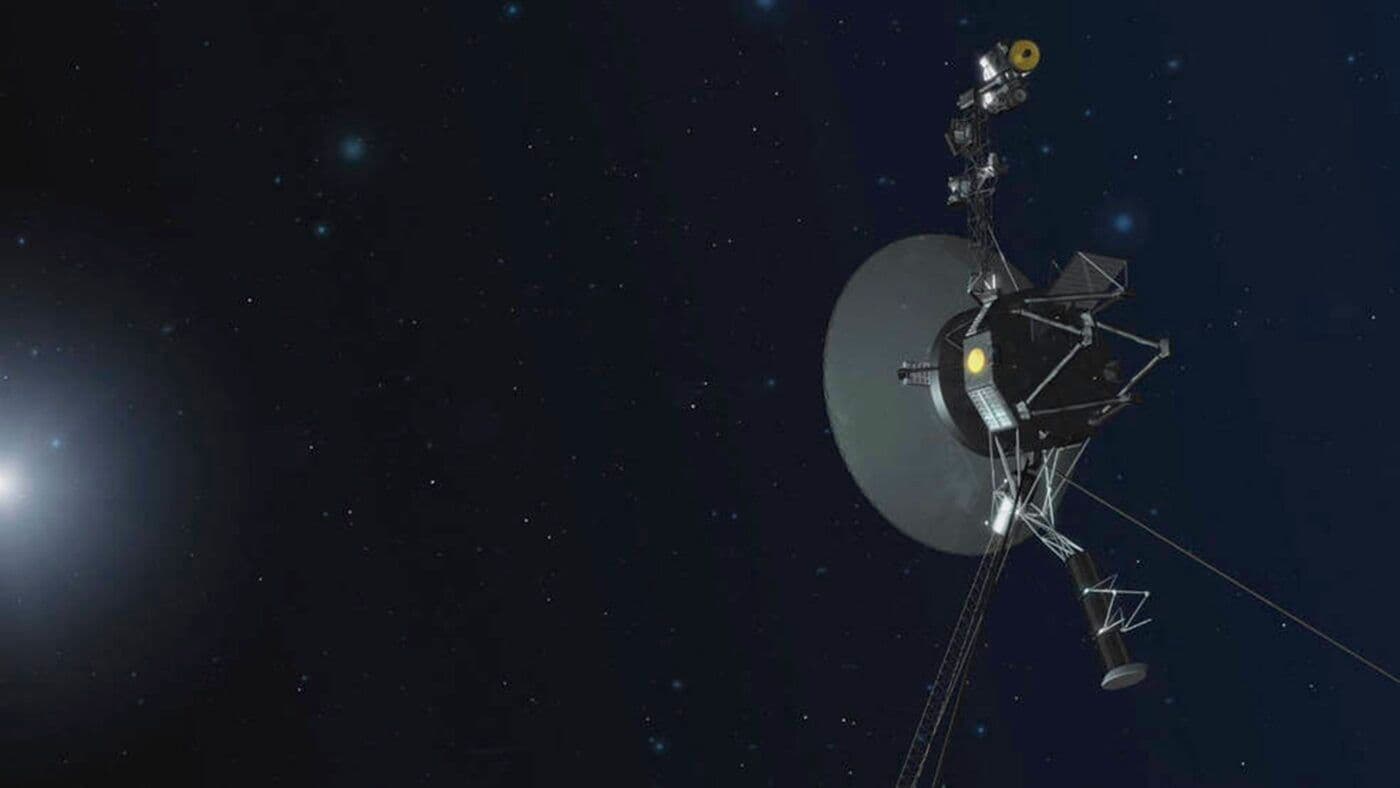
Voyager 1 at 49: NASA Powers Down an Instrument to Keep History's Farthest Spacecraft Alive
NASA has shut down one of Voyager 1's last science instruments to preserve power on the most distant human-made object ever built.

A Journey That Was Never Supposed to Last This Long
In the summer of 1977, a spacecraft not much larger than a compact car was bolted atop a rocket at Cape Canaveral and launched into the unknown. The plan was modest: a five-year tour of the outer solar system. Nearly half a century later, that same spacecraft is still out there — and NASA engineers are still fighting to keep it alive.
This week, the space agency confirmed it had powered down one of Voyager 1's final remaining science instruments. The decision was not a sign of failure. It was an act of survival.
What Exactly Is Voyager 1?
Launched on September 5, 1977, aboard a Titan-Centaur rocket, Voyager 1 is a robotic space probe built at NASA's Jet Propulsion Laboratory (JPL) in Pasadena, California — a federally funded research center operated by the California Institute of Technology. The spacecraft weighs approximately 1,797 pounds, comparable to a mid-size sedan, and is equipped with a 12-foot-wide dish antenna that keeps it locked in communication with Earth.
It has been operational for almost 49 consecutive years, an extraordinary testament to engineering, scientific ambition, and a fair amount of cosmic luck.
The Rare Alignment That Made It All Possible
The story of Voyager 1 begins with an astronomical coincidence. In the late 1960s, scientists and engineers realized that Jupiter, Saturn, Uranus, and Neptune were slowly drifting into a rare geometric alignment — one that would not repeat for approximately 175 years. This configuration opened a once-in-a-lifetime opportunity to use each planet's gravitational field as a natural slingshot, propelling a spacecraft from one world to the next without burning additional fuel. The technique is known as a gravity assist.
NASA initially envisioned a sweeping mission called the "Grand Tour" that would visit all four outer planets. Budget pressures ultimately scaled the vision back, and the program was restructured under the Voyager name, with two spacecraft designed to conduct intensive flybys of Jupiter and Saturn over a projected five-year lifespan. They have now operated for nearly ten times that duration.
Historic Discoveries Along the Way
Jupiter and the Birth of a New Discovery
When Voyager 1 swept past Jupiter in March 1979, it delivered one of the most stunning revelations in planetary science history. Cameras aboard the probe captured active volcanoes erupting on Io, one of Jupiter's moons — the first confirmed evidence of volcanic activity anywhere beyond Earth. It was a discovery that permanently reshaped our understanding of the solar system.
Saturn's Rings and a Fateful Encounter
Arriving at Saturn in November 1980, Voyager 1 sent back extraordinarily detailed imagery of the planet's iconic ring system and conducted a close study of Titan, Saturn's largest moon. That close encounter with Titan came at a cost, however. The gravitational interaction altered the spacecraft's trajectory, tilting it upward out of the plane of the solar system and effectively ending its planetary tour. But it also set Voyager 1 on a heading toward interstellar space — toward the unknown.
Crossing Into the Space Between Stars
In 1990, NASA formally broadened Voyager 1's objectives under the Voyager Interstellar Mission, tasking the probe with studying the outermost boundary of the Sun's influence. On August 25, 2012, Voyager 1 crossed the heliopause — the frontier where the Sun's stream of charged particles fades and true interstellar space begins — becoming the first human-built object ever to exit our solar system. Its twin, Voyager 2, crossed the same threshold in 2018.
15 Billion Miles Away — and Running Low on Power
As of spring 2026, Voyager 1 sits more than 15 billion miles from Earth. A radio signal traveling at the speed of light takes over 23 hours to reach the probe one way. Every command the engineering team sends, and every byte of data the spacecraft returns, must bridge that immense distance.
The probe is powered by a radioisotope thermoelectric generator — a device that converts heat produced by decaying plutonium into usable electricity. There are no solar panels. There are no rechargeable batteries. Just the gradual, reliable release of nuclear heat, which diminishes by roughly 4 watts every year. After five decades, that steady decline has reached a critical threshold.
Why NASA Powered Down the LECP
During a routine operational maneuver in late February 2026, Voyager 1's power levels dropped more sharply than expected, nudging the spacecraft dangerously close to triggering an automatic fault-protection response — a built-in self-preservation mode that, if activated, would have forced engineers into a complex and risky recovery process with a 23-plus-hour communication delay on every exchange.
To prevent that outcome, mission engineers sent a carefully prepared sequence of commands on April 17, instructing the spacecraft to deactivate the Low-energy Charged Particles experiment, known as the LECP. This instrument had spent decades measuring ions, electrons, and cosmic rays from both the solar system and the galaxy beyond, contributing to scientists' understanding of the architecture of interstellar space in ways no other tool could replicate. The same instrument had already been switched off on Voyager 2 back in March 2025.
The science and engineering teams at JPL had long ago agreed on a prioritized shutdown sequence for Voyager 1's instruments, designed to conserve power while holding onto the most scientifically valuable capabilities for as long as possible. The LECP was next on that list.
"While shutting down a science instrument is not anybody's preference, it is the best option available," said Kareem Badaruddin, Voyager mission manager at JPL, in a statement published by NASA.
What Comes Next
Voyager 1 now carries just two functioning science instruments: a plasma wave detector that listens for electromagnetic activity in interstellar space, and a magnetometer that tracks magnetic field behavior. Engineers estimate the latest power-saving measure could extend the mission by approximately one additional year.
Looking further ahead, the Voyager team is developing a more ambitious conservation strategy they have informally dubbed "the Big Bang" — a coordinated procedure that would simultaneously swap several powered components for lower-energy alternatives. Testing on Voyager 2 is scheduled for May and June 2026. If successful, the same approach will be attempted on Voyager 1 no earlier than July 2026. There is even a realistic, if slim, possibility that a successful implementation could allow the LECP to be reactivated.
Ultimately, the team's goal is to keep at least one science instrument operating on each spacecraft well into the 2030s — ensuring that these two remarkable machines continue sending data from regions of the universe no human instrument has ever before explored.
The Legacy of an Unstoppable Probe
Voyager 1 was built to last five years. It has lasted nearly fifty. It has revealed volcanoes on another world, mapped the edges of our solar system, and crossed into the space between the stars. Now, its engineers are rationing every last watt to squeeze out whatever time remains.
In the history of human exploration, few endeavors have delivered so much from so far away.