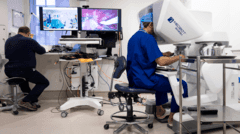
UK Surgeon Performs Groundbreaking Remote Robotic Operation 1,500 Miles Away in Gibraltar
A London-based surgeon has made history by performing the UK's first long-distance robotic surgery on a patient located 1,500 miles away in Gibraltar.

UK Surgeon Makes History with 1,500-Mile Remote Robotic Operation
A pioneering surgical milestone has been reached in the United Kingdom, as a London-based surgeon successfully performed a remote robotic operation on a patient situated 1,500 miles (approximately 2,400km) away in Gibraltar — marking a landmark moment in modern medical history.
Renowned robotic urological surgeon Professor Prokar Dasgupta conducted the procedure from The London Clinic, describing the experience as feeling "almost as if I was there." The operation involved the complete removal of a prostate from cancer patient Paul Buxton, 62, who reported feeling "fantastic" in the aftermath.
Patient Says the Decision Was a 'No-Brainer'
Buxton, originally from Burnham-on-Sea in Somerset, relocated to Gibraltar four decades ago. When he received a shocking prostate cancer diagnosis shortly after Christmas, he anticipated a lengthy wait on an NHS list followed by an extended trip to London for treatment.
Instead, he was presented with an extraordinary alternative — becoming the first patient in the UK to undergo a long-distance robotic surgical procedure as part of a clinical trial.
"A lot of people said to me: 'You're not going to do it, are you?'" Buxton recalled. "I thought, I'm giving something back here."
He noted that without the remote procedure, he would have faced flying to London, joining an NHS waiting list, undergoing surgery, and likely spending around three weeks in the capital. The telesurgery option eliminated all of that entirely.
"It is pioneering for Gibraltar, because you don't need to leave Gibraltar," he added.
How the Technology Works
The operation, carried out on 11 February, utilized the advanced Toumai Robotic System — a collaboration between The London Clinic and the Gibraltar Health Authority. The robotic unit deployed in Gibraltar is equipped with a high-definition 3D camera and four precision-controlled arms.
Professor Dasgupta operated the system through a dedicated console in London, connected to the robot in Gibraltar via fibre-optic cables, supported by a backup 5G link. The signal delay was a remarkably low 0.06 seconds, ensuring near-real-time responsiveness throughout the procedure.
A standby surgical team remained present in Gibraltar in the event of a connectivity failure, though the connection remained stable for the entire duration of the operation.
A Step Toward Global Access to Elite Healthcare
Gibraltar, a British overseas territory, is served by just one hospital — St Bernard's at Europort. Residents requiring complex medical care have historically needed to travel abroad, often to the UK, for specialist treatment. This breakthrough has the potential to significantly reduce that burden.
Professor Dasgupta highlighted the broader humanitarian implications of the technology:
"This gives us the opportunity to treat patients in remote areas and smaller communities by literally being able to take the best surgeon anywhere."
He described the development as "very, very exciting," emphasizing that its humanitarian benefit would be considerable.
Previous Milestones in Telesurgery
British surgeons have already contributed to major advances in the field of telesurgery. Notably, a 4,000-mile transatlantic robotic stroke procedure was conducted on a cadaver — a body donated to science — demonstrating that long-distance robotic surgery was technically achievable. This latest live operation on a real patient marks a significant leap forward.
What Comes Next
This historic procedure was the first of two planned test cases. A second operation involving an unidentified 52-year-old patient was conducted on 4 March, also in Gibraltar.
Professor Dasgupta is scheduled to perform a further procedure on 14 March, which will be live-streamed to approximately 20,000 leading urological surgeons gathered at the prestigious European Association of Urology congress — giving the global medical community a front-row seat to this revolutionary advancement.
Meanwhile, the NHS has set an ambitious target of delivering 500,000 robot-assisted surgical procedures annually by 2035, underscoring its commitment to expanding robotic healthcare capabilities across the country.
For patients in remote or underserved locations, developments like this could soon mean that world-class surgical expertise is never truly out of reach.

