Trump Administration Unveils AI Policy Framework That Overrides State Laws and Redefines Child Safety Responsibilities
The Trump administration's new AI framework seeks federal dominance over state regulations, favors industry growth, and places child safety duties on parents rather than tech platforms.

Trump's National AI Framework: What It Means for States, Parents, and the Tech Industry
The Trump administration has released a sweeping legislative framework designed to establish a single, unified artificial intelligence policy across the United States. The proposal prioritizes innovation and industry growth while significantly curbing the authority of individual states to regulate AI — and it places the burden of protecting children online squarely on the shoulders of parents rather than technology companies.
Federal Control Over a Fragmented Regulatory Landscape
At the heart of the framework is a push for federal preemption — the legal principle that national law supersedes state law. The White House argues that allowing each state to craft its own AI rules would create a chaotic regulatory environment that damages America's competitive edge.
"This framework can only succeed if it is applied uniformly across the United States," the White House stated. "A patchwork of conflicting state laws would undermine American innovation and our ability to lead in the global AI race."
The document outlines seven core objectives, all of which tilt heavily toward accelerating AI development and scaling the technology across industries. Rather than establishing firm guardrails, the framework envisions what it calls a "minimally burdensome national standard" — language that reflects the administration's broader regulatory philosophy of removing barriers to innovation.
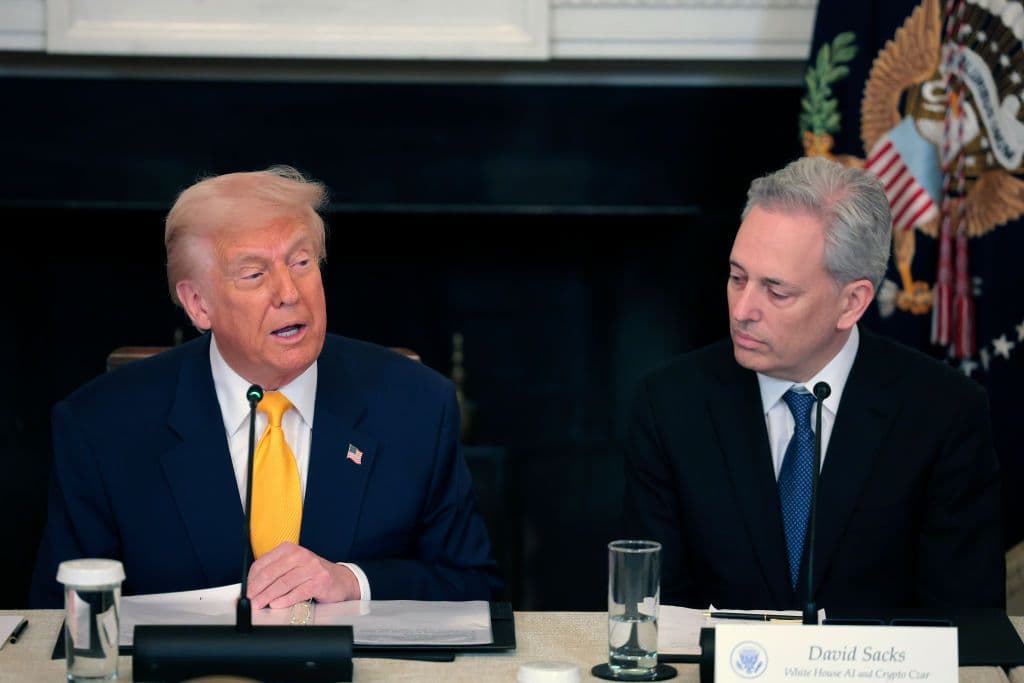
This approach closely aligns with the views of White House AI czar David Sacks, a venture capitalist and prominent advocate of the so-called "accelerationist" school of thought, which favors rapid AI expansion with limited government interference.
States Lose Ground as Regulators of Emerging Technology
The framework draws a hard boundary between what states may and may not regulate. While states would retain authority over general legal matters — such as fraud, child protection laws, zoning, and their own government use of AI — they would be explicitly barred from regulating AI development itself, which the administration classifies as an "inherently interstate" matter tied to national security and foreign policy considerations.
The proposal also shields AI developers from being held liable for harm caused by third parties using their models, a significant legal protection that critics argue removes accountability from the companies building these systems.
Notably absent from the framework are any concrete enforcement mechanisms, independent oversight bodies, or structured liability standards for harms arising from AI systems.
This rollback of state authority comes at a time when many states have been actively stepping in to fill the regulatory void. States like New York and California have proposed legislation — including New York's RAISE Act and California's SB-53 — that would require large AI companies to publicly document and follow safety protocols.
"White House AI czar David Sacks continues to do the bidding of Big Tech at the expense of regular, hardworking Americans," said Brendan Steinhauser, CEO of The Alliance for Secure AI. "This federal AI framework seeks to prevent states from legislating on AI and provides no path to accountability for AI developers for the harms caused by their products."
Industry Applauds Lighter Regulatory Touch
Unsurprisingly, many voices within the technology sector have welcomed the framework's direction. Startup founders and investors have long complained that navigating a maze of state-specific AI regulations stifles growth and makes national scaling difficult.
"This framework is exactly what startups have been asking for: a clear national standard so they can build fast and scale," said Teresa Carlson, president of the General Catalyst Institute. "Founders shouldn't have to navigate a patchwork of conflicting state AI laws that impede innovation."
The framework also mirrors positions the AI industry has advocated in ongoing copyright disputes, invoking "fair use" principles to allow AI systems to continue training on existing works — language that directly echoes arguments tech companies have used in court.
Child Safety: A Shift Away from Platform Accountability
One of the more controversial elements of the framework is its approach to protecting minors online. Rather than imposing strict, enforceable obligations on platforms, the administration calls on parents to take primary responsibility for managing their children's digital lives.
"Parents are best equipped to manage their children's digital environment and upbringing," the framework states, calling on Congress to equip parents with tools such as account controls and privacy management features.
While the framework does say that AI platforms should implement safeguards against the sexual exploitation of children and content that encourages self-harm, the language used is notably soft. Terms like "commercially reasonable" appear throughout, and no clear compliance benchmarks or penalties are established. Critics argue this approach lets tech companies off the hook on one of the most urgent digital safety issues of our time.
Anti-Censorship Provisions Raise Questions
The framework also includes language aimed at preventing what it describes as government-driven censorship of AI platforms. It calls on Congress to stop federal agencies from coercing AI providers into altering or suppressing content based on political or ideological motivations, and to give Americans legal recourse if such interference occurs.
However, legal and policy experts have raised concerns about how these provisions would function in practice. The line between censorship and legitimate content moderation is murky, and the framework's broad language could complicate efforts by regulators to coordinate with platforms on issues like election misinformation, public health risks, or national security threats.
Samir Jain, vice president of policy at the Center for Democracy and Technology, highlighted an inherent contradiction: "[The framework] rightly says that the government should not coerce AI companies to ban or alter content based on 'partisan or ideological agendas,' yet the Administration's 'woke AI' Executive Order this summer does exactly that."
The framework's emphasis on protecting "lawful political expression" appears to build on earlier executive action in which Trump directed federal agencies to adopt AI systems considered ideologically neutral — an effort critics say was itself politically motivated.
Context: A Long-Term Regulatory Shift
This framework did not emerge in isolation. Three months ago, Trump signed an executive order directing federal agencies to identify and challenge state AI regulations deemed overly burdensome. That order instructed the Commerce Department to compile a list of problematic state laws within 90 days — a list that has yet to be published — and suggested that states with such laws could risk losing access to federal funding including broadband grants.
The new framework represents the next step in that broader regulatory strategy: translating executive intent into a legislative blueprint that Congress can act upon. Whether Congress will adopt it wholesale, modify it, or stall remains to be seen — but its release signals a clear direction for how the Trump administration envisions America's AI future: fast-moving, industry-friendly, and centrally controlled from Washington.

