The Silent Victims of the Strait of Hormuz: How Military Conflict Is Devastating Marine Life
A ceasefire between the US and Iran hasn't protected the Arabian Gulf's unique marine ecosystems. Here's what's happening beneath the surface.
The Ceasefire Didn't Reach the Ocean Floor
When the United States and Iran agreed to a two-week ceasefire following weeks of escalating military tensions, the world exhaled. Shipping lanes through the Strait of Hormuz—one of the most strategically critical waterways on Earth—began to reopen. With roughly 800 vessels stranded behind a month-long blockade, the focus quickly turned to oil flows and global trade.
But beneath those congested waters, another crisis was quietly unfolding. Naval mines still litter the seabed. Residual military operations continue to generate noise and pressure waves. And the unique marine ecosystems that call the Arabian Gulf home have no ceasefire of their own.
A Living Blueprint for Climate Survival
The species inhabiting the Arabian Gulf are not ordinary. They are extremophiles—organisms that have evolved to thrive in conditions of intense heat and extreme salinity. Scientists regard them as a rare natural laboratory, offering insight into how ocean life might adapt as global temperatures rise. Some researchers believe these creatures represent a living preview of what much of the world's marine life will face by 2050.
If they survive long enough to be studied, that is.
Sound Is Life for Gulf Whales
For the Arabian humpback whale, the Strait of Hormuz is not a migration route—it is a permanent home. Unlike their Atlantic relatives, these whales do not travel between feeding and breeding grounds. The Gulf is all they have.
This makes them extraordinarily vulnerable to the one form of damage that rarely makes headlines: underwater noise pollution.
Olivier Adam, a marine researcher at Sorbonne University Abu Dhabi, explains that Gulf cetaceans—the broader family of marine mammals that includes whales and dolphins—face an impossible choice: flee their only habitat or endure prolonged acoustic trauma.
"These baleen whales have no way to escape," Adam says.
How Noise Disrupts Everything
Whales use sound for virtually every critical life function. Navigation, feeding, reproduction, and social bonding all depend on their ability to emit and receive acoustic signals. When that system is overwhelmed by human-generated noise, the consequences are immediate and far-reaching.
Humpback whales communicate in low-frequency ranges—the same frequencies produced by ship engines and military sonar. According to Adam, this overlap masks the vocalizations that hold whale social groups together and guide their behavior.
"The radiated underwater noise generated by maritime traffic disrupts the feeding of humpback whales," he says.
As noise intensifies, whales reduce their diving activity, effectively forcing themselves into extended fasting periods that steadily erode their physical condition.
Underwater explosions add a more acute layer of harm. The pressure waves generated by detonations can kill fish outright and permanently damage the hearing of larger marine mammals. Adam cautions that even non-fatal acoustic injuries can compromise a whale's long-term survival in an environment already under stress.
Dolphins, Displacement, and the Cost of Moving
Aaron Bartholomew, a professor of biology, chemistry, and environmental sciences at the American University of Sharjah, notes that dolphins and whales may temporarily vacate zones where sonar activity is most intense. But in a waterway as narrow as the Strait of Hormuz—spanning just 21 miles at its tightest point—there is very little room to relocate.
"Their short-term behavior in the region may be negatively affected," Bartholomew says. "The most likely outcome is temporary displacement from areas with extensive sonar use."
Even that limited displacement carries consequences. Interruptions to feeding territories and habitat patterns, even brief ones, can compound into longer-term ecological damage in a system already operating under strain.
The Gulf's Slow-Flush Problem
What makes the Arabian Gulf particularly susceptible to lasting harm is its geography. Scientists classify it as a "slow-flush" sea—meaning it takes between two and five years for the water to fully cycle and renew itself. Contaminants introduced through oil spills, fuel discharge, or military debris do not simply wash away. They linger, spreading through both surface waters and the seabed.
Bartholomew warns that a single major oil spill in the strait could cause damage extending far beyond the immediate event. Turtle nesting beaches, including those on islands like Sir Bu Nair, could be contaminated for years. Seabirds, sea snakes, Indo-Pacific humpback dolphins, and bottlenose dolphins in the Musandam waters near the strait would all face acute risk from surface oil exposure.
Whale Sharks and the Surface Feeding Trap
Whale sharks that migrate seasonally into the Gulf between May and September are particularly exposed. Because they feed near the water's surface, floating oil slicks pose a direct threat during their most active months in the region.
Bartholomew also highlights a less obvious danger: oil slicks cast shadows that mimic the effect of fish-aggregating devices, naturally drawing small fish—and in turn, turtles, sharks, and seabirds—into contaminated zones. Animals that enter these areas risk ingesting toxins or becoming coated in oil.
In shallow coastal zones where biodiversity is most concentrated, even small-scale pollution events can trigger cascading ecological collapses. Recovery, when it comes at all, is measured in decades.
Dugongs Losing the Light
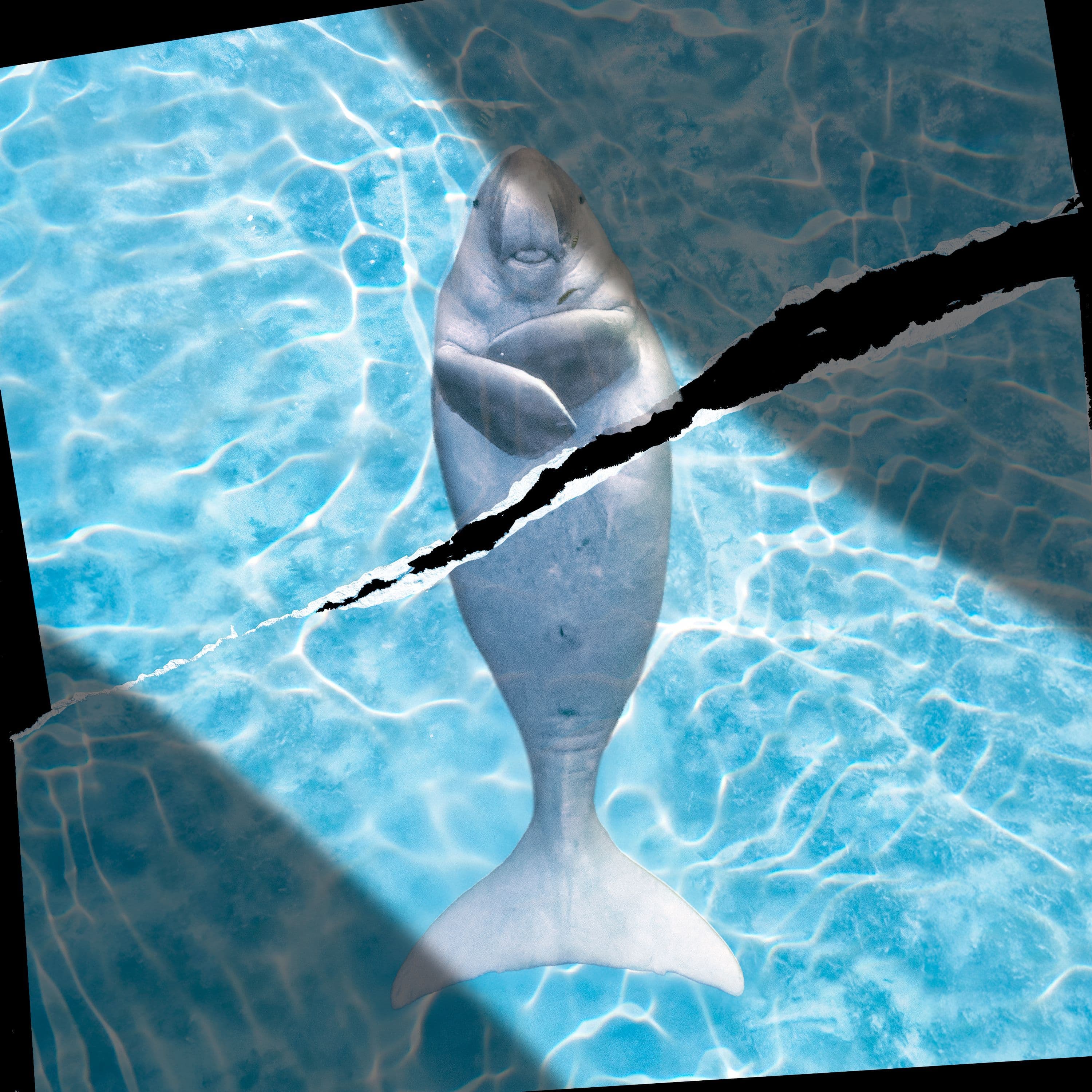
For dugongs, the damage arrives in a form that is harder to see. These slow-moving herbivores depend entirely on seagrass meadows for sustenance—and seagrass requires sunlight to survive.
Oil slicks on the surface block that sunlight, halting photosynthesis and effectively starving the meadows from above. Adam notes that vessel traffic also introduces physical disruption to the seabed, compounding the pressure on already fragile shallow-water habitats.
If oil-laden currents push toward coastlines, mangrove systems face similar risks. What begins as a surface-level event can quietly destroy the foundation of an entire ecosystem below.
Science Goes Dark During Conflict
Perhaps the most insidious consequence of ongoing military activity in the region is one that rarely features in environmental reporting: the collapse of scientific monitoring.
When access to coastlines and open water becomes impossible, researchers lose their ability to track what is happening to the species they study. Adam describes this as a critical gap that outlasts the conflict itself.
"Fieldwork becomes impossible," he says. "This constitutes a major obstacle to conducting medium-term scientific studies, particularly for understanding ecosystem variations over several months or years."
Even passive acoustic monitoring—a technique that tracks marine mammals by detecting their vocalizations—becomes unreliable when military and commercial noise floods the same frequency bands.
"The addition of human-generated noise, especially when continuous like that of boat engines, poses a real problem because it masks the sounds emitted by these large cetaceans," Adam explains.
A Global Scientific Loss in the Making
The Arabian Gulf represents something genuinely rare in marine science: an ocean environment where species have already adapted to extreme heat, low oxygen levels, and wide seasonal temperature swings. Adam describes the Gulf as a critical case study for understanding how marine life might respond to a warming planet.
Losing these populations—or losing the ability to study them—would set back climate-related marine research by years, perhaps decades.
As vessels begin moving through the strait again under the ceasefire window, the risks do not disappear. They shift. Higher traffic volumes in waters that may still contain mines, combined with sustained noise and potential pollution events, could intensify the very pressures that Gulf species are struggling to endure.
For the whales, dugongs, dolphins, turtles, and whale sharks of the Arabian Gulf, the threat was never limited to the conflict itself. It lives in what the conflict leaves behind.

