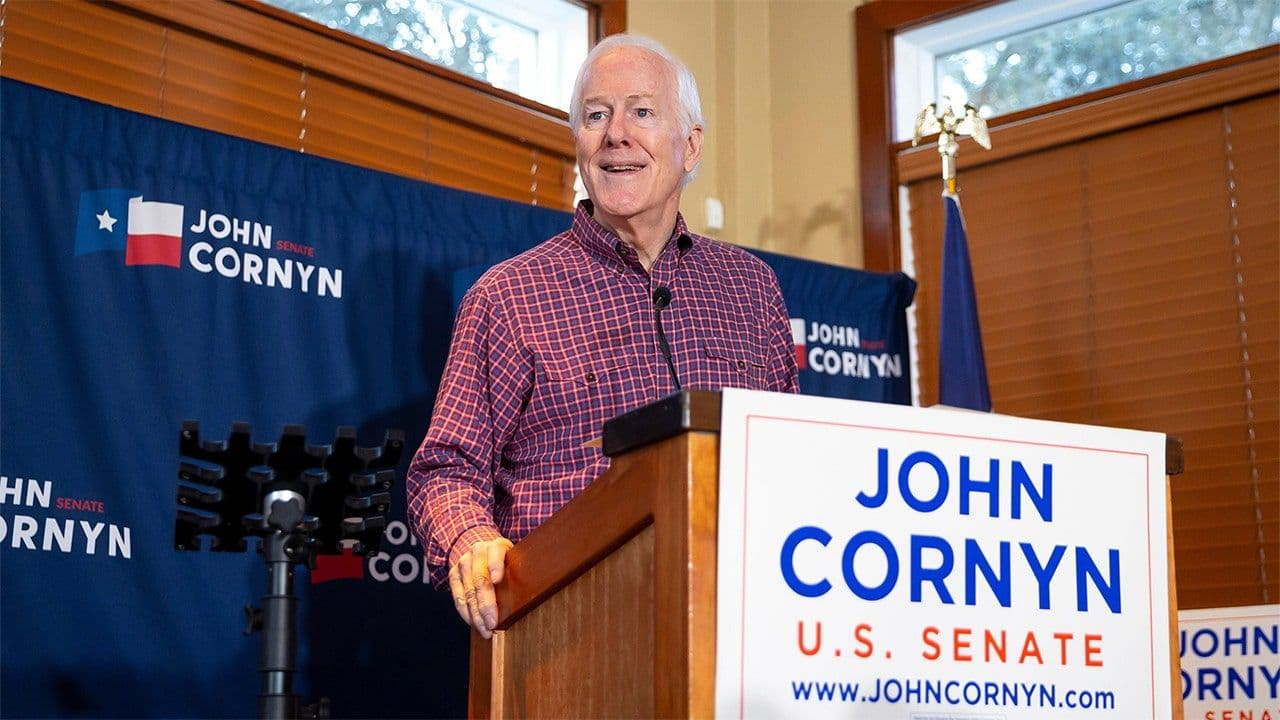
The Save America Act Could Be Cornyn's Political Lifeline — And a Win for Everyone
Nearly 60% of Texas Republicans rejected John Cornyn at the polls. Now a bold offer from Ken Paxton could reshape the Senate's priorities and save Cornyn's career.

Texas Voters Sent a Clear Message to John Cornyn
The most critical takeaway from this week's Texas primary results is not who won or lost — it's what the numbers reveal about voter sentiment. Nearly 60% of Republican voters in the Lone Star State signaled that they do not want incumbent Senator John Cornyn returning to Washington. That kind of rejection from within your own party is not a minor setback. It is a political alarm bell, and no presidential endorsement alone will silence it.
President Donald Trump acknowledged on Friday that he would announce his endorsement decision "fairly shortly," but in the same breath, he made something clear for the first time: he wants to see the "full and complete Save America Act" passed. The connection between the two issues was now explicitly on the table.
Ken Paxton's Unexpected Offer
On Thursday, Texas Attorney General Ken Paxton introduced a proposal that caught many observers off guard. Rather than pressing forward into a costly and contentious runoff election scheduled for May, Paxton offered a straightforward deal: if the U.S. Senate passes the Save America Act — legislation that would mandate voter ID and proof of citizenship for participation in federal elections — he would withdraw from the race entirely.
This proposal had been floated by several political commentators once it became apparent that neither candidate had surpassed the 50% threshold required to avoid a runoff. It represents an elegant off-ramp that would spare both sides a bruising campaign battle while delivering something of genuine substance to voters.
The implicit message to Senate Republican leadership is unmistakable: pass the Save America Act, and Paxton steps aside. The ball is now firmly in the Senate's court.
Why the Save America Act Matters So Much
The Save America Act is not fringe legislation. Polling consistently places its approval rating between 70% and 80% among the general public. Voter ID requirements and citizenship verification for federal elections enjoy broad, bipartisan support across the country. And yet, despite controlling the Senate, Republican leadership has repeatedly failed to push this bill across the finish line.
This failure is precisely what frustrated GOP voters are expressing at the ballot box. When Majority Leader John Thune and the Senate's cautious inner circle cannot advance legislation that commands the support of roughly four out of five Americans, it raises a legitimate question: what exactly is the point of a Senate majority?
One voter from El Paso captured the mood succinctly, stating that if lawmakers cannot pass measures that 80% of the public supports, the entire exercise feels pointless. That sentiment is not unique to Texas — it echoes across red states where Republican voters increasingly feel that their Senate majority is more symbolic than functional.
A Bipartisan Opening
Perhaps most surprisingly, the Save America Act may not be strictly a partisan endeavor. Pennsylvania Senator John Fetterman, a Democrat, indicated openness to supporting a streamlined version of the bill. When asked about utilizing a standing filibuster to pass voter ID legislation with a simple majority, Fetterman commented that Republicans were being too ambitious in their approach and suggested a cleaner bill focused solely on legitimate identification for federal elections.
Fetterman pointed to Wisconsin's existing voter ID framework as a potential model, adding that under those conditions, he could lend his support. He further argued that passing such a measure would strategically benefit Democrats by forcing opponents to defend a position that most Americans find difficult to justify.
When legislation has the potential to attract Democratic crossover votes, and when it polls as well as voter ID does, the failure to act becomes increasingly indefensible.
Cornyn Must Earn His Seat, Not Inherit It
For Senator Cornyn, this moment presents both a challenge and an opportunity. The instinct of his campaign — to attack Paxton's electability and lean on the argument that Cornyn is the safer general election choice — is unlikely to be enough. Dismissing a 60-point rebuke from your own party's voters is not a viable long-term strategy.
If Cornyn genuinely wants to reconnect with Texas Republicans, the path forward is not to wait passively for a Trump endorsement to bail him out. It is to demonstrate tangible leadership on issues that voters clearly care about. Championing the Save America Act — actively whipping votes for it in the Senate — would signal that Cornyn has heard the message and is prepared to act on it.
The Senate's so-called "RINOsaurs" face a growing credibility problem. Holding a majority while consistently failing to advance popular legislation damages the party's standing and voter trust in equal measure. The Save America Act offers a rare chance to reverse that perception with a concrete, measurable victory.
The Bottom Line
Passing the Save America Act would accomplish several things simultaneously. It would deliver a high-priority policy win on election integrity. It would demonstrate that Senate Republicans can govern effectively. It would potentially attract rare bipartisan support. And it could resolve a politically costly Senate primary without an expensive and divisive runoff.
For John Cornyn, the calculus is straightforward. A presidential endorsement may soften the blow of Tuesday's results, but it will not rebuild trust with voters who have already expressed deep dissatisfaction. Leading on the Save America Act would. The senator has an opportunity to grab the initiative, prove his worth, and show Texas voters that he is not merely occupying a seat — but actively fighting for them. The question is whether he will take it.
