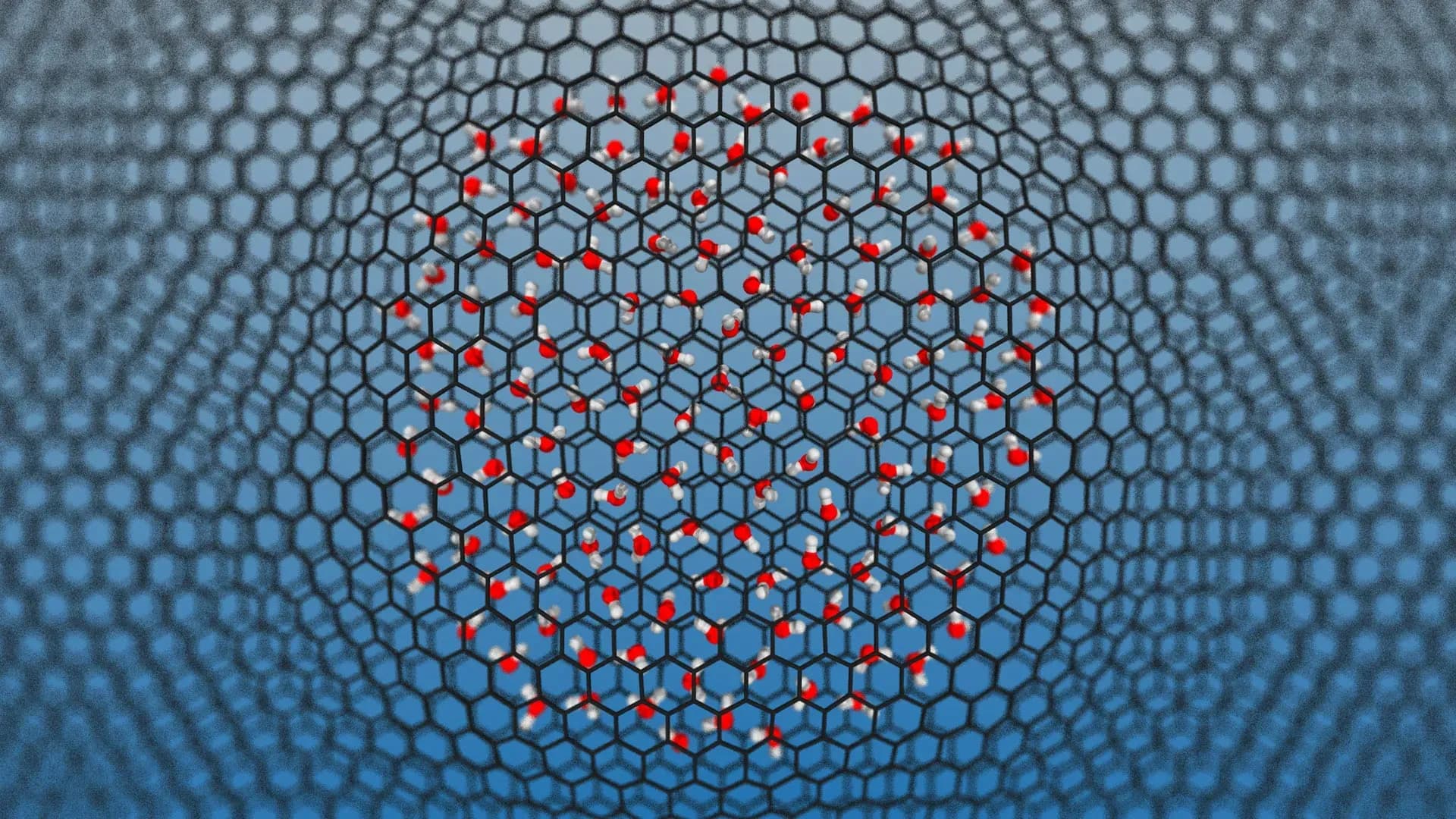
The Real Reason Water Behaves Differently in Nanoscale Spaces
A new study finally explains why water acts strangely when squeezed into tiny spaces — and the answer isn't what scientists expected.
A Long-Standing Mystery About Water Gets Solved
Water is one of the most thoroughly studied substances on Earth, yet scientists have spent decades arguing over a deceptively simple question: does water become more chemically reactive when squeezed into spaces just a few molecules wide?
A new study has delivered a clear answer — and it comes with a surprising twist. Water confined in nanoscale environments is not inherently more reactive on its own. The real culprit behind its altered behavior is the enormous pressure that builds up inside those microscopic gaps, along with the chemical properties of the surrounding material.
Why Nanoconfined Water Matters
These ultra-small spaces are far from rare. They appear throughout nature and modern technology — inside nanopores, biological membranes, cellular channels, and advanced energy devices. Understanding how water behaves in these environments has significant implications for everything from enzyme function in living cells to the performance of hydrogen fuel cells and batteries.
One of water's most fundamental chemical traits is its ability to split into two charged particles: the hydronium ion (H₃O⁺) and the hydroxide ion (OH⁻). This splitting process determines pH and governs acid-base chemistry across countless biological and industrial systems. Scientists have long wanted to know whether squeezing water into nanometer-scale spaces changes how readily this splitting occurs.
The new research, published in Science Advances, concludes that the apparent chemical reactivity of nanoconfined water is shaped by several interacting factors — including density, pore size, wall flexibility, and the chemistry of the surrounding surfaces.
Machine Learning Unlocks Quantum-Level Insights
To investigate the problem, the research team turned to machine learning simulations capable of achieving quantum mechanical accuracy. This approach allowed them to explore a far wider range of conditions than conventional computational methods would permit.
The team focused on water trapped between two atomically thin materials: graphene and hexagonal boron nitride (hBN). Though structurally similar — both just one atom thick — these two materials have very different surface chemistries, making them ideal candidates for comparison.
Extreme Pressure Without Any External Force
One of the study's most striking discoveries was that water droplets confined between these ultra-thin sheets experience extraordinarily high internal pressures — reaching several gigapascals, comparable to conditions found deep within the Earth's interior. Remarkably, no external force is required to generate this pressure.
The pressure arises naturally from van der Waals attraction between the atomically thin layers. Although the force between individual atoms is relatively weak, it becomes exceptionally powerful across the large surface area of two-dimensional materials, drawing the sheets together and compressing the water caught between them.
Pressure Is the Primary Driver — Not Confinement Itself
When the researchers analyzed the data, they found that these intense pressures are largely responsible for the increased splitting of water molecules observed in nanoscale environments.
Critically, when confined water was compared with ordinary bulk water subjected to the same pressure, both behaved in essentially identical ways. This finding demonstrates that confinement alone does not make water intrinsically more reactive — the pressure it creates is what drives the chemistry.
"When we compared systems under equivalent thermodynamic conditions — specifically at the same chemical potential — the effect of confinement largely disappeared," said Xavier R. Advincula, the study's lead author. "The contradictions in the literature were largely because scientists were comparing systems at different effective pressures or densities without realizing it."
Professor Angelos Michaelides of the Yusuf Hamied Department of Chemistry at the University of Cambridge added: "What surprised us most was how much of the apparent confinement effect could be explained by thermodynamics. Once pressure and chemical potential are properly accounted for, a great deal of the complexity simply falls into place."
Surface Chemistry Still Shapes the Outcome
While confinement itself may not be the deciding factor, the material surrounding the water can still play an influential role in its chemical behavior.
In experiments involving hBN-confined water droplets, hydroxide ions (OH⁻) that formed near the edges bonded chemically with the surrounding material. This interaction stabilized the ions, reduced the energy needed for water molecules to split apart, and ultimately increased the overall level of dissociation.
Graphene, by contrast, produced no such effect. Its chemically inert surface does not engage with the reaction products, leaving water's behavior governed almost entirely by pressure.
These results confirm that the choice of confining material actively influences the chemistry of water at the nanoscale — a finding with major practical implications.
A New Framework for Nanoscale Chemistry
"This research provides a new framework for understanding water chemistry at the nanoscale and helps reconcile a decade of apparently conflicting studies," said Dr. Christoph Schran of the Theory of Condensed Matter Group at the Cavendish Laboratory.
"More importantly, the work offers a practical design principle for engineering nanoscale chemical environments. Rather than focusing solely on the size of pores or channels, we can tailor water reactivity by choosing a confining material whose surfaces interact with the products of water dissociation and by controlling the pressures generated within confined spaces."
Implications for Energy Technology and Beyond
The study's findings carry meaningful consequences for technologies that rely on confined water, including hydrogen fuel cells, next-generation batteries, ion-selective membranes, and catalytic systems.
Looking ahead, the research team plans to investigate more realistic environments that incorporate defects and edges commonly found in practical materials. They also intend to validate their computational predictions against laboratory measurements using advanced spectroscopic and nanofluidic techniques.
In parallel, the team is evaluating large families of two-dimensional materials and surface chemistries to identify combinations that can either amplify or suppress water reactivity — a step toward engineering precisely controlled nanoscale chemical environments for specific technological applications.

