The Forgotten Skull That Revealed a Dinosaur That Should Not Have Existed
A crushed, neglected dinosaur skull sat in a drawer for decades before an undergraduate student uncovered its extraordinary secret — a brand-new species that rewrites extinction history.
A Forgotten Fossil Hiding in Plain Sight
For more than three decades, an unassuming, badly crushed dinosaur skull gathered dust inside a museum drawer, overlooked and largely forgotten. When it was finally brought back to light, no one expected it to challenge what scientists thought they knew about one of Earth's most dramatic extinction events. Yet that is precisely what happened — and the discovery was made not by a seasoned paleontologist, but by a college undergraduate.
The skull, now recognized as belonging to an entirely new dinosaur species, was painstakingly reconstructed by Simba Srivastava, a geosciences senior at Virginia Tech. His findings, published in the journal Papers in Palaeontology, are reshaping our understanding of how dinosaurs rose to dominance and which creatures the great Triassic extinction truly claimed.
A Specimen So Damaged It Was Almost Dismissed
Srivastava made no effort to sugarcoat the fossil's condition.
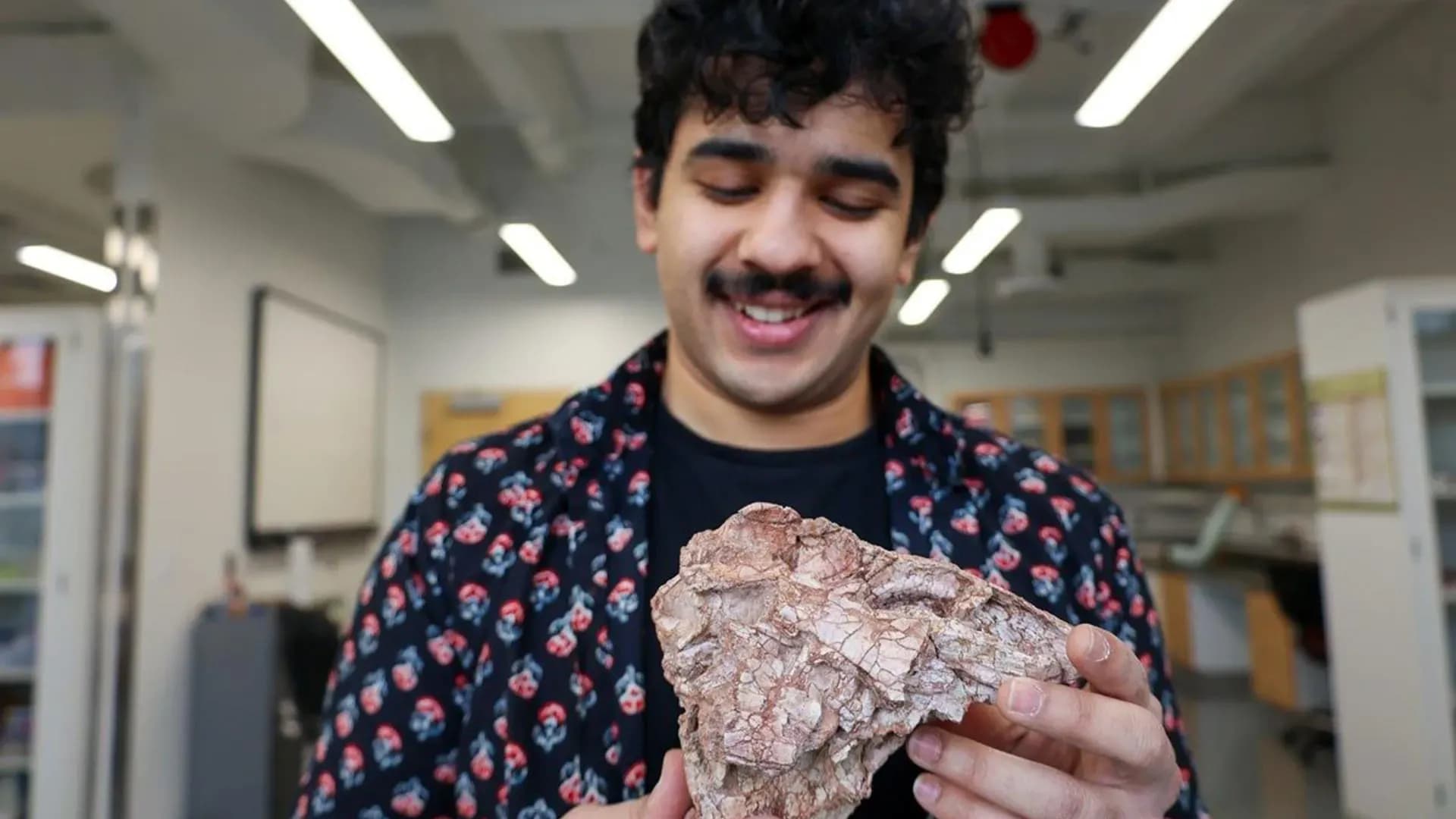
"This is a uniquely sucky specimen," he said, holding up the rough, pitted skull inside Virginia Tech's paleobiology lab. "It's so bad. Like, if you saw a human skull in this way, you'd throw up."
Despite its wretched state, Srivastava dedicated two full years to digitally reconstructing the fossil. Using computed tomography — the same CT scanning technology used in modern medicine — he digitally separated the crushed and distorted bones, ultimately producing a detailed 3D-printed replica of the skull.
The fossil had first been unearthed in 1982 by a Carnegie Museum of Natural History team excavating at Ghost Ranch in New Mexico, a site long celebrated for its remarkable prehistoric finds. It then spent more than 30 years sitting in storage until geobiologist Sterling Nesbitt rediscovered it and brought it to Virginia Tech for proper investigation.
"We want undergraduate researchers to experience the whole paleontological research process at Virginia Tech," said Nesbitt, who took Srivastava on as a first-year student. "Simba grabbed the project by the reins."
Meet the 'Folded Hunter With Full Cheeks'
The reconstructed skull told a remarkable story. The dinosaur it belonged to was a carnivore that roamed the earth more than three times earlier than the infamous Tyrannosaurus rex. It lived during the late Triassic period — a span running from roughly 252 million to 201 million years ago — when dinosaurs were far from the undisputed rulers of the land.
During that era, dinosaurs competed fiercely with early crocodilian relatives and proto-mammals for ecological dominance. They were, as Srivastava put it, "co-stars" rather than headliners. The catastrophic mass extinction that closed out the Triassic period wiped out much of their competition and propelled dinosaurs to center stage.
"Dinosaurs go from being co-stars to the headliner," Srivastava said.
What made this particular skull stand out were its distinctly unusual anatomical features — prominent cheekbones, a wide braincase, and what appears to have been a short, deep snout. None of these characteristics had been observed together in early dinosaurs before, pointing to a more complex and varied evolutionary landscape than scientists had previously imagined.
Srivastava named the new species Ptychotherates bucculentus, a Latin phrase meaning "folded hunter with full cheeks." One paleoartist offered a more colorful description: it looked, they said, like a "murder muppet."
A Lineage on the Brink of Extinction
After extensive analysis, the research team classified Ptychotherates within Herrerasauria, one of the earliest and most primitive groups of carnivorous dinosaurs ever identified. The evidence suggests this specimen may represent one of the very last members of that lineage.
The rock layers in which the fossil was found likely date to just before the catastrophic end-Triassic extinction event, and no herrerasaurian dinosaurs have been discovered in geological records from after that time. The implication is striking: this ancient group of dinosaurs was not a survivor of the extinction — it was one of its victims.
"This forces us to reconsider the impact of the end-Triassic extinction as something that wiped out not just the competitors to dinosaurs, but some long-standing dinosaur lineages themselves," Srivastava said.
Because no other herrerasaurian fossils from such a late Triassic date have been found anywhere else in the world, researchers believe what is now the American Southwest may have served as the group's final refuge before disappearing entirely.
One Small Skull, One Enormous Story
Fossils from the critical transition between the Triassic and Jurassic periods are extraordinarily rare, making even a mangled specimen like this one scientifically invaluable. No other fossil matching this species has ever been found — making Ptychotherates bucculentus a singularly important window into a lost world.
"This specimen fits in my hands, but it is the only proof that any of these dinosaurs lived this long, lived in these latitudes, the only proof that they evolved to have this skull shape," Srivastava reflected. "All these billions of individuals that existed through time are spoken for by this one specimen."
What began as a neglected curiosity in a museum drawer has become a pivotal piece of the prehistoric puzzle — proof that even the most battered and forgotten fossil can still have an extraordinary story left to tell.