Thawing Permafrost Has a Hidden Carbon-Absorbing Side Effect Scientists Never Expected
New research reveals that melting permafrost can trigger rock weathering that actively pulls CO2 from the atmosphere, sometimes offsetting river emissions entirely.
Melting Permafrost May Be Fighting Its Own Emissions
When scientists talk about thawing permafrost, the conversation almost always centers on one alarming outcome: the release of long-trapped greenhouse gases into the atmosphere. But a groundbreaking new study published in Nature is reshaping that narrative. Researchers have discovered that as permafrost melts, it can simultaneously trigger a geological process that draws carbon dioxide out of the atmosphere — and in certain regions, that carbon removal is powerful enough to fully cancel out river greenhouse gas emissions.
The study was conducted by researchers from Umeå University in Sweden and East China Normal University in China.
How Thawing Ground Triggers Natural CO2 Removal
As global temperatures continue climbing, vast stretches of permanently frozen ground across the Northern Hemisphere are beginning to degrade. When permafrost thaws, ancient organic material is exposed to microbial activity. Those microbes break it down and release greenhouse gases — a well-documented feedback loop that concerns climate scientists worldwide.
What this new research reveals, however, is that something else is happening at the same time. As frozen soils deteriorate, minerals that were previously locked beneath the surface become exposed to water. That increased contact between water and rock accelerates chemical weathering — a natural geochemical process that consumes atmospheric CO2 in the course of breaking down rock surfaces.
According to the research team, this weathering-driven carbon uptake can substantially reduce the volume of CO2 emitted by rivers. Under the right conditions, it can eliminate those emissions entirely.
Studying 50 Rivers Across the World's Largest High-Altitude Cryosphere
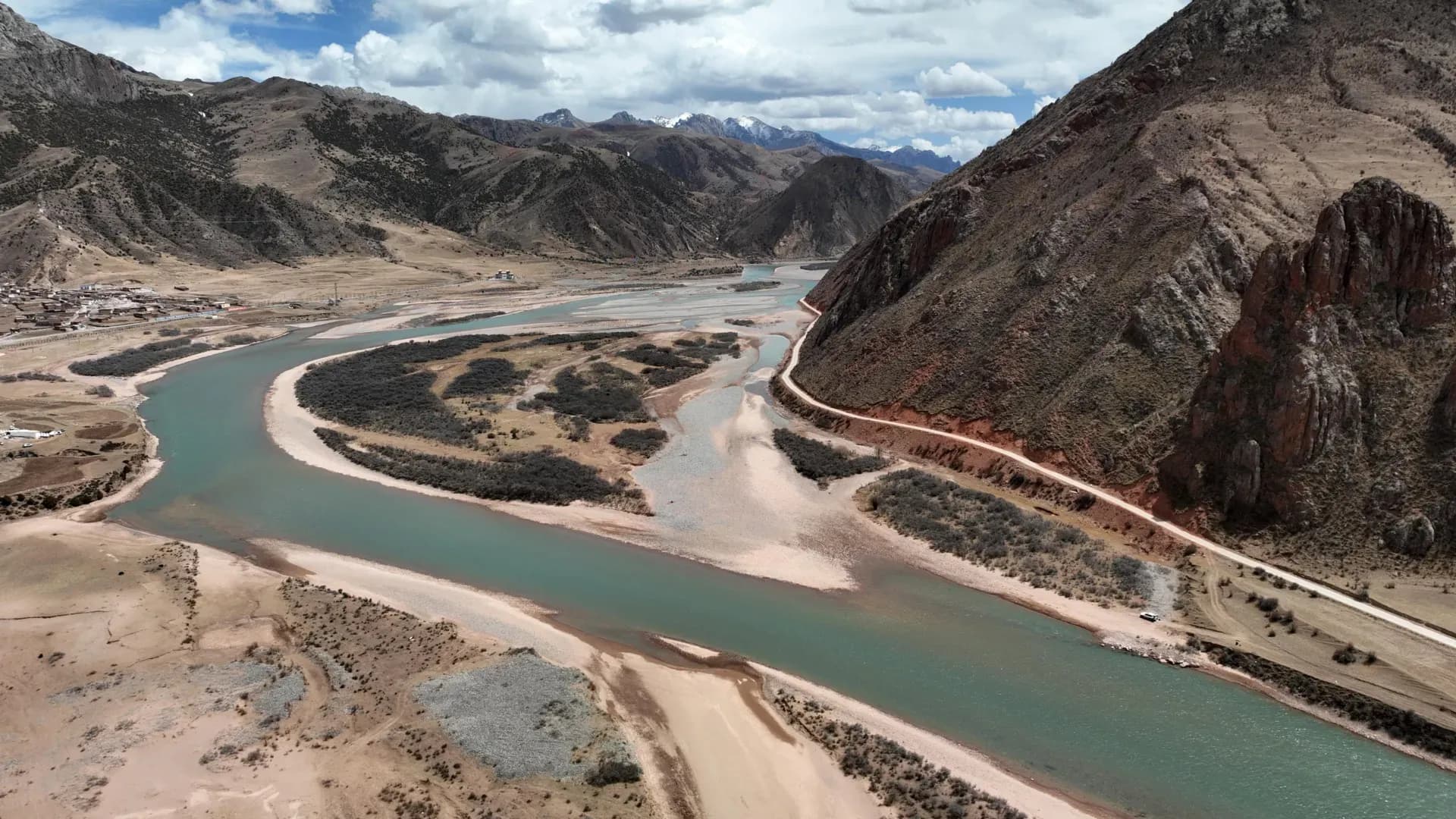
To explore this phenomenon, scientists examined 50 river systems spread across the Qinghai-Tibet Plateau — the largest high-altitude frozen region on Earth outside the polar zones. The team measured river CO2 emissions, analyzed dissolved carbon content, applied isotopic tracers, and used geochemical modeling to map the relationship between permafrost thaw and carbon cycling.
Their findings confirmed that as permafrost coverage decreases, chemical weathering intensifies. This process shifts carbon into dissolved inorganic forms while simultaneously removing CO2 directly from the atmosphere.
Carbon Absorption Can Exceed River Emissions
"We found that river CO2 emissions decline while carbon uptake through rock weathering increases as permafrost cover decreases," said Liwei Zhang, a biogeochemist at East China Normal University. "In some catchments where permafrost has become patchier, weathering-driven carbon uptake was large enough to offset or even exceed river CO2 emissions."
Across the entire study region, the researchers calculated that rock weathering offsets approximately 35 percent of river CO2 emissions on average.
The scale of the effect depended heavily on how much permafrost remained in a given area:
- Continuous permafrost zones showed relatively modest weathering offsets.
- Discontinuous or isolated permafrost regions sometimes saw weathering-driven carbon uptake surpass 100 percent of river CO2 emissions.
These results suggest that geological carbon removal can, in certain environments, rival the carbon released through biological decomposition.
Rethinking the Role of Permafrost in the Carbon Cycle
This study directly challenges the assumption that thawing permafrost functions purely as a carbon source. While biological processes — microbes converting organic material into atmospheric greenhouse gases — are real and significant, the new findings make clear that geology is an active player in the same system.
That said, the researchers are careful not to overstate the implications. Rock weathering is not a straightforward or permanent solution to climate change. The chemistry is complex: depending on which minerals are involved, some weathering reactions can actually release CO2 rather than absorb it. The findings are not a reason for complacency — they're a reason for more nuanced science.
Climate Models Must Account for Geological Carbon Sinks
"Our findings show that biological and geological carbon cycles are tightly linked," said Jan Karlsson, professor at the Department of Ecology, Environment and Geoscience at Umeå University. "To understand whether thawing permafrost ultimately amplifies or dampens climate warming, we need to consider both the carbon released from ancient soils and the carbon consumed through rock weathering."
The research team is calling on climate modelers and policymakers to move beyond a biology-only view of permafrost emissions. As frozen landscapes continue to thaw at accelerating rates, geological carbon sinks and sources will play an increasingly important role — one that current climate models are not yet fully equipped to capture.
Accounting for these hidden geological feedbacks could meaningfully change how scientists project the long-term climate impact of permafrost thaw.

