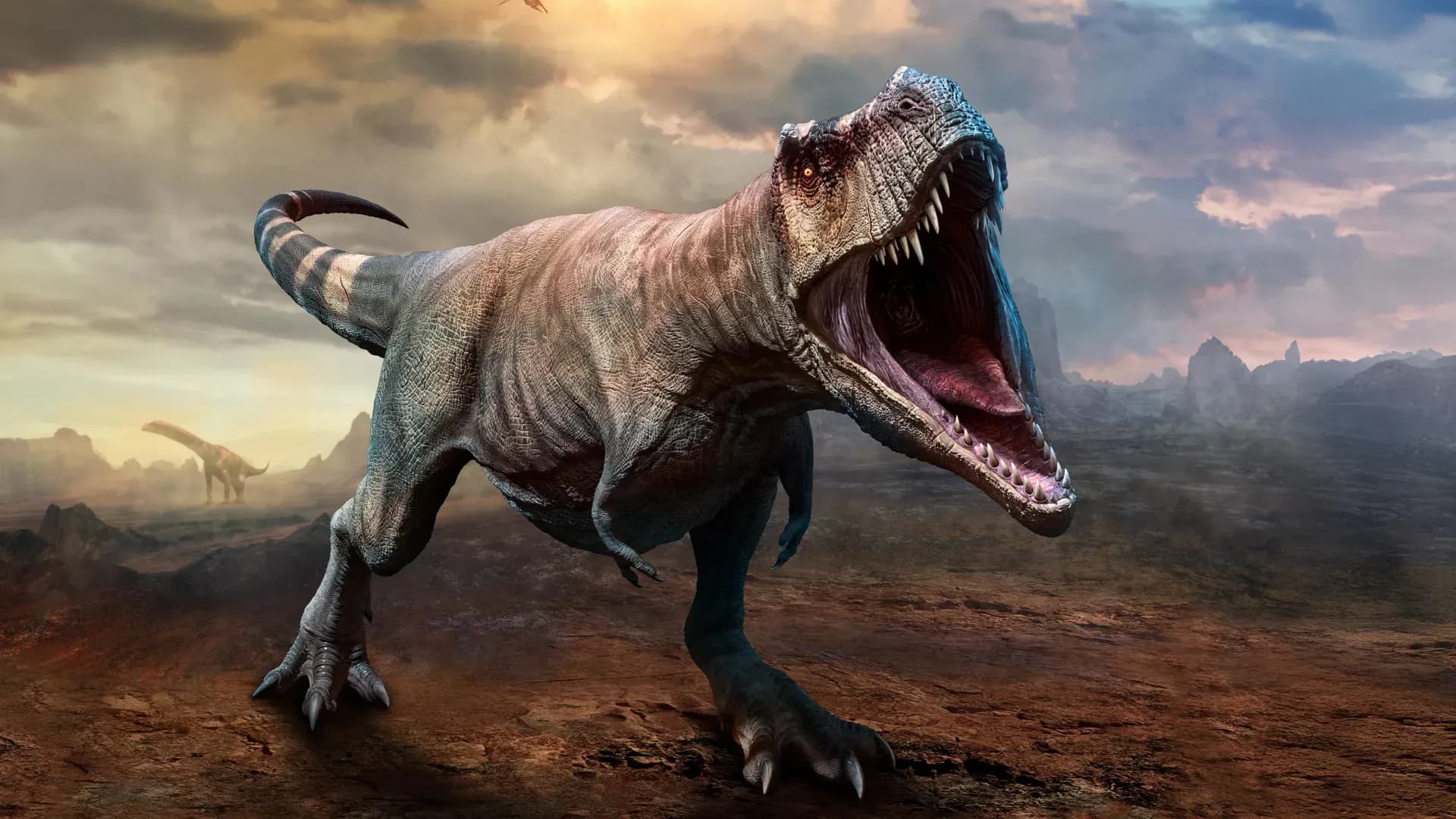
T. Rex Needed 40 Years to Reach Full Size, Groundbreaking Study Reveals
Scientists have overturned decades of assumptions about T. rex growth, finding the iconic predator took 40 years — not 25 — to reach its massive adult size.

T. Rex Was a Slow Grower, New Research Shows
For decades, paleontologists believed Tyrannosaurus rex reached its full adult size somewhere around age 25. A sweeping new study has shattered that assumption. After analyzing 17 tyrannosaur fossils, an international team of researchers has concluded that the world's most famous predatory dinosaur likely spent roughly 40 years growing before reaching its maximum weight of approximately eight tons — pushing back the previous estimate by a full 15 years.
The study was published in the peer-reviewed journal PeerJ and represents the most comprehensive reconstruction of T. rex growth ever attempted.
How Scientists Read Age Inside Fossilized Bone
To determine how old a dinosaur was at death, paleontologists rely on growth rings embedded within fossilized bone — a technique not unlike reading the rings inside a tree trunk. Each ring corresponds to a period of growth, offering clues about the animal's age and how rapidly it was developing at any given stage of life.
While this method has been used for years, the new study pushed the science considerably further. Researchers examined ultra-thin slices of fossil bone under specialized lighting conditions designed to expose growth markers that conventional methods routinely miss. The enhanced imaging revealed rings that had previously gone undetected, adding meaningful data to the overall picture.
Stitching Together a Life History
One inherent challenge with dinosaur bones is that a cross-section of a T. rex leg bone typically preserves only the final 10 to 20 years of an individual animal's life — far from a complete biography. To compensate, the research team developed an innovative statistical framework that combined growth data from multiple specimens of varying ages, effectively stitching together a continuous growth record from youth through full adulthood.
"We came up with a new statistical approach that stitches together growth records from different specimens to estimate the growth trajectory of T. rex across all stages of life in greater detail than any previous study," explained Nathan Myhrvold, a mathematician and paleobiologist at Intellectual Ventures who spearheaded the statistical analysis. "The composite growth curve provides a much more realistic view of how Tyrannosaurus grew and how much they varied in size."
Holly Woodward, a professor of anatomy at Oklahoma State University who led the overall research effort, described the scope of the project: "This is the largest data set ever assembled for Tyrannosaurus rex. Examining the growth rings preserved in the fossilized bones allowed us to reconstruct the animals' year-by-year growth histories."
A Steadier, More Prolonged Path to Dominance
The portrait of T. rex that emerges from this research is notably different from earlier depictions. Rather than surging rapidly to adulthood, the animal appears to have grown at a measured, consistent pace over several decades.
According to the researchers, this extended developmental window may have carried significant ecological advantages. As younger tyrannosaurs matured slowly, they would have occupied distinct ecological roles — feeding on different prey and interacting differently with their environment than their fully grown counterparts.
"A four-decade growth phase may have allowed younger tyrannosaurs to fill a variety of ecological roles within their environments," said coauthor Jack Horner of Chapman University. "That could be one factor that allowed them to dominate the end of the Cretaceous Period as apex carnivores."
The Cretaceous Period came to a close approximately 66 million years ago, coinciding with the mass extinction event that wiped out non-avian dinosaurs.
Could Some T. Rex Fossils Actually Belong to Different Species?
The study also wades into one of paleontology's more contentious ongoing debates: whether every fossil classified as T. rex truly belongs to the same species.
Some researchers have long argued that certain smaller specimens may represent a separate dinosaur genus altogether — known as Nanotyrannus — rather than juvenile T. rex individuals. Others have suggested that even among larger specimens, subtle differences may point to multiple closely related species or subspecies.
To address this complexity, the research team deliberately framed their study around what they call the Tyrannosaurus rex species complex, a designation that leaves room for the possibility that more than one distinct species is represented within the group.
Jane and Petey: Outliers in the Dataset
Two well-known specimens — affectionately nicknamed "Jane" and "Petey" — displayed growth patterns that diverged markedly from the other 15 fossils examined. While the authors acknowledge that growth data alone cannot definitively resolve questions of species classification, the unusual patterns exhibited by these two individuals make the case for further investigation compelling.
Notably, a separate recent study by researchers Zanno and Napoli, using entirely different analytical methods, reached a parallel conclusion — classifying both Jane and Petey as distinct species within the Nanotyrannus genus.
Hidden Bone Rings Could Reshape Dinosaur Research Broadly
Perhaps one of the most far-reaching implications of this study lies not in what it reveals about T. rex specifically, but in what it suggests about dinosaur research more broadly. The discovery of previously overlooked growth markers — made possible only through advanced imaging techniques — raises an important question: how many other dinosaur species have been mischaracterized because subtle bone features were simply never detected?
As imaging technology and statistical methods continue to advance, studies like this one suggest that scientists may need to revisit long-held conclusions about the growth, lifespan, and classification of many prehistoric species.
For now, T. rex stands as a more patient giant than anyone imagined — one that spent four deliberate decades building itself into the apex predator that has captivated human imagination for over a century.