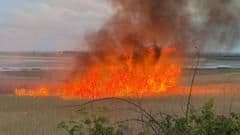
Suspected Arson Devastates Protected Bird Nesting Site at Pegwell Bay
A deliberate fire has scorched three acres of protected reed beds at Pegwell Bay in Kent, destroying critical habitat during prime nesting season.

Suspected Arson Destroys Protected Reed Beds at Kent Nature Reserve
Authorities are treating a weekend fire that tore through a protected nature reserve in Kent as a deliberate act of arson, raising serious concerns among conservationists about the safety of the region's most ecologically sensitive landscapes.
The fire ignited on Sunday evening at Pegwell Bay in Ramsgate, a designated Site of Special Scientific Interest (SSSI), consuming approximately three acres of reed bed habitat and leaving a visible scar stretching roughly 300 metres across the protected land.
Environmental Impact During Critical Nesting Season
Local environmentalist Nik Mitchell described the destruction as "devastating," particularly given the timing. Speaking through his Get Wild social media platform, Mitchell emphasised that the blaze struck during the heart of nesting season — a period when the reed beds are most alive with activity.
"There would have been loads of nesting birds in there and lots of nest building — it's devastating," he said.
The reed beds at Pegwell Bay serve as essential breeding grounds for species including warblers and reed buntings, both of which begin nesting in early spring. The loss of this habitat at such a critical time could have serious consequences for local bird populations.
Mitchell also praised Kent Fire & Rescue Service (KFRS) for their swift response, saying crews had done "an incredible job" containing the blaze and limiting further damage. However, he expressed concern that members of the public might begin walking through the burned area, potentially forming informal footpaths that would hinder the natural regeneration of the reed bed.
Authorities Launch Arson Investigation
Kent Police confirmed they received multiple reports at approximately 20:30 BST on Sunday evening, relating to separate fires involving bins in the Cliffsend area, including at Pegwell Bay Nature Reserve and Chapmans Fields. Officers attended the scene, and a formal arson investigation is now under way. No injuries were reported.
A spokesperson for KFRS confirmed that three fire engines were dispatched to reports of marshland alight on Sandwich Road, Ramsgate. Crews deployed main jets and hose reel jets to bring the flames under control.
A Site of Irreplaceable Ecological Value
Emma Waller, Senior Planning and Policy Officer at Kent Wildlife Trust, underscored the ecological significance of Pegwell Bay, calling it "one of the most sensitive and important coastal sites in Kent."
"Its saltmarsh is an irreplaceable habitat that supports rare species and underpins the functioning of the wider ecosystem," Waller stated.
She also warned that this incident is far from isolated, pointing to a troubling rise in disturbances across multiple Kent Wildlife Trust reserves — from antisocial behaviour to mounting recreational pressures that are becoming increasingly difficult for wildlife to withstand.
In one recent example, the Trust was forced to relocate its herd of Highland cattle from Hothfield Heathlands Nature Reserve after viral social media content encouraged visitors to approach the animals directly, putting both the wildlife and the public at risk.
Growing Threat to Kent's Natural Spaces
The incident at Pegwell Bay highlights a broader and deeply concerning pattern of human interference with protected natural environments. As disturbances escalate across the region, conservationists are calling for greater public awareness, stronger deterrents, and more robust protections for habitats that took centuries to form and cannot simply be replaced.