Supreme Court Rules in Monsanto's Favor, Blocking State Lawsuits Over Roundup Weed Killer
The Supreme Court ruled 7-2 that federal law shields Monsanto from state liability claims over its Roundup weed killer, impacting thousands of pending cancer lawsuits.

Supreme Court Sides With Monsanto in Landmark Roundup Ruling
In a sweeping decision with far-reaching consequences for public health litigation, the United States Supreme Court has ruled in favor of Monsanto, effectively protecting the agrochemical giant from state-level liability claims tied to its widely used Roundup weed killer. The 7-2 ruling deals a significant blow to thousands of plaintiffs who allege that glyphosate — the active ingredient in Roundup — caused their cancers.
The Case at the Center of the Controversy
The legal battle originated with John Durnell, a Missouri resident who sued Monsanto claiming the company failed to adequately warn consumers about the health risks associated with glyphosate exposure. At the heart of the dispute was a fundamental question: who holds the authority to determine what warning labels must appear on pesticide products — federal regulators or state courts?
Monsanto, now operating under its parent company Bayer, maintained that the U.S. Environmental Protection Agency (EPA) holds sole jurisdiction over pesticide labeling under the Federal Insecticide, Fungicide, and Rodenticide Act (FIFRA). State-level lawsuits, the company argued, undermine that federal authority by attempting to impose different or additional labeling requirements.
The Court's Majority Opinion
Justice Brett Kavanaugh authored the majority opinion, joined by six of his colleagues, concluding that FIFRA expressly preempts state tort claims like the one brought by Durnell.
"Because Durnell's state tort claim would impose a pesticide labeling requirement 'in addition to or different from' the label required by EPA, FIFRA expressly preempts Durnell's claim," Kavanaugh wrote.
The current U.S. Solicitor General, John Sauer, aligned with Monsanto's position, lending additional weight to the company's federal preemption argument. Monsanto's legal counsel, former U.S. Solicitor General Paul Clement, had urged the justices during April oral arguments to uphold a single, uniform national standard for pesticide labeling.
"You shouldn't let a single Missouri jury second-guess that judgment," Clement told the court.
Dissenting Justices Push Back
Not all justices were convinced. Justice Ketanji Brown Jackson filed a pointed dissent, joined by Justice Neil Gorsuch, arguing that the majority fundamentally misread FIFRA's scope and left an injured plaintiff without recourse.
"In accepting Monsanto's argument and holding that Durnell's failure-to-warn claim is preempted, the Court misunderstands FIFRA's requirements, misinterprets the scope of FIFRA's preemption, and ultimately leaves Durnell without a remedy for the significant harms he has suffered," Jackson wrote.
Durnell's attorney, Ashley Keller, had argued before the justices that Congress had not yet acted to formally shield Monsanto from state lawsuits — and until it did, state juries retained the right to evaluate such failure-to-warn claims. Keller noted that Congress had actively debated granting the company legal protection through farm bill negotiations, suggesting that no such shield yet exists in law.
What This Means for Pending Lawsuits
Legal experts suggest the ruling could dramatically narrow Monsanto's exposure in the tens of thousands of cases slowly winding through state and federal courts. The decision hands Bayer a critical legal lifeline as the company has struggled financially and reputationally to manage the enormous volume of Roundup-related litigation.
Bayer CEO Bill Anderson welcomed the ruling in a public statement, calling it a long-overdue resolution.
"This decision provides the regulatory clarity necessary for innovators like us to develop the agricultural tools that guarantee an affordable food supply," Anderson said. "This litigation has enormous costs for the company and has impacted public trust. The decision brings overdue justice on an issue that should have been clarified much earlier."
Political and Public Backlash
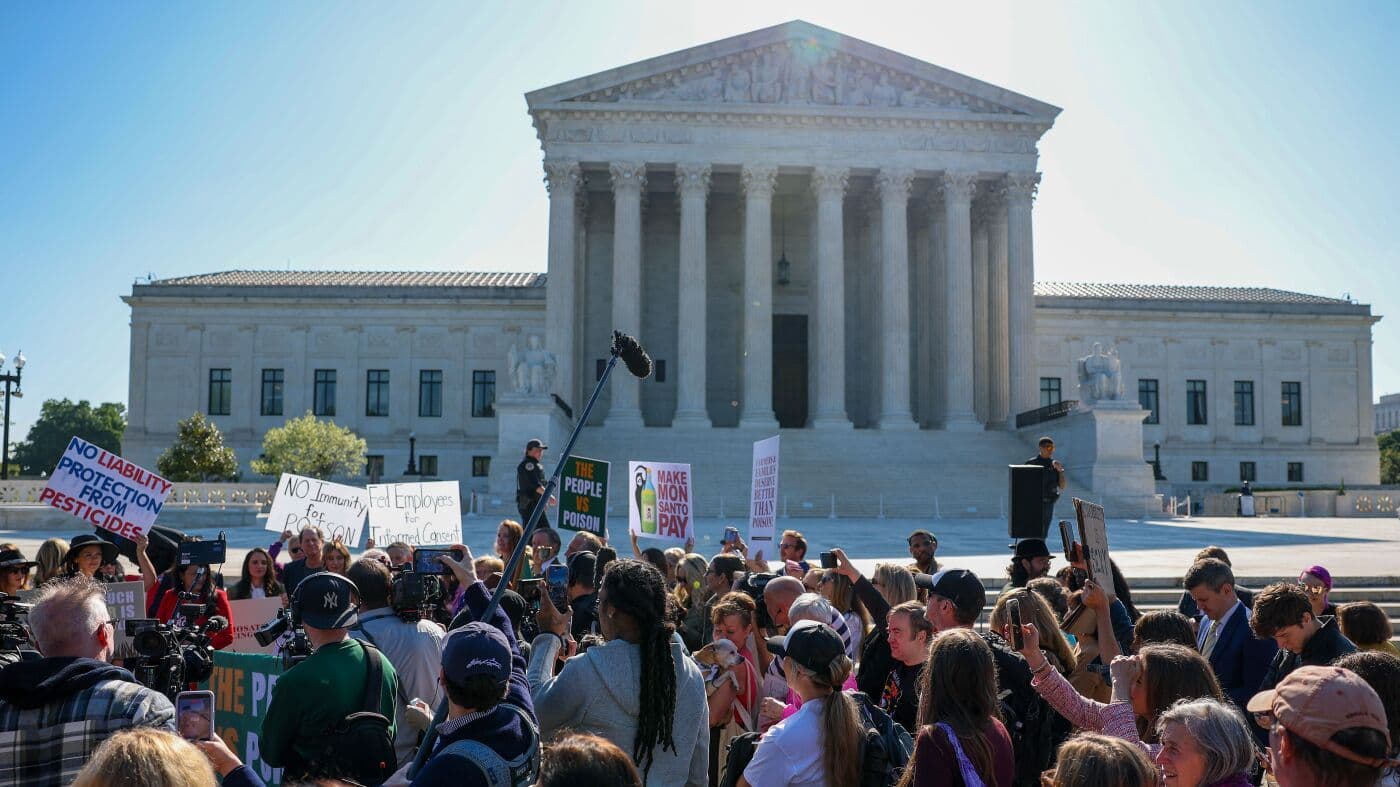
The ruling arrives amid heightened public scrutiny of glyphosate. Dozens of protesters aligned with the Make America Healthy Again (MAHA) movement gathered outside the Supreme Court in late April in solidarity with those who claim Roundup harmed their health.
The controversy has also created political tension within the Trump administration. President Trump signed an executive order aimed at boosting domestic glyphosate production — a move that has created friction between the White House and vocal MAHA supporters who view the chemical as a public health threat.
A Victory for Bayer, A Setback for Consumer Advocates
For Bayer, the ruling represents one of the most consequential legal victories since it acquired Monsanto in 2018 and inherited its mounting legal liabilities. For consumer advocates and cancer patients who believe glyphosate damaged their health, the decision closes a critical legal avenue — leaving federal regulatory oversight as the primary check on pesticide labeling standards.

