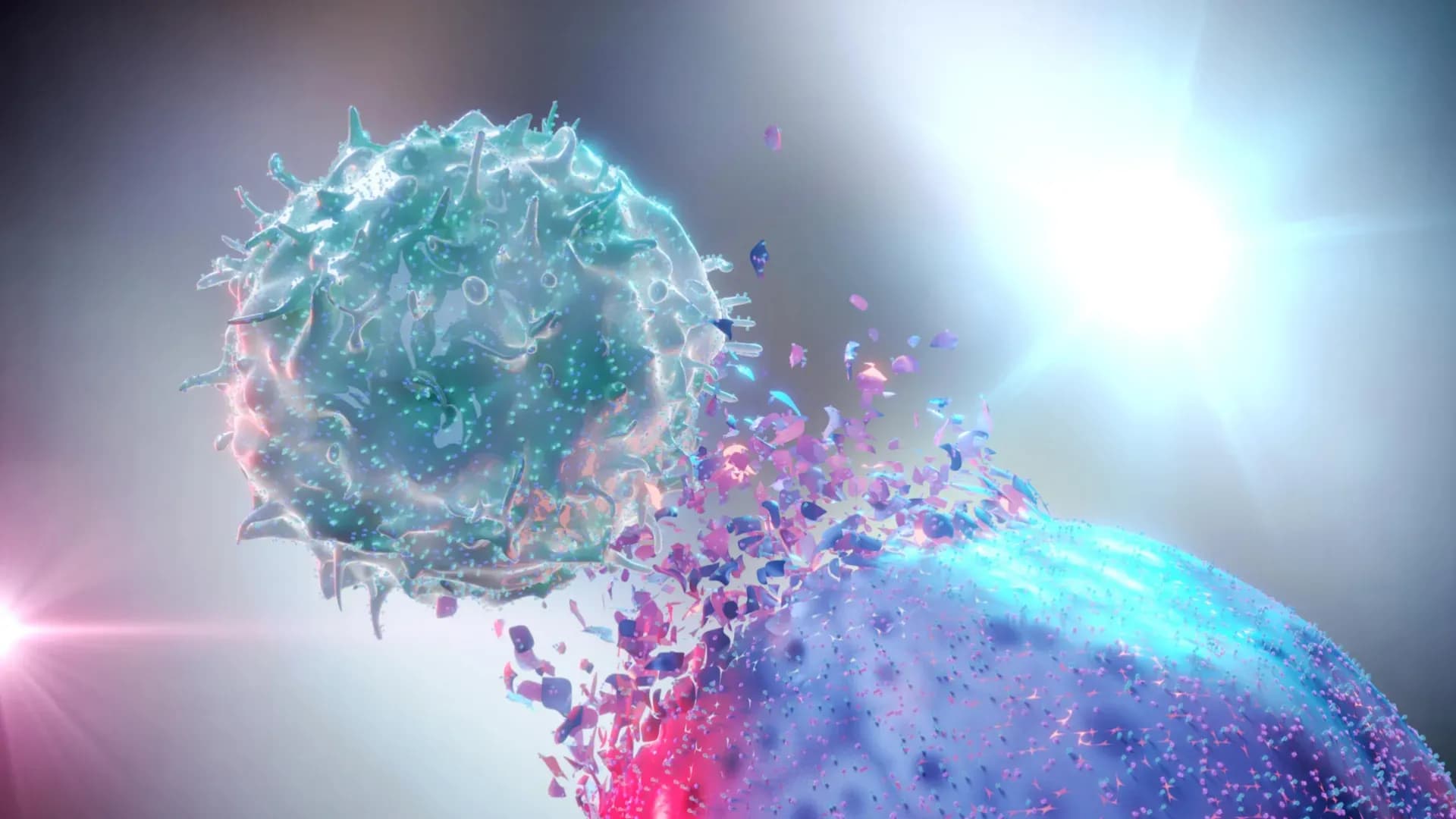
Supercharged Immune Cells Could Revolutionize How We Fight Cancer
Brazilian scientists have engineered more powerful NK immune cells using advanced CAR designs and a novel drug strategy, achieving stronger tumor destruction in preclinical models.
Supercharged Immune Cells Could Revolutionize How We Fight Cancer
A team of Brazilian researchers has taken a significant step forward in cancer immunotherapy, developing a method to make immune cells more potent and precise in their ability to destroy tumors. Their findings, published in Frontiers in Immunology, could lay the groundwork for a new generation of more effective and controllable cancer treatments.
Engineering Smarter Cancer-Killing Cells
Scientists at the Ribeirão Preto Blood Center and the Center for Cell-Based Therapy (CTC) focused their efforts on natural killer (NK) cells — immune cells that the body naturally deploys against threats like cancer. Using the NK-92 cell line, the researchers designed and tested new versions of chimeric antigen receptors (CARs), which are engineered proteins that direct immune cells to recognize and attack specific targets.
What set this study apart was the inclusion of particular signaling components — specifically 2B4 and DAP12 — within the CAR structure. These costimulatory domains function like internal switches, priming the cells for action. The result was a dramatically heightened state of readiness, enabling the engineered NK cells to identify and eliminate tumor cells far more effectively than standard approaches.
A Drug-Based Strategy That Boosts Performance
Perhaps the most surprising discovery came from an unconventional technique the team employed to further refine cell performance. The researchers introduced dasatinib, a pharmaceutical compound capable of temporarily dampening cell activity, as a pre-treatment step before deploying the CAR-NK cells.
Rather than weakening the cells long-term, this brief suppression appeared to enhance their performance once reactivated. The combination of optimized signaling pathways and reversible pharmacological control produced cells that were both stronger and more efficient — a finding that opens exciting possibilities for designing therapies with greater precision and adaptability.
Promising Results in Animal Models
The approach was put to the test in preclinical animal experiments, where the outcomes were encouraging. CAR-NK cells engineered with the 2B4-DAP12 signaling combination and pretreated with dasatinib demonstrated superior tumor control compared to conventional CAR-NK cell therapies. These results suggest the strategy could translate into meaningful clinical benefits, though further research and human trials will be needed to confirm this potential.
The Bigger Picture for Cancer Immunotherapy
CAR-based therapies have already reshaped the landscape of cancer treatment, particularly for hematological malignancies. While CAR-T cell therapy has received considerable scientific attention, CAR-NK cells represent a compelling alternative that researchers are still working to fully optimize. Unlike CAR-T cells, NK cells may offer certain safety and manufacturing advantages, making them an attractive focus for next-generation immunotherapy development.
This study helps address a critical knowledge gap — namely, which internal signaling mechanisms allow NK cells to operate at peak capacity. By pinpointing 2B4 and DAP12 as key activators, the team has provided a valuable blueprint for future CAR-NK cell design.
Institutional Backing and Collaboration
The Center for Cell-Based Therapy (CTC) operates as part of the Research, Innovation, and Dissemination Centers (RIDCs) network, supported by FAPESP. It is housed within the Ribeirão Preto Blood Center and maintains an affiliation with the Hospital das Clínicas at the Ribeirão Preto Medical School of the University of São Paulo (FMRP-USP).
Together, these institutional resources and collaborative expertise position the research team well for advancing this work toward clinical application. Their findings collectively point toward a more powerful, flexible class of CAR-NK therapies that could one day offer patients a safer and more effective path to cancer remission.