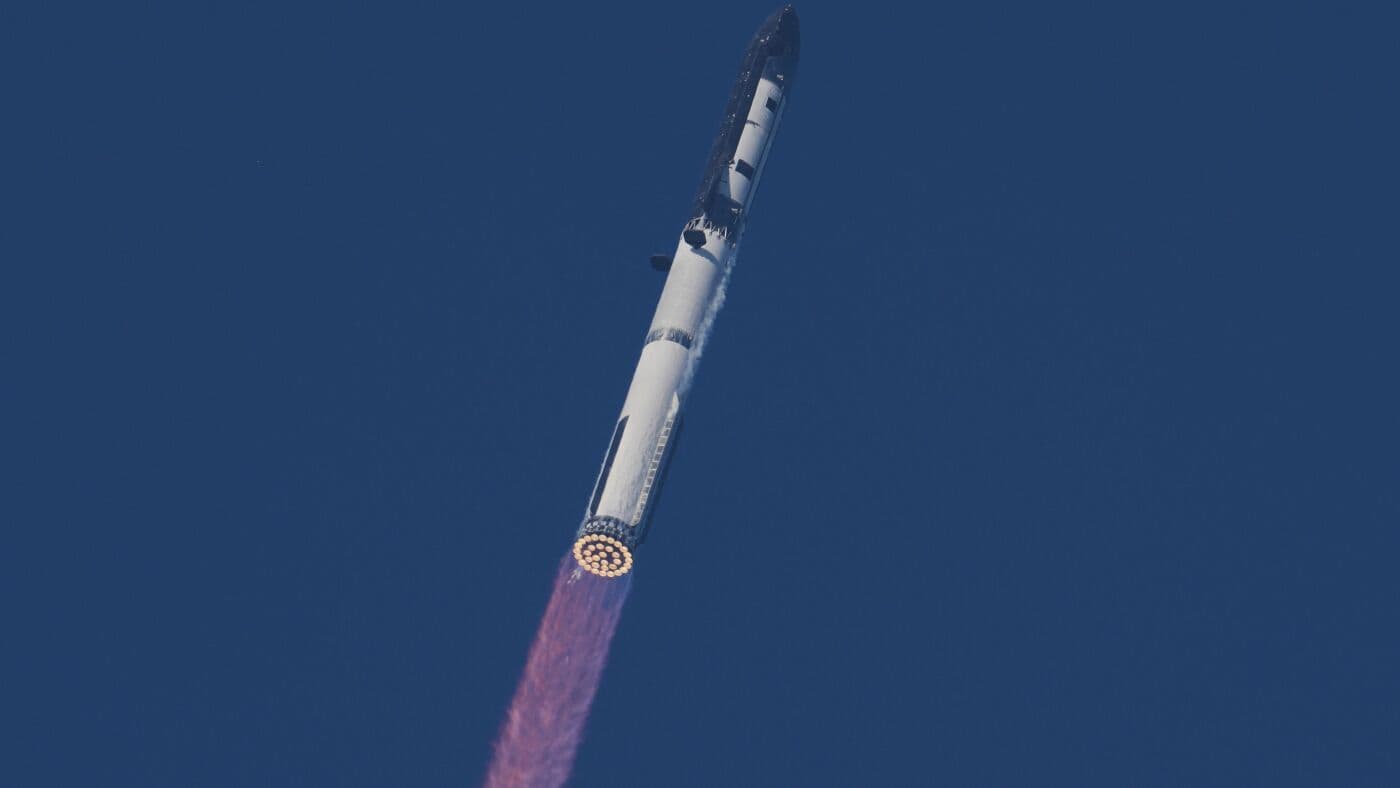
SpaceX's Most Powerful Starship Ever Completes Historic Test Flight, Bringing Moon Landing Closer
SpaceX launched its upgraded Starship V3 rocket on a landmark test flight, releasing mock Starlink satellites and reaching the Indian Ocean despite minor engine issues.
SpaceX Sends Its Most Advanced Starship on a Groundbreaking Test Flight
SpaceX has successfully launched the most powerful and technologically advanced version of its Starship rocket to date, marking a significant milestone in humanity's journey toward returning astronauts to the Moon — and eventually reaching Mars. The test flight took place on Friday, May 22, 2026, lifting off from Starbase near the southern tip of Texas.
A New Generation of Starship Takes Flight
Dubbed the third-generation Starship, or V3, this upgraded behemoth stands 407 feet (124 meters) tall — surpassing its predecessors by several feet — and delivers substantially greater engine thrust than any previous iteration. The rocket thundered off a brand-new launch pad at Starbase, situated near the Texas-Mexico border, after a last-minute technical issue scrubbed an earlier Thursday evening attempt.
This marked the 12th overall test flight of the Starship program, and the first for the redesigned V3 configuration. The debut came just two days after SpaceX CEO Elon Musk announced plans to take the company public, adding another layer of significance to an already high-profile event.
What Happened During the Flight
The spacecraft carried 20 simulated Starlink satellites, which were successfully deployed midway through the roughly one-hour flight. Two specially modified Starlink units, equipped with cameras, were among those released, capturing rare in-flight footage of Starship from an external vantage point — a remarkable first for the program.
Despite some engine irregularities during the booster's controlled return sequence and a reduced engine count on the spacecraft itself, Starship continued on its eastward trajectory approximately 120 miles (194 kilometers) above Earth. The vehicle ultimately reached its intended endpoint over the Indian Ocean, where it descended in an upright, seemingly controlled manner before tipping over and bursting into flames on impact.
SpaceX had anticipated this outcome. The first-stage booster, meanwhile, concluded its journey in the Gulf of Mexico. Neither stage was recovered on this test run, as the primary objective was to evaluate the upgraded hardware in real flight conditions.
Elon Musk praised the mission enthusiastically, writing on X: "You scored a goal for humanity," and calling it "an epic" launch and landing.
NASA Takes Notice
NASA Administrator Jared Isaacman attended the launch in person, affirming that Starship is now measurably closer to fulfilling its role in the agency's Artemis lunar program. NASA is investing billions of dollars in SpaceX — and separately in Jeff Bezos' Blue Origin — to develop the lunar landers that will carry Artemis astronauts to the Moon's surface.
Blue Origin's competing vehicle, the Blue Moon lander, has yet to fly, though a prototype is reportedly being prepared for a test mission later this year.
What's Next for Artemis and the Moon
Following April's successful lunar flyby involving four astronauts, NASA is planning an orbital docking rehearsal around Earth in the coming year. During this Artemis III mission, crew members will practice linking their Orion capsule with either Starship, Blue Moon, or potentially both vehicles.
Artemis IV — which would place two astronauts on the lunar surface — is tentatively scheduled for as early as 2028. It would be the first crewed Moon landing since Apollo 17 in December 1972. NASA's long-term vision centers on establishing a permanent base near the Moon's south pole, operated by both astronauts and robotic systems.
Technical Upgrades That Set V3 Apart
The redesigned Starship V3 boasts a suite of meaningful improvements over earlier models:
- Larger, more robust grid fins on the booster for improved steering during atmospheric reentry
- A significantly expanded fuel transfer line — comparable in diameter to SpaceX's entire Falcon 9 first-stage booster — to efficiently supply the 33 main engines
- Enhanced onboard cameras, navigation systems, and computing power
- Docking cones designed for future orbital rendezvous and lunar surface missions
Starship is engineered to be fully reusable, with large mechanical catching arms positioned at launch pads to retrieve returning rocket stages. Those recovery systems were not deployed during this particular flight.
Private Passengers Already Booking Moon and Mars Trips
SpaceX has opened reservations for private Starship missions to both the Moon and Mars. The world's first space tourist, California entrepreneur Dennis Tito, and his wife booked a lunar flyby aboard Starship three and a half years ago, though a firm launch date has not been confirmed.
This week, Chinese-born bitcoin investor Chun Wang announced he has secured a seat on Starship's inaugural interplanetary mission to Mars. Wang previously made history by leading a SpaceX Dragon crew on the first polar orbital flight, circling above both the north and south poles. No pricing or departure timeline has been disclosed for the Mars voyage.
With each successive test flight, SpaceX inches closer to transforming Starship from an ambitious prototype into the workhorse of a new era of human space exploration.