Space-Based Data Centers: The Next Frontier for Big Tech's AI Ambitions
Tech giants are racing to put data centers into orbit. But while solar power is free in space, the engineering and financial hurdles are anything but.
The Sky Is No Longer the Limit — It's the Destination
For decades, data centers have been firmly rooted on Earth. Now, some of the biggest names in technology are looking upward — literally — as the race to power artificial intelligence pushes companies to explore orbital computing as a serious alternative to ground-based infrastructure.
The idea sounds like science fiction, but it is quickly becoming a focal point of real investment, engineering research, and corporate strategy.
Elon Musk's Vision: AI Satellites in Orbit
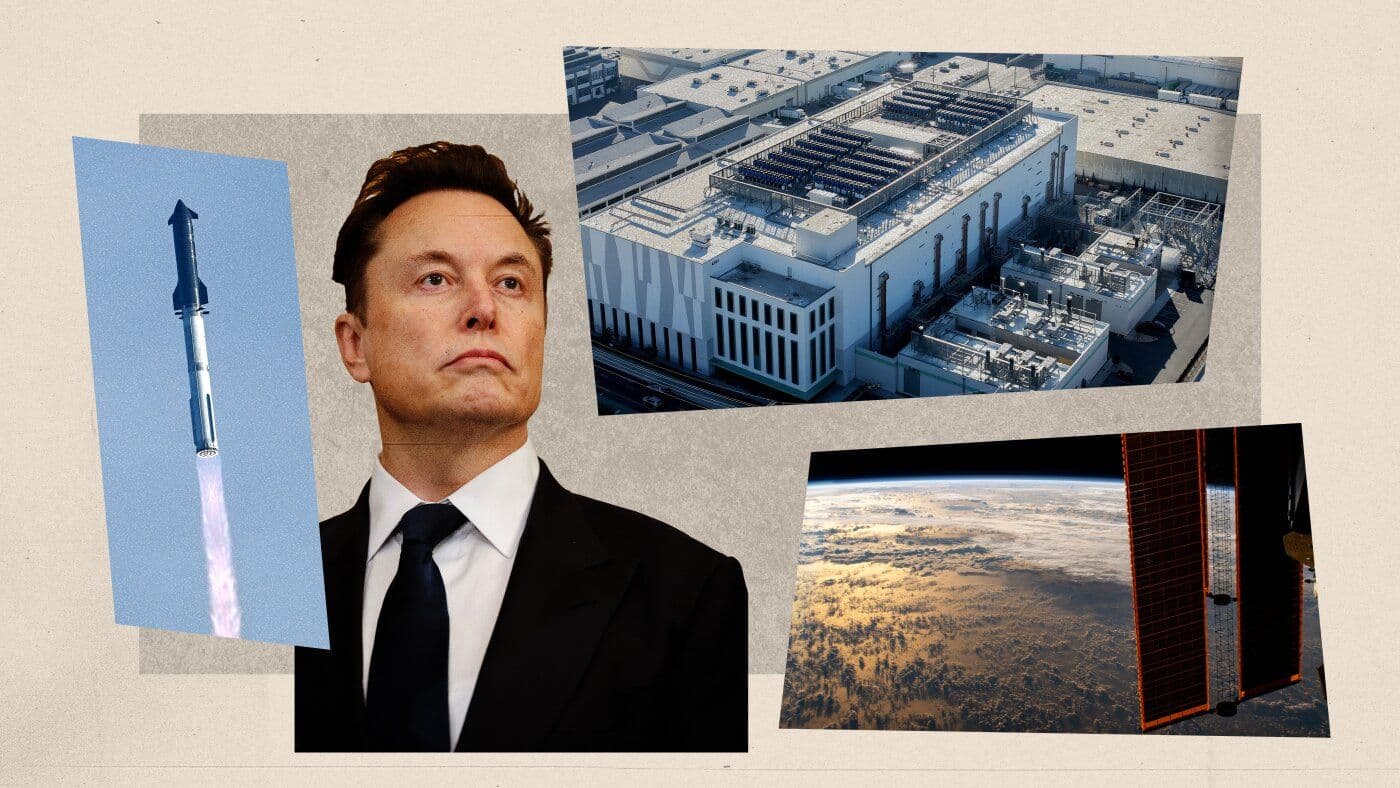
Earlier this year, Elon Musk stood before an enthusiastic audience and unveiled one of his most ambitious plans yet. His space-launch company, SpaceX — which has recently merged with his AI venture, xAI — intends to deploy data centers directly into Earth's orbit.
The driving argument is electricity. "You're power constrained on Earth," Musk explained. "Space has the advantage that it's always sunny."
His concept involves vast networks of computing satellites encircling the planet, feeding the insatiable energy demands of the AI industry from above. The pitch also carries financial motivation: SpaceX reportedly filed confidential documents with the Securities and Exchange Commission this week, signaling plans for an initial public offering as early as this summer.
Musk went further, claiming that deploying AI infrastructure in space could become cheaper than doing so on Earth within just two to three years. That prediction, however, has drawn considerable skepticism from the scientific community.
Why Earth-Based Data Centers Are Struggling
The urgency behind these proposals stems from a very real crisis unfolding on the ground. Artificial intelligence is consuming electricity at an unprecedented rate. According to the International Energy Agency, global data center power consumption is projected to nearly double — approaching 1,000 terawatt-hours — before the decade is out.
Some companies are responding by constructing dedicated gas turbines, while others are turning to nuclear energy to keep up with demand. Yet even these measures may not be sufficient. Philip Johnston, CEO and co-founder of Starcloud — a startup actively working to build orbital data centers — paints a stark picture of what lies ahead.
"We're very quickly running up on constraints on where you can build new energy projects terrestrially," Johnston warned. "Within six months, they'll just be leaving chips in warehouses because they don't have power for turning them on."
Early Movers: Starcloud and Google's Suncatcher Project
Starcloud is already putting its vision into practice. The company launched its first spacecraft last autumn, carrying an Nvidia H100 chip. It successfully demonstrated the ability to run a version of Google's Gemini AI model from space and has a second satellite scheduled for launch in October, boasting 100 times the power generation of its predecessor — though still producing only around 8 kilowatts.
Google is pursuing a parallel path through a project called Suncatcher, developed in partnership with satellite-imagery firm Planet. The initiative envisions a cluster of 81 satellites, with two prototype units set to launch in early 2027.
"Orbital data centers are an idea whose time has come," said Will Marshall, Planet's CEO. "When exactly it will be more cost efficient than terrestrial ones is debatable, but now is the time to be working on this."
The Engineering Challenges Are Enormous
Power: More Than the ISS Can Handle
While sunlight is freely available in orbit, converting it into usable power at the scale required for AI computing is a monumental challenge. For context, the International Space Station — the largest power-generating structure currently in space — features solar panels covering roughly half the size of a football field and produces approximately 100 kilowatts of average power.
Olivier de Weck, a professor of astronautics at MIT, notes that this is roughly equivalent to the output of a single large car engine. Replicating a 100-megawatt Earth-based data center in orbit would require a facility 500 to 1,000 times larger, depending on altitude.
"Is that feasible? Yeah, I think it's feasible, but not next year and certainly not in three years," de Weck said.
Cooling: The Vacuum Problem
Heat management presents another critical obstacle. On Earth, data centers use air cooling and liquid systems to keep microchips from overheating. In space, however, the vacuum environment means there is no medium through which heat can naturally escape.
"All of that heat that the computer generates has to be dispelled," said Rebekah Reed, a former NASA official now affiliated with Harvard University's Belfer Center for Science and International Affairs.
The most practical solution involves large radiator panels that circulate liquid and release heat into space. This means an AI satellite would need not only expansive solar arrays but also substantial radiator systems — both of which add significant size and weight to any spacecraft.
Latency and Data Transfer
Building smaller satellites arranged in coordinated constellations could help distribute the power and cooling burden. However, this approach introduces another problem: the satellites must exchange enormous volumes of data at high speed. Even with laser-based communication links operating at the speed of light, the distances involved introduce latency that can slow computing performance.
Google's Suncatcher project addresses this by grouping satellites into extremely tight clusters to minimize communication delays. Musk, on the other hand, has proposed launching more than one million satellites into polar orbits. His recently unveiled first-generation "AI Sat Mini" spacecraft features solar arrays stretching approximately 180 meters — or around 600 feet — in width.
The Cost Equation: Launch Economics Are the Bottleneck
Even if the engineering problems were solved tomorrow, getting all of this hardware into space remains prohibitively expensive. Current launch costs sit at roughly $1,000 per kilogram. Google has stated that this figure must fall to at least $200 per kilogram — a fivefold reduction — before orbital data centers can be economically viable.
Musk believes SpaceX's next-generation Starship rocket, still under development, can achieve that cost reduction. Starcloud's Johnston agrees that Starship is central to the entire orbital data center concept, telling potential investors plainly: "If you don't think Starship's going to work, don't invest in us — that's totally fine."
Maintenance: The Human Factor
Beyond power, cooling, and launch costs, there is yet another challenge that is easy to overlook: data centers are not simply passive structures filled with quietly humming hardware.
Raul Martynek, CEO of DataBank — a company that manages 75 data centers across the United States — emphasizes that these facilities demand continuous maintenance, hardware upgrades, and hands-on human oversight. Replicating that level of operational support in the unforgiving environment of outer space raises questions that the industry has yet to fully answer.
A Bold Bet With a Long Horizon
The concept of space-based data centers sits at the intersection of genuine technological necessity and extraordinary ambition. The pressure on Earth's energy grid is real, and the demand from AI systems shows no sign of easing. Whether orbital infrastructure can serve as a meaningful solution — or remains a compelling but distant dream — will depend on breakthroughs in launch technology, satellite engineering, and cost reduction that are still years away.
Brandon Lucia, a professor of electrical and computer engineering at Carnegie Mellon University who specializes in satellite computing, captures the prevailing sentiment among experts: Musk's two-to-three-year timeline represents, at best, "an optimistic interpretation" of what is technically and economically possible.
For now, the stars may be the goal — but the road to get there is longer and more complicated than any rocket trajectory suggests.
