Southeast Asia's Overfishing Crisis: How Depleted Seas Are Devastating Ecosystems and Coastal Communities
Southeast Asia supplies over half the world's fish, yet its waters are among the most stripped bare. Here's the human and ecological toll of unchecked overfishing.

A Crisis Hidden Beneath the Waves
Southeast Asia sits at the center of one of the most severe and least discussed environmental emergencies on the planet. The region produces more than half of the world's fish supply, yet its waters are simultaneously among the most exhausted and most fiercely contested on Earth. What unfolds beneath the surface — and along the docks, fishing boats, and coastal villages — is a story of ecological collapse intertwined with profound human suffering.
Vanishing Fish Stocks and the Scale of Depletion
Since the 1950s, fish populations across Southeast Asian waters have been decimated at an alarming rate. The Center for Strategic and International Studies estimates that between 70% and 95% of regional fish stocks have been depleted and now face the risk of total collapse. Industrial-scale fishing operations — many of which operate illegally — have driven much of this decline, compounded by legal overfishing that continues unchecked due to weak regulatory frameworks, inadequate monitoring infrastructure, and relentless global demand.
According to the United Nations, roughly half of the world's entire marine fish catch originates from the seas of Southeast Asia. In the United States alone, approximately 50% of imported seafood comes from Asia, with nearly $6.3 billion in trade flowing from China, Vietnam, Indonesia, and India, according to the National Oceanic and Atmospheric Administration. The appetite for affordable seafood in wealthy nations carries consequences that ripple back to some of the world's most vulnerable communities.
The Human Cost: Labor Abuse and Sea Slavery
Behind the global seafood supply chain lies an opaque and often brutal world. Organizations like the international Freedom Fund and Thailand's Labour Protection Network have documented widespread human rights abuses aboard fishing vessels across the region. Workers — many of them migrants from impoverished backgrounds — are routinely subjected to violence, trapped in cycles of debt bondage, and in the most extreme cases, murdered at sea.
One Indonesian crewmember, Akbar Fitrian, 29, recounted a harrowing experience aboard a Chinese-owned fishing vessel in 2022. A dispute over the day's catch turned violent when his captain pushed a fellow crewmember overboard. "The ship then started to drive away as my crewmate tried to swim towards us," Fitrian recalled. "The captain never reported the incident."
The lawless nature of open waters has emboldened traffickers to exploit desperate fishermen and impoverished laborers with near impunity. The intersection of criminal networks, corrupt oversight, and desperate poverty has allowed sea slavery to persist as a troubling norm across the region.
Geopolitics at Sea: Militarized Fishing Fleets
The crisis is further complicated by escalating geopolitical tensions. In a drive to assert dominance over some of the most resource-rich waters in the world, China — and to a lesser degree Vietnam, the Philippines, Taiwan, and Malaysia — have constructed outposts and military installations on shoals, reefs, and atolls throughout the South China Sea. China operates the world's largest fishing fleet, and these vessels are increasingly taking on a quasi-military character.
Filipino fisherman Donald Carmen experienced this reality firsthand. The first time Chinese vessels harassed him off the coast of Palawan was in December 2024. By the following February, they had returned — close enough to strike his boat's outriggers. "They forced us to move away and recorded us with cell phones and cameras," Carmen said. "I have been fishing in this area since 2016, and back then, everyone was free to fish. I would catch 400 to 500 kilograms of fish in a night, about 60 nautical miles offshore. Now, because I don't dare venture out as far, I'm lucky if I catch 200 to 300 kilograms over three days."
Another Filipino fisherman, Vincent Gehisan, 36, was detained for nearly a full day by Chinese Coast Guard and navy ships during a resupply mission. He now says fear prevents him from venturing far from Philippine shores.
Three Nations at the Epicenter
Thailand: Indigenous Communities and Industry Rollbacks
On the island of Koh Lipe, the Urak Lawoi people — an Indigenous seafaring community with deep ancestral ties to these waters — have watched their way of life erode over decades. Mimit Hantele, 53, a tribal member, remembers when fish were plentiful. "But now, the fishing season is a lot shorter, the variety of fish is far fewer, and I sell less," he said. To compensate, Hantele now takes tourists out on scuba diving expeditions. "Fishing is in our blood," he acknowledged, "but our way of life has changed. We can't rely only on the fish."
The shift began in the 1970s when large Thai and Malaysian commercial fishing vessels began operating in the area — often at night to evade detection and frequently within protected marine zones. These ships deploy purse seiner nets and demersal trawlers, which devastate coral reef ecosystems and eliminate the habitats that sustain fish populations.
In recent years, the situation has been aggravated by political decisions at the highest levels. Last year, artisanal fishermen staged protests after the Thai government moved to roll back key fisheries reforms that had been implemented a decade earlier and had shown measurable success in rebuilding fish stocks. Thai corporations with significant stakes in commercial fishing operations had lobbied heavily for deregulation to boost profits. Protesters warned that loosening regulations would resurrect illegal, unreported, and unregulated fishing, erode transparency, and ultimately destroy the livelihoods of small-scale fishers who depend on the sea for their survival.
Indonesia: The Shark Trade and Endangered Species
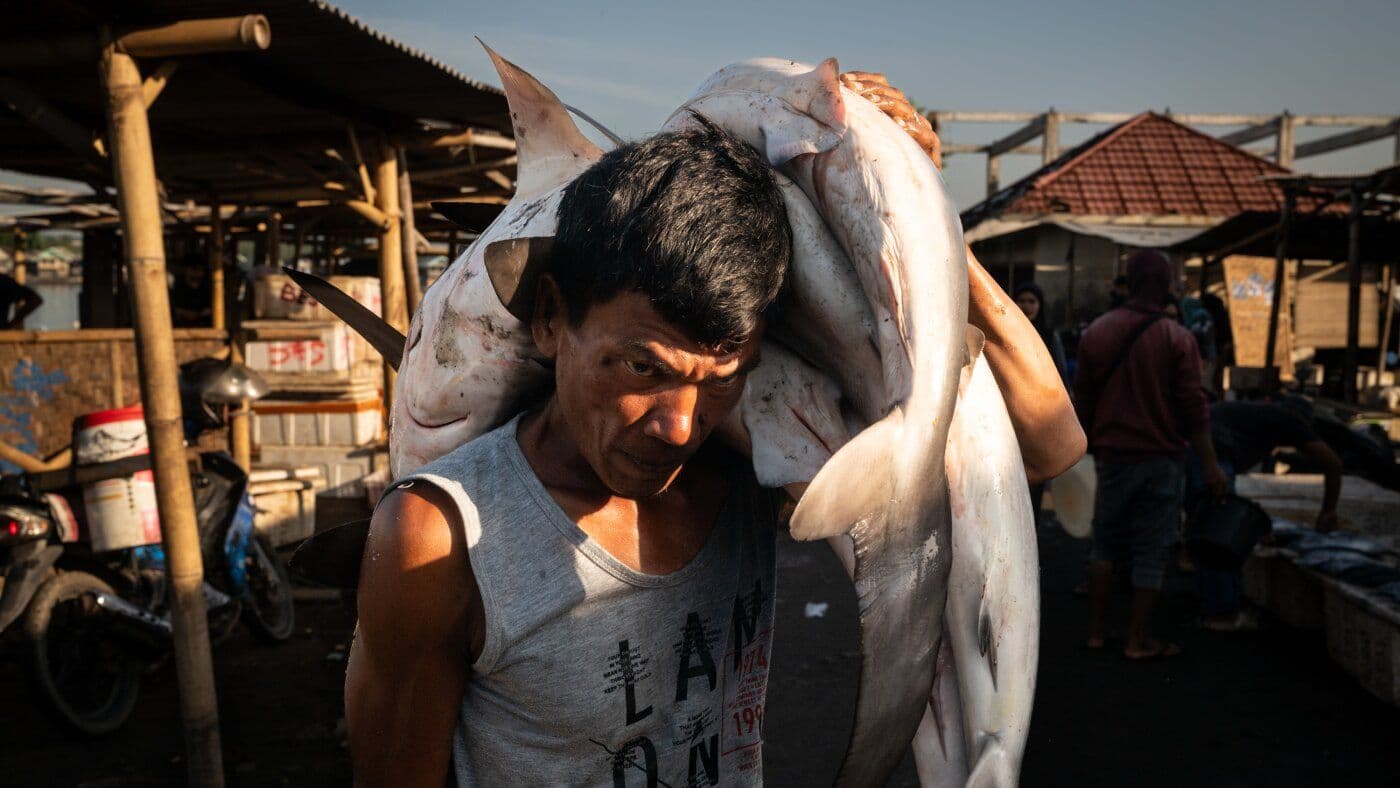
At the Tanjung Luar port in East Lombok, Indonesia — one of the largest shark markets in all of Southeast Asia — endangered and vulnerable shark species are hauled ashore at dawn on a regular basis. Shark fins are exported primarily to Hong Kong and China, while shark bones are processed into cosmetic products also destined for Chinese markets. This trade continues despite international protections for many of the species involved.
Indonesia's waters are a microcosm of the broader regional crisis: rich in biodiversity yet under siege from industrial exploitation, weak enforcement, and the lucrative black market for marine wildlife.
The Philippines: Shrinking Catches and Chinese Intimidation
In the Philippines, the twin pressures of depleted fish stocks and aggressive harassment by Chinese maritime forces have dramatically reduced the incomes of coastal fishing families. Many fishermen in Palawan report losing more than half their earnings as they are effectively pushed away from their traditional fishing grounds by Chinese ships and militia vessels.
The broader South China Sea dispute has transformed fishing from a matter of sustenance and livelihood into a front line of geopolitical conflict, with ordinary Filipino fishermen caught in the crossfire.
Destructive Practices and Their Irreversible Consequences
Across the region, several specific practices have proven catastrophic for marine ecosystems. Demersal trawling scrapes the ocean floor, destroying coral and seabed habitats. Cyanide fishing poisons entire reef systems. The capture of juvenile fish prevents populations from replenishing naturally. Ghost nets — fishing gear lost or abandoned at sea — continue to ensnare and kill marine animals long after they have been discarded.
A hawksbill turtle rescued off the coast of Thailand illustrates the collateral damage. Found tangled in ghost nets by local fishermen, the animal suffered severe injuries to both front flippers. Veterinarians at Thailand's Department of Marine and Coastal Resources worked to rehabilitate it — a small mercy against an enormous tide of destruction.
The dried seahorse trade presents another troubling example. Thailand, the Philippines, Vietnam, and India rank among the world's largest exporters of dried seahorses, which are used in traditional medicine markets. As trade volumes have surged, seahorse populations have declined sharply. Seahorses are listed under the Convention on International Trade in Endangered Species of Wild Fauna and Flora, yet enforcement remains deeply inconsistent.
Small-Scale Fishers: The Greatest Victims
According to a 2001 United Nations report, approximately 80% of fishers in Southeast Asia at the time were small-scale or artisanal, relying on traditional, low-impact methods. Decades later, nearshore fish stocks have declined so severely that many of these fishers are now forced to venture farther offshore in pursuit of commercially viable catches — increasing both their costs and their risks.
Government fuel subsidies and tax incentives for large commercial fishing vessels have further skewed the playing field, enabling industrial fleets to operate with competitive advantages that small-scale fishers cannot match. Meanwhile, advances in maritime technology — including GPS-guided fish-finding equipment and the deliberate disabling of vessel monitoring systems to avoid detection — have made industrial fleets increasingly effective and increasingly difficult to hold accountable.
A Path Forward?
The scale of the crisis demands urgent and coordinated action across governments, international bodies, the private sector, and consumer markets worldwide. Stronger enforcement of existing regulations, greater transparency in seafood supply chains, meaningful protections for fishing workers, and robust monitoring of vessel activity at sea are all essential steps.
For the coastal communities — the Urak Lawoi of Thailand, the fishermen of Palawan, the dock workers of Ranong — the stakes could not be higher. Their cultures, their economies, and their very identities are bound to seas that are rapidly running out of fish. The window to reverse course is narrowing, and the cost of inaction will be measured not only in ecological loss, but in generations of human lives upended.