She paid into Medicare for years. Trump's immigration policy will end her coverage
A provision in the GOP's One Big Beautiful Bill Act will make Rosa María Carranza and an estimated 100,000 other lawfully present immigrant seniors ineligible. Her once secure retirement is in qu

A provision in the GOP's One Big Beautiful Bill Act will make Rosa María Carranza and an estimated 100,000 other lawfully present immigrant seniors ineligible. Her once secure retirement is in question.
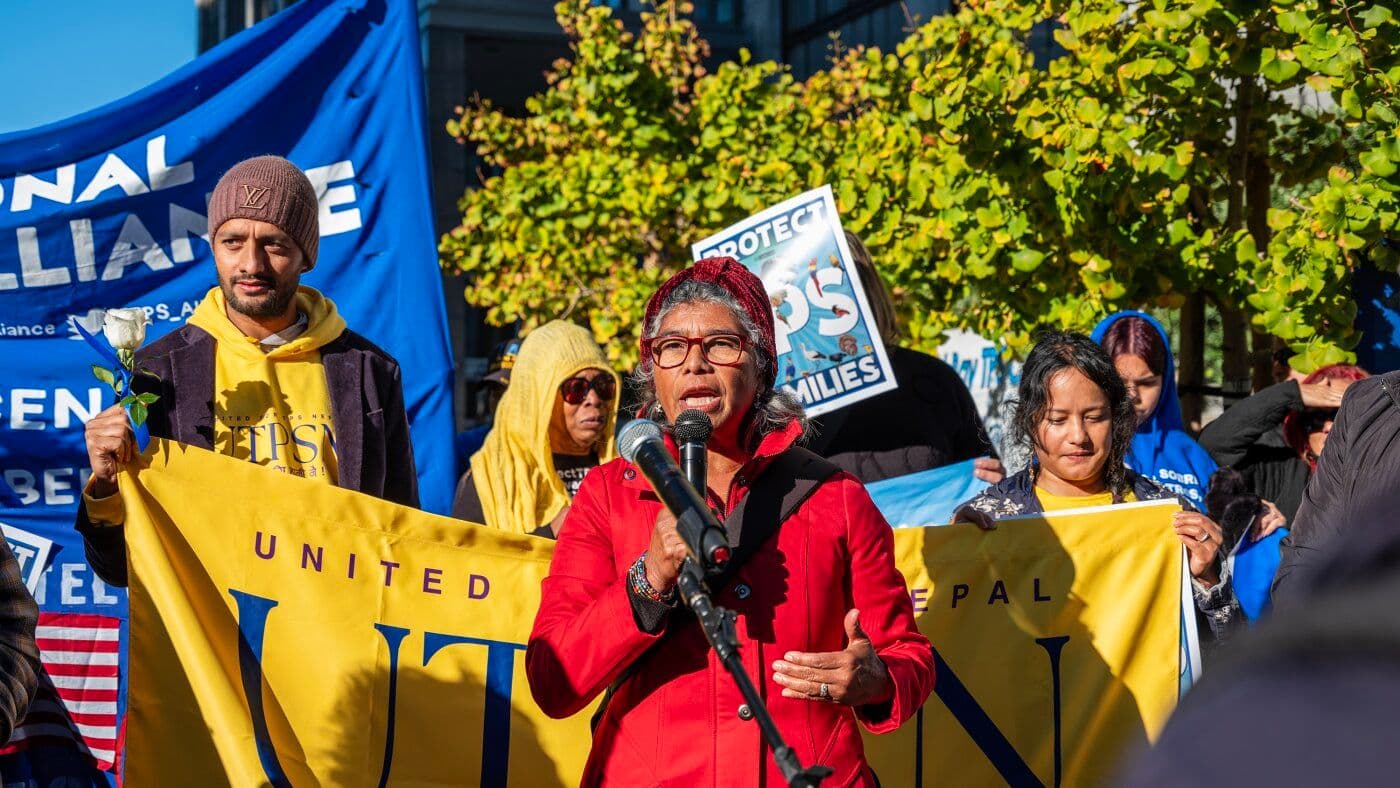
Rosa María Carranza attends a protest supporting the temporary protected status program outside the Phillip Burton Federal Building and U.S. Courthouse in San Francisco on Nov. 18, 2025. Carranza, a resident of neighboring Oakland, worries she could lose her legal status and risk indefinite detention or deportation. Hiram Alejandro Durán/El Tímpano hide caption
OAKLAND, Calif. — Rosa María Carranza leaned forward to hold a 3-year-old's back as the girl climbed a rock in the forested hills of northeast Oakland.
Dressed in hiking gear and beaded necklaces, Carranza, 67, maneuvered between trees and children on a sunny morning in December. "Hold onto that branch," she said in Spanish. "You can do it, my love!"
Carranza, a child development professional who grew up swinging through trees and swimming in rivers in El Salvador, said she feels at home in the forest at the outdoor preschool she co-founded. She has worked with children and teens as a caregiver and educator for more than three decades, long enough to know when to lean in and when to step back to let her students find their own footing.
This article was produced in collaboration with El Tímpano .
When she transitioned to working part time last year, Carranza counted on getting Medicare and Social Security checks — benefits given to American workers and lawfully present immigrants when they retire, if they meet work history and age or disability requirements.
Law Supreme Court to hear expedited arguments on protected status for migrants She's contributed tens of thousands of dollars into Medicare and Social Security over 24 years, according to her Social Security Administration earnings record, reviewed by El Tímpano and KFF Health News . But Carranza and an estimated 100,000 other lawfully present immigrants will soon be cut out of Medicare.
Rosa María Carranza encourages a toddler to navigate uneven ground at Joaquin Miller Park in Oakland, Calif., on Dec. 5, 2025. Carranza will lose Medicare when a federal policy restricting health care coverage for some lawfully present immigrants takes effect next year. Hiram Alejandro Durán/El Tímpano hide caption
The GOP's One Big Beautiful Bill Act, signed last July by President Trump, barred certain categories of lawfully present immigrants — including temporary protected status holders, refugees, asylum-seekers, survivors of domestic violence, trafficking victims and people with work visas — from Medicare.
Those already in the program, like Carranza, will be disenrolled by Jan. 4 — a move by Republican lawmakers to rein in Medicare spending, as they and Trump have argued that taxpayer dollars should not be used to pay for the health care of immigrants in the U.S. without authorization.
"The Democrats want Illegal Aliens, many of them VIOLENT CRIMINALS, to receive FREE Healthcare," Trump posted on Truth Social two months after he signed the bill into law. "We cannot let this happen!"
However, the categories of immigrants now losing coverage do have legal status. Neither the White House nor the Department of Health and Human Services responded to a question about whether it was fair to disenroll legal residents from Medicare.
Immigration Immigrants now have fewer legal options to stay in the U.S. under Trump Undocumented immigrants were already ineligible for Medicare or most other federally funded public benefits.
Carranza is worried that she could also lose legal permission to live in the United States if the Trump administration ends temporary protected status for Salvadorans, as it sought to do during his first term .
If that happened, Carranza would lose legal residency, risking time in an immigration detention center or deportation.
"This is like a horror movie, a complete nightmare," Carranza said. "This is not how I imagined getting old."
Carranza left El Salvador in 1991 during a brutal civil war, leaving behind three young children, to earn money to send home to her family. She overstayed her visa until 2001, when she qualified for temporary protected status, after two earthquakes struck El Salvador, killing more than 1,100 people and displacing 1.3 million.
Temporary protected status, or TPS, was passed by Congress and signed into law by Republican President George H.W. Bush in 1990. It allows people such as Carranza, from select nations undergoing armed conflict, civil war and climate disasters, to live and work in the United States if being in their home country poses a risk.
Health Medicaid can share data with ICE. Here's how that 180-degree change spreads fear Carranza missed her youngest daughter's graduation from kindergarten and first medal-winning performance in track. She worked overnight shifts babysitting newborns and later substitute-taught in public schools in the San Francisco Bay Area to pay for her children's schooling in El Salvador, and for her own classes at City College of San Francisco, where she earned a degree in child development.
And she cared for dozens of 3-, 4-, and 5-year-olds who gazed in awe as they uncovered little treasures buried in the redwood forest of the Oakland park where she co-founded Escuelita del Bosque, a Spanish immersion preschool that teaches children outdoors.
The trade-off was supposed to be a peaceful retirement. But Congress narrowed Medicare eligibility to citizens, lawful permanent residents, Cuban and Haitian nationals, and people covered under the Compacts of Free Association, agreements between the United States and Pacific island nations.
The move followed Trump's efforts to bar some immigrants with legal status from Medicaid, marketplace insurance subsidies and social support services, such as food assistance, housing subsidies and medical visits in federally funded health centers. Altogether, 1.4 million lawfully present immigrants were projected to lose health insurance, according to KFF, a health information nonprofit that includes KFF Health News.
A spokesperson for House Speaker Mike Johnson, Taylor Haulsee, did not respond to requests for comment.
Michael Cannon, director of health policy studies at the Cato Institute, a libertarian think tank, said Republicans wanted to enact tax cuts and eliminate health insurance for immigrants because it wouldn't upset their base.
"They don't want to turn the United States into a welfare magnet," he said. "And they resent the government for making them pay for a welfare state."
Medicare data on lawfully present immigrants is not available. However, undocumented immigrants paid $6.4 billion into Medicare and $25.7 billion into Social Security in 2022, according to the Institute on Taxation and Economic Policy. The Congressional Budget Office estimated that the Medicare restrictions alone would reduce federal spending by $5.1 billion by 2034.
Rosa María Carranza holds hands and sings with toddlers while they walk along a trail in the forested hills of northeast Oakland, Calif., on Dec. 5, 2025. Carranza co-founded Escuelita del Bosque, a Spanish immersion preschool at which children spend much of their day learning and exploring outside. Hiram Alejandro Durán/El Tímpano hide caption
Health experts say eliminating coverage for immigrants with legal status is unprecedented .
"This is actually the first time that Congress has taken away Medicare from any group," said Drishti Pillai, director of immigrant health policy at KFF. "This change is impacting immigrants who have lawful presence in the U.S., and many of whom have already worked and paid into the system for decades."
As older adults like Carranza lose their Medicare coverage, clinicians anticipate that they will delay their care, leading to an increase in severely ill patients, especially in hospital emergency rooms.

