Secret Entrance May Lurk Behind Menkaure Pyramid After Hidden Voids Discovered
Scientists have detected two concealed air-filled cavities behind the eastern face of Egypt's Menkaure pyramid, fueling speculation about a long-suspected secret entrance.
Ancient Mystery Deepens at Egypt's Third-Great Pyramid
Egypt's iconic pyramids continue to guard their secrets carefully — but researchers are getting closer to unlocking them. A team of scientists has identified two previously unknown air-filled cavities concealed behind the eastern face of the Menkaure pyramid at Giza, reigniting theories that a hidden entrance may lie buried beneath one of antiquity's most celebrated monuments.
The discovery was made by researchers from Cairo University and the Technical University of Munich (TUM), operating under the internationally recognized ScanPyramids research initiative. Their findings represent the first concrete structural evidence supporting a hypothesis that has intrigued Egyptologists for years.
A Polished Surface That Never Fit the Pattern
Standing over 60 meters tall, the Menkaure pyramid is the smallest of the three iconic structures at Giza — yet it continues to present some of the most compelling archaeological puzzles. For some time, experts have noted an unusual section along its eastern facade: a stretch of granite blocks, roughly four meters high and six meters wide, bearing a smooth, polished finish that stands out sharply from the surrounding stonework.
This kind of refined surface treatment is otherwise only observed at the pyramid's confirmed entrance on the northern side. The anomaly caught the attention of researcher Stijn van den Hoven, who formally proposed in 2019 that this distinctive patch might mark the location of a second, undiscovered entrance into the structure.
Cutting-Edge Scanning Technology Confirms the Voids
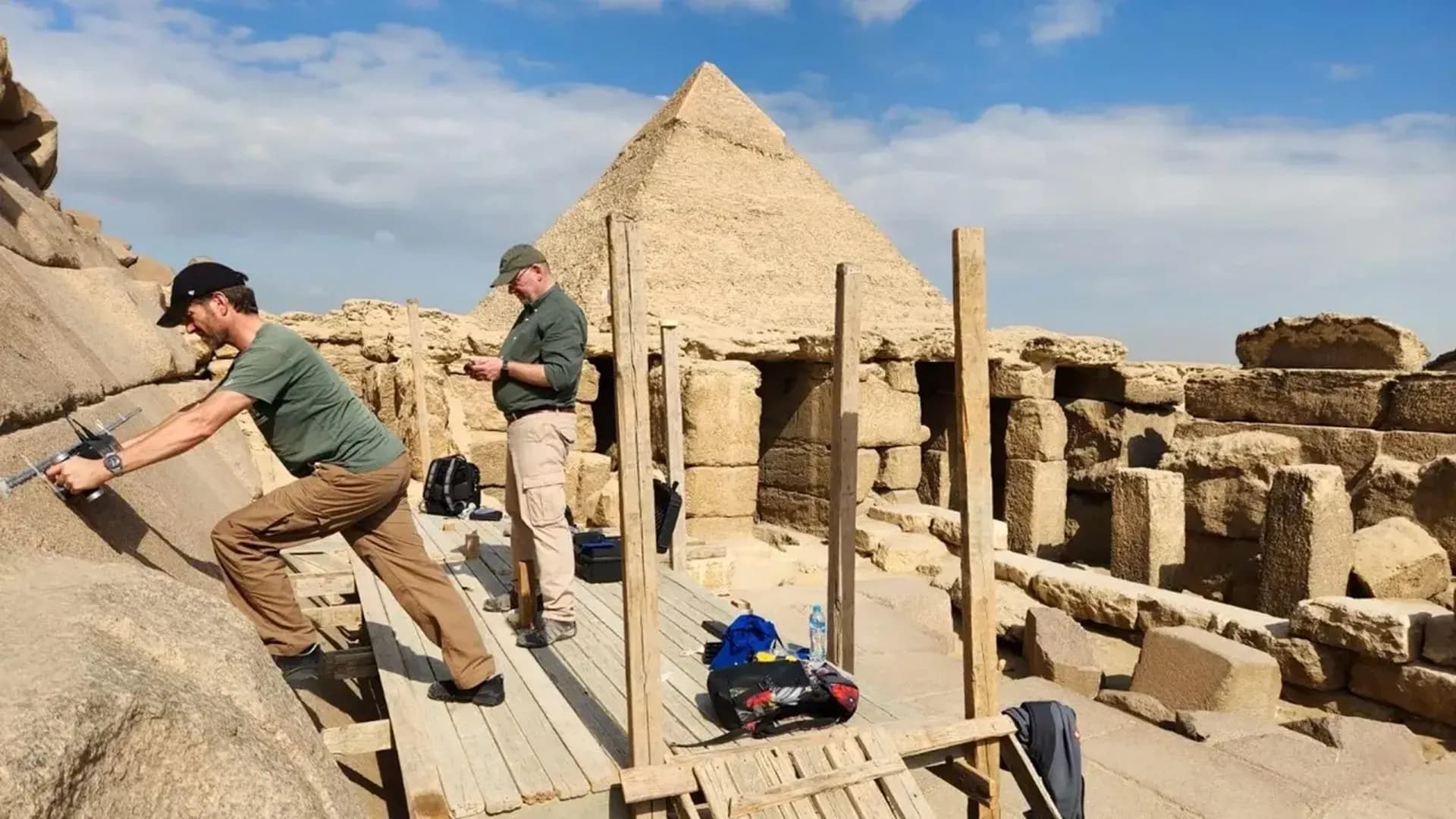
To investigate van den Hoven's hypothesis, the ScanPyramids team deployed a powerful combination of non-invasive scanning technologies, including ground-penetrating radar, ultrasound imaging, and electrical resistivity tomography (ERT). Together, these methods allowed scientists to peer beneath the pyramid's exterior without disturbing a single stone.
The results were striking. Two distinct air-filled voids were detected behind the polished granite section. The first cavity sits approximately 1.4 meters beneath the outer wall surface and measures around one meter in height and 1.5 meters in width. The second void lies at a depth of 1.13 meters and spans roughly 0.9 meters by 0.7 meters.
How Image Fusion Made the Difference
Achieving such precise measurements required more than just individual scans. The team employed an Image Fusion technique, which integrates data collected from all scanning methods into a single, cohesive analysis. This multi-layered approach allowed researchers to not only confirm the existence of the cavities but also determine their dimensions with a high degree of confidence.
First Solid Evidence of Structural Irregularities
This marks the first time that confirmed structural anomalies have been identified behind this specific section of the Menkaure pyramid. While the true nature and purpose of these voids remains unknown, their presence strongly aligns with the theory of a concealed entrance.
Christian Grosse, Professor of Non-destructive Testing at TUM, underscored the significance of the discovery: "Following the significant validation of a hidden corridor in the Pyramid of Cheops in 2023, ScanPyramids has once again succeeded in making an important finding in Giza. The testing methodology we developed allows very precise conclusions to be drawn about the nature of the pyramid's interior without damaging the valuable structure. The hypothesis of another entrance is very plausible, and our results take us a big step closer to confirming it."
What Comes Next
The discovery builds on the ScanPyramids project's growing track record of groundbreaking finds, including the identification of a hidden corridor inside the Great Pyramid of Cheops just two years ago. While further investigation will be needed to determine whether these voids are connected to a passageway or entrance chamber, the findings offer the most compelling evidence yet that the Menkaure pyramid still holds undiscovered architectural secrets.
For now, the eastern facade of one of the ancient world's greatest structures quietly waits — and science is steadily closing in.