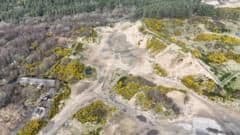
Scotland's Wildlife Gem Being Destroyed While Authorities Delay Protection Decision
Environmental campaigners warn that a rare Ayrshire nature haven is being systematically damaged during a four-year wait for protected status.

Scotland's Ardeer Peninsula: A Nature Haven Under Threat
A remarkable stretch of wildlife-rich coastline in Ayrshire is being stripped of its natural assets while a government agency continues to deliberate over whether to award it formal protection — and conservationists have had enough.
Environmental groups say the Ardeer peninsula, nestled between the towns of Irvine and Stevenston, has been effectively "trashed" during the prolonged wait for a Site of Special Scientific Interest (SSSI) designation. Local campaigners first pushed for that protected status back in 2022, yet development activity has continued unabated across the site ever since.
A Landscape Worth Fighting For
The Ardeer peninsula is no ordinary patch of land. It harbors an extraordinary range of habitats — including sand dunes, open grassland, ancient woodland, and wetlands — alongside more than 1,000 invertebrate species. At least 99 of those species are considered to be of conservation concern, and the site has earned a remarkable reputation among experts as potentially Scotland's finest location for wild bees.
Conservation charity Buglife's Scotland and Northern Ireland manager, Rebecca Lewis, described the peninsula as a nationally significant wildlife site with a vital role to play in reversing Scotland's ongoing biodiversity decline.
"We are delighted that NatureScot agree that it is worthy of consideration for SSSI notification," she said, "but the ongoing activity is a blow to the integrity of this nationally important wildlife site."
Developers Moving In as Decision Drags On
Multiple companies currently hold ownership over different portions of the land. These include brownfield developer NPL Group, explosives manufacturer Chemring Energetics, and several smaller property development firms. The precise nature of each company's activities on the ground remains difficult to untangle, though Chemring has confirmed to BBC Scotland News that any work being conducted is unrelated to land under its ownership.
Chemring also stated that all operations it does carry out are "rigorously regulated" and conducted with prior approval from NatureScot.
Nevertheless, campaigners paint a deeply troubling picture. One anonymous source described the situation as "asset-stripping a nature site," pointing specifically to the removal of sand from the peninsula's dunes — material believed to be sold on to industries such as golf course construction.
"During the past four years the sand dunes have continually been removed and presumably sold off," the source explained. "Hectares of woodland are being chopped down as well, so even though the site is heading towards being protected, the land is being trashed."
Campaigners Speak Out
Roger Hissett of the Ardeer Action Group expressed deep frustration at the pace of events, noting that local naturalists have been campaigning for the site's protection for well over a decade.
"It is tragic to see a developer determined to destroy the special and rare habitats and wildlife of this part of the Ardeer Peninsula," he said. "It is so sad that this attitude still persists into the 21st Century, just when the area is being considered for protection for the benefit of future generations."
Hissett also highlighted the fact that the site currently remains heavily restricted from public access, adding another layer of frustration for the local community.
A Complex Industrial History
The Ardeer peninsula carries a weighty industrial past. The site was once home to Scotland's largest explosives manufacturing facility, operated by the chemical giant ICI, which finally ceased operations in the 1990s. In the decades since, nature has been quietly reclaiming the land.
A brief attempt to repurpose the area for public use came in the form of the Big Idea science centre, which opened approximately 26 years ago on the peninsula. The venue closed within three years and its empty shell remains visible today from Irvine harbour across a broken bridge. The site was also shortlisted at one point as a potential location for a prototype fusion energy plant, before Nottinghamshire was ultimately selected.
Significantly, a special development order dating back to 1953 means that planning permission is not legally required for a range of development activities in the area — a loophole that critics argue has left the site dangerously exposed.
NatureScot Defends Its Approach
Scottish government agency NatureScot has acknowledged that the SSSI decision remains "a priority under consideration" but defended the time being taken, describing Ardeer as "an extremely complex site."
A spokesperson explained: "NatureScot staff have, as far as possible, surveyed the site for suitable habitat and are currently completing work on a proposed boundary based on our experience of the land and expert judgement. We will be discussing this work further with the owners and occupiers of the land and North Ayrshire Council."
The agency added that it hopes to "balance several different interests" across the site, including those of businesses, developers, local community groups, environmental non-governmental organisations, and recreational users.
However, for those watching habitats disappear in real time, patience is wearing thin. As one campaigner put it, NatureScot has "played a role in leaving this open to continued degradation" simply through the length of time it has taken to reach a decision.
What SSSI Status Would Mean
Should the SSSI designation ultimately be granted, the Ardeer peninsula would receive formal legal recognition as a protected area of outstanding biological or geological significance. Scientific research and conservation management would then be able to proceed under a structured framework — but for many of the rare species already lost or displaced, that recognition may come too late.