Scientists Engineer a Material That Transforms Sunlight Into Powerful UV Light
Researchers in Japan have developed a solid-state material capable of converting visible sunlight into UV light, unlocking new possibilities for clean technology and solar-powered applications.
A Quantum Leap in Light Conversion Technology
A team of researchers at Kyushu University in Japan has achieved something that scientists have been chasing for years — a solid-state material capable of converting ordinary visible sunlight into higher-energy ultraviolet (UV) light. The breakthrough, published on June 23 in Nature Communications, could reshape how we approach air purification, advanced manufacturing, and solar-driven chemistry.
To appreciate why this matters, consider a simple analogy: imagine combining two cups of warm water and somehow producing boiling water as a result. That defies everyday physics — but at the quantum level, a comparable process is entirely real. Multiple low-energy light particles can pool their energy to generate a single, far more energetic photon.
What Is Photo Upconversion?
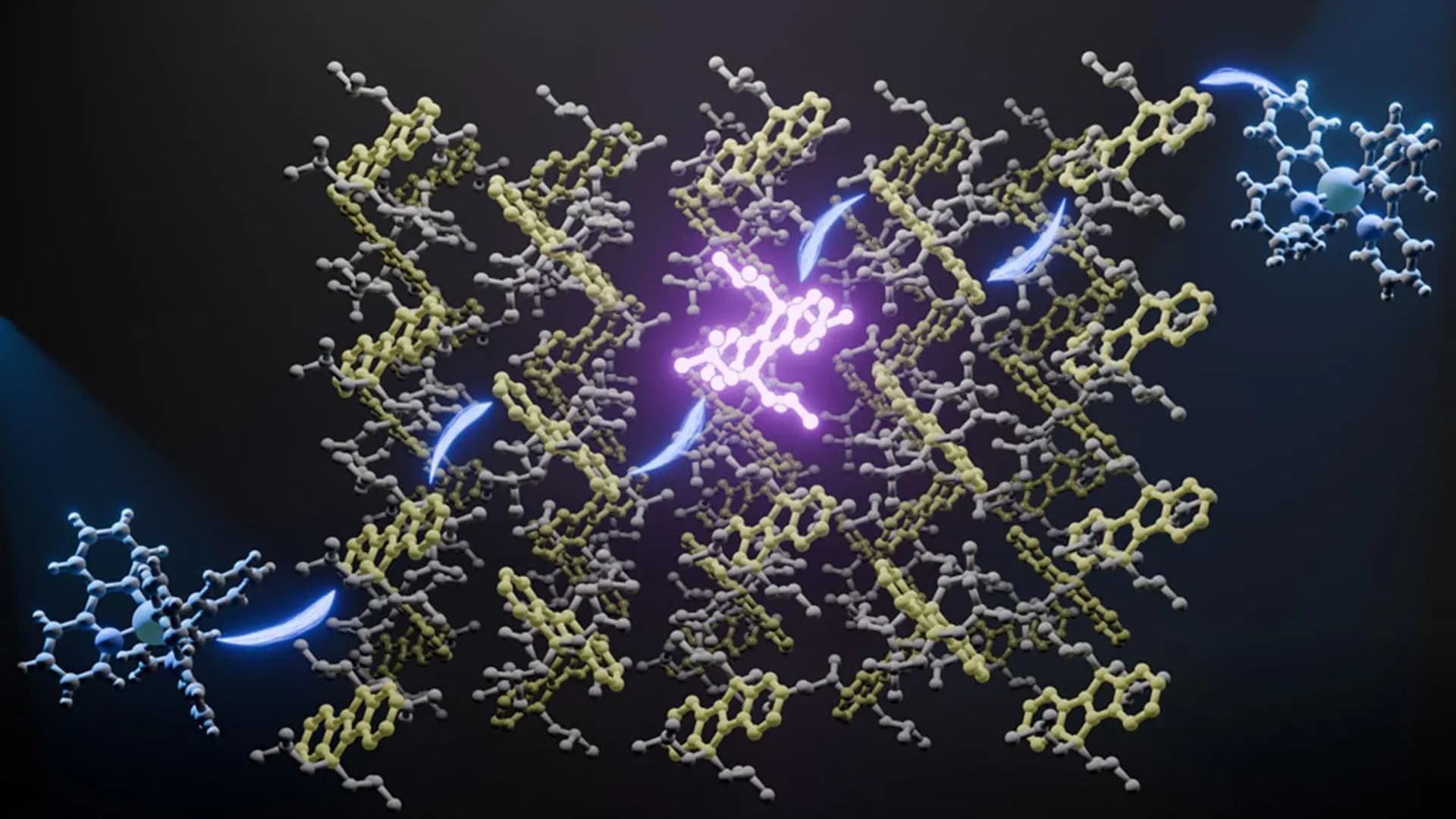
The phenomenon at the heart of this discovery is called photo upconversion, specifically a mechanism known as triplet-triplet annihilation (TTA). In this process, a donor molecule absorbs visible light and enters an elevated energy state known as a triplet state. That energy is then transferred to a nearby acceptor molecule. When two of these energized acceptor molecules meet, their combined energy is released as a single UV photon — one with significantly more energy than the original light particles that created it.
"What we do here is 'add together' the energy from two visible light photons to make one ultraviolet photon," explains Yoichi Sasaki, Associate Professor at Kyushu University's Faculty of Engineering and the study's lead corresponding author. "It's a fascinating process called photo upconversion."
While TTA has been demonstrated effectively in liquid systems for some time, those environments come with serious drawbacks — including the use of toxic solvents and susceptibility to evaporation. Translating the same process into a stable solid-state material had remained an elusive scientific goal, until now.
The Challenge of Building a Solid-State System
Creating an upconversion material in solid form is far more technically demanding than working in liquids. In a liquid environment, molecules move freely and interact with relative ease. In a solid, molecules are densely packed, and the overlapping electron clouds surrounding each molecule can interfere with energy transfer — causing excited energy states, known as excitons, to dissipate before they can do useful work.
"In solids, molecules are packed tightly, and the π electron clouds can overlap," Sasaki notes. "When that happens, triplets easily fizzle out before they ever meet. Molecules must be close enough for energy to transfer but separated enough to prevent quenching of excitons."
Striking that precise molecular balance was the central engineering challenge the Kyushu team set out to solve.
The Breakthrough: A Specially Engineered Organic Semiconductor
The key to the team's success was an organic semiconductor called dihydroindenoindenedene (DHI). By attaching alkyl chains to specific carbon atoms within the DHI structure — atoms with four bonds extending in fixed three-dimensional directions — the researchers were able to introduce controlled spacing between neighboring molecules.
This molecular architecture kept the molecules close enough together to allow efficient energy transfer while preventing the destructive electronic interactions that had derailed earlier attempts. The result was a material with impressive optical properties: strong light emission, long-lived excited states, and a solid-state fluorescence quantum yield exceeding 60%.
When combined with an appropriate donor molecule, the system achieved an upconversion efficiency of 1.9% — meaning roughly two UV photons are generated for every hundred visible-light photons the material absorbs. Crucially, this performance is achieved under natural outdoor sunlight conditions, without any need for concentrated or artificially intensified light sources.
"It may sound low, but it runs on natural sunlight alone," Sasaki points out. "Most solid-state materials cannot realize this even at much higher light intensity."
Why UV Light Matters
UV light often carries a negative reputation — primarily associated with sunburn and skin damage — but it serves a wide range of essential technological functions. It is used in systems that purify indoor air, cure resins during 3D printing, harden dental filling materials, and support various cosmetic and medical applications.
Despite its usefulness, UV light accounts for only around 6% of the sunlight reaching Earth's surface, and only a portion of that is practically usable for technology. The ability to generate UV light directly from the more abundant visible portion of the solar spectrum could significantly expand access to UV-powered technologies — particularly in energy-conscious and off-grid settings.
Real-World Applications on the Horizon
The research team has already filed a patent application for the material, signaling confidence in its commercial potential. Beyond the lab, the researchers envision the material being used in:
- Solar-powered photocatalysis — driving chemical reactions using only sunlight
- Indoor air purification systems — eliminating pathogens and pollutants without conventional UV lamps
- Low-intensity 3D printing — curing resins without high-powered UV sources
Adding to the material's appeal, it can be synthesized using straightforward processes and relatively affordable starting materials, making it a viable candidate for real-world scaling.
Over a Decade in the Making
For the Kyushu University team, this achievement carries deep personal significance as well as scientific weight. The project traces its roots back to 2012, when Professor Nobuo Kimizuka — now Professor Emeritus at the university's Research Center for Negative Emissions Technologies — began investigating photon upconversion through triplet energy migration in self-assembled molecular systems.
Over the following years, his group made consistent progress in solution-based and gel-based systems, but achieving reliable solid-state upconversion remained stubbornly out of reach. A pivotal breakthrough finally came in May 2024, less than a year before Kimizuka's retirement from active research.
What followed was an intense collaborative effort. Graduate students Naoyuki Harada, Hayato Shoyama, and Nutnicha Boonmong worked closely with Sasaki and then-Assistant Professor Kiichi Mizukami to bring years of accumulated research together into a completed, publishable study.
"We handed the draft to Professor Kimizuka just 11 days before he left the lab, which for us felt like a heartfelt retirement gift," Sasaki reflects.
For Kimizuka himself, the moment carried the weight of a career's worth of dedication. "This discovery is the culmination of over 14 years of our research and marks a major milestone in photon-upconversion and molecular self-assembly research," he concludes.

