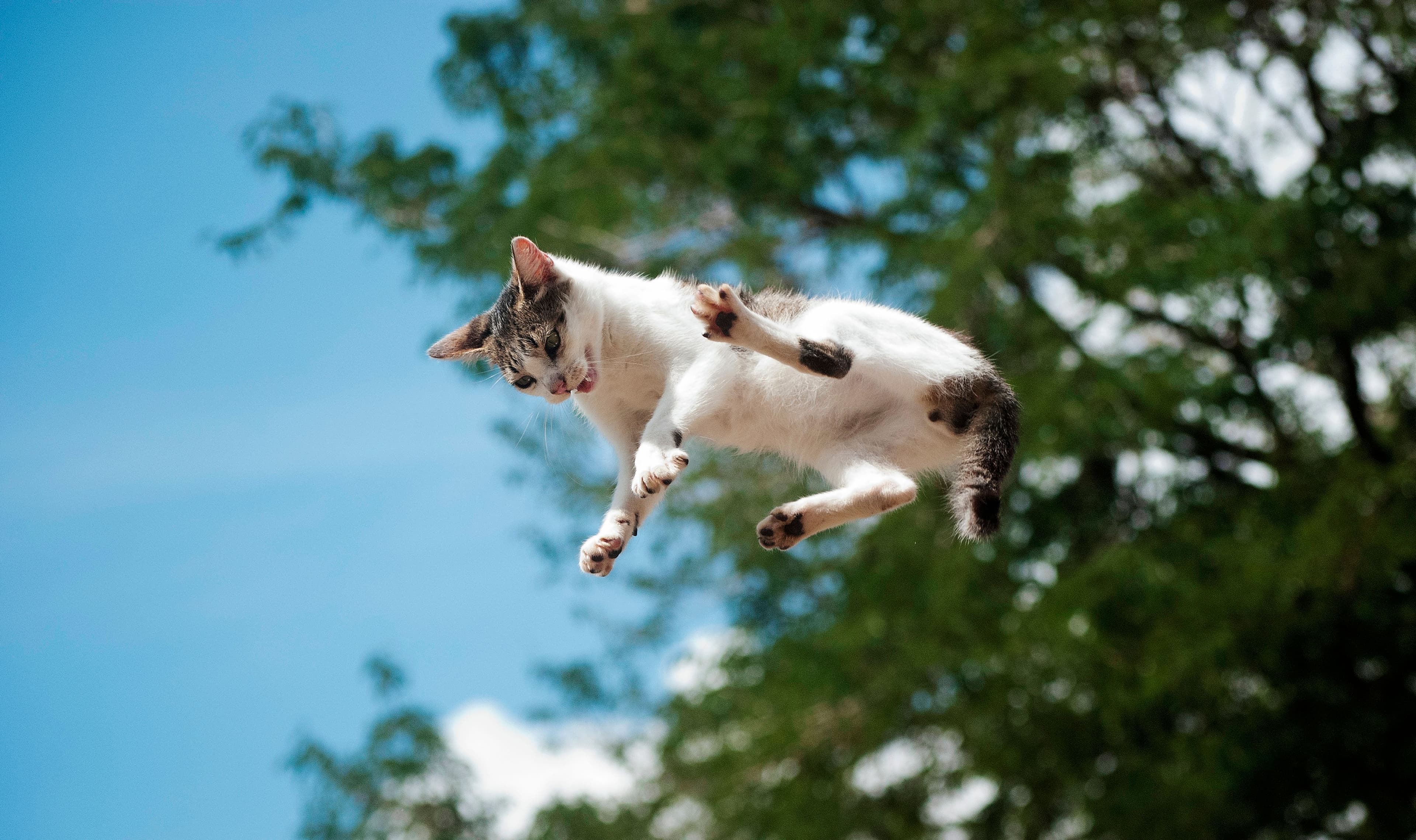
Science Finally Explains Why Cats Almost Always Land on Their Feet
Researchers in Japan have uncovered the biomechanical secret behind cats' legendary ability to land safely — and it all comes down to their spine.

Science Finally Explains Why Cats Almost Always Land on Their Feet
Cats have long fascinated scientists and pet owners alike with their seemingly gravity-defying ability to land on their feet after a fall. While this remarkable skill has been observed and admired for centuries, the precise mechanics behind it have remained somewhat mysterious — until now.
Researchers at Yamaguchi University in Japan have published a groundbreaking study in The Anatomical Record that sheds new light on exactly how cats pull off this incredible midair feat, pinpointing the spine as the key to their extraordinary landing ability.
The Science Behind the Skill
To understand how cats manage to right themselves during a fall without any external surface to push against, the research team took a detailed two-part approach. First, they examined the spines of five deceased cats, carefully separating the thoracic and lumbar regions before conducting a series of mechanical tests designed to measure each section's flexibility, strength, and resistance to rotational force.
In a second experiment, the team used high-speed cameras to capture footage of two live cats being dropped onto a soft cushion, allowing them to closely analyze each phase of the midair correction in real time.
A Tale of Two Spine Regions
What the researchers discovered was both elegant and surprising. A cat's spine is not uniformly flexible — far from it. The thoracic region, located in the upper portion of the back, is remarkably supple, capable of rotating up to 50 degrees with minimal resistance. The lumbar region, situated in the lower back, is considerably stiffer and serves as a natural stabilizing anchor.
This structural contrast is precisely what enables cats to perform their signature midair righting maneuver with such precision and consistency.
How the Righting Maneuver Actually Works
The process unfolds in a specific, sequential order. When a cat begins to fall, it first rotates its head and front legs downward, a movement made possible by the highly flexible thoracic spine. Once the front half of the body is oriented toward the ground, the rest of the body follows. Throughout this process, the rigid lumbar spine acts as a stabilizing counterbalance, preventing the rotation from becoming uncontrolled or erratic.
As the study's authors put it: "During air-righting, anterior trunk rotation was completed earlier than posterior trunk rotation... trunk rotation during air-righting in cats occurs sequentially, with the anterior trunk rotating first followed by the posterior trunk."
This precise sequencing is what makes the maneuver so efficient and reliable across countless different fall scenarios.
Beyond Cat Biology — Real-World Applications
While the study offers a fascinating window into feline biomechanics, its implications stretch well beyond understanding our four-legged companions. The researchers suggest that these findings could have meaningful practical applications in two important areas.
First, veterinarians may be able to use this deeper understanding of spinal mechanics to develop more effective treatments for cats suffering from spinal injuries. Second, and perhaps more unexpectedly, the principles observed in feline spine function could inform the design and development of more agile, adaptive robots — machines capable of recovering from falls and maintaining balance in unpredictable environments.
Why This Research Matters
Cats' ability to land on their feet is far more than a curious quirk of nature. It represents a sophisticated biomechanical system refined over millions of years of evolution. By breaking down exactly how this system operates, scientists are not only satisfying a long-standing curiosity but also opening doors to innovations in veterinary medicine and robotics.
The next time you watch a cat leap gracefully from a height and land without so much as a stumble, you'll know there is a remarkable interplay of spinal flexibility and structural rigidity working seamlessly behind the scenes.

