Schisto & Ladders: The Board Game Fighting a Deadly Parasitic Disease in Nigeria
A creative twist on a classic board game is teaching Nigerian children how to avoid schistosomiasis — a devastating parasitic disease spread through contaminated water.

When a Board Game Becomes a Public Health Tool
For decades, Chutes & Ladders has entertained children across America with its simple mechanics and colorful board. Originally adapted from an ancient Indian game designed to impart moral lessons, it has long been a childhood staple. Now, a Nigerian research team has reimagined the concept with a far more urgent purpose — and the stakes couldn't be higher.
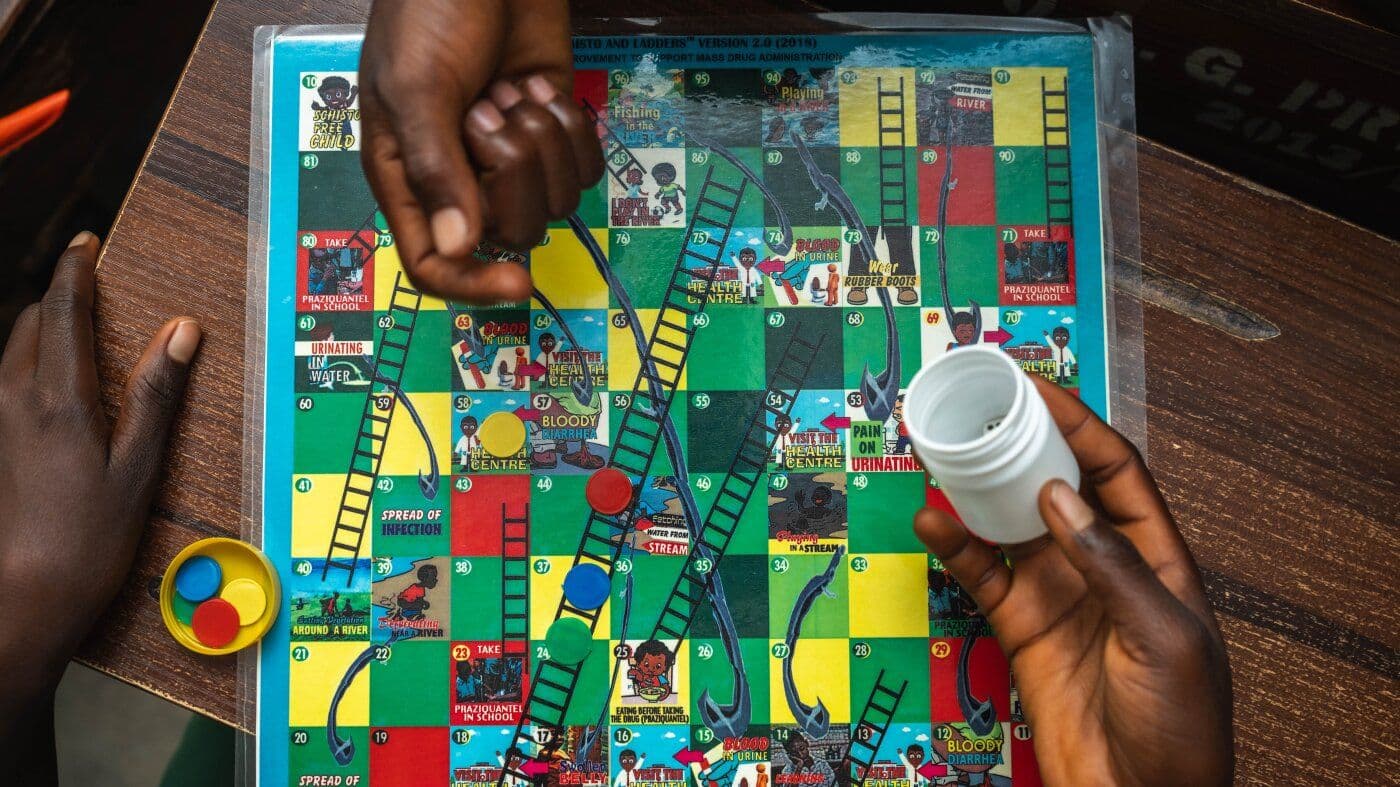
In rural communities across Nigeria, elementary school children are sitting down to play a game called Schisto & Ladders. It looks familiar enough: roll the dice, move your token, climb ladders, and slide back down. But instead of chutes, players slide down illustrated parasitic worms. And instead of moral lessons, the game delivers life-saving knowledge about schistosomiasis — a serious tropical disease that affects millions of people across sub-Saharan Africa.
What Is Schistosomiasis?
Schistosomiasis is a parasitic infection caused by microscopic worm larvae that penetrate human skin upon contact with contaminated freshwater. Even a brief splash can be enough for infection. Locally referred to as Atosi Aja, or "Bloody Urine," the disease is named for one of its most visible symptoms.
Beyond blood in the urine, the illness brings fever, rash, and considerable discomfort in its early stages. Left untreated, it can escalate into severe organ damage, neurological complications, infertility, and even bladder cancer. In Nigeria, the disease has been directly linked to elevated rates of bladder cancer among young people — a sobering statistic that underscores the urgency of prevention.
Classified as a Neglected Tropical Disease (NTD) due to chronic underfunding, schistosomiasis currently affects more than 200 million people across sub-Saharan Africa. School-age children face the greatest risk, as they frequently play in and around water sources and their immune systems are still developing.
How the Game Works
Developed in 2014 by a team led by Professor of Parasitology Uwem Ekpo of Akwa Ibom State University, Schisto & Ladders follows a straightforward path across a brightly illustrated board. Players roll a dice and advance toward a final square labeled "Schisto-Free Child." Along the way, the squares they land on reflect real-life behavioral choices — with consequences to match.
Land on "Playing in a River" and your token slides back down a worm. Land on "Eat Before Taking Medicine" and you climb a ladder, moving closer to victory. The game rewards good decisions like taking the antiparasitic drug praziquantel at school and cutting vegetation along riverbanks — a practice that disrupts the habitat of the intermediate snail hosts that carry the parasite.
Other squares reinforce the disease's transmission cycle in memorable ways. "Fetching Water from a Stream" connects via a worm to "Swollen Belly," while "Defecating Near a River" leads to "Spreading Infection" — illustrating the two critical points at which the parasite's life cycle can be broken: preventing larvae from entering the human body, and stopping human waste from reseeding the water with parasite eggs.
Field Work in Apojola Village
In July 2025, parasitologist and educator Dr. Cynthia Umunnakwe — one of the game's key developers — brought Schisto & Ladders to a schoolhouse in Apojola village in Ogun State. The visit was part of a broader Ministry of Health initiative that combined hands-on education with urine testing and medical treatment for affected children.
The need was immediately apparent. Screening at a local urine testing clinic revealed that one in three residents had an active schistosomiasis infection — a staggering rate in a community where daily life revolves around the Oyan River. Locals use the river for washing clothes, fishing, preparing cassava, and bathing. Children wade and splash along its shallow edges, sometimes at the request of their parents to check fish traps.
Dr. Umunnakwe reorganized the classroom furniture into clusters and introduced the game with a warm greeting. She also brought along live freshwater snails — collected from the river by her colleague Dr. Olubukola Adelakun, a veterinary public health researcher and post-doctoral scholar at the Federal University of Agriculture in Abeokuta. Dr. Adelakun had waded waist-deep into the water the previous day, wearing waterproof waders, to collect and clean snail specimens for identification purposes — helping children recognize the very animals that harbor the parasite in their local waterways.
In a neighboring building, Ministry of Health staff administered free doses of praziquantel, an oral medication that both prevents and treats schistosomiasis. Children received snacks alongside their treatment, since taking the drug on a full stomach reduces the likelihood of nausea and stomach discomfort.
Proven Impact on Knowledge and Behavior
The game's effectiveness is not just anecdotal. Dr. Umunnakwe previously conducted a rigorous six-month study involving 275 students across six schools in rural Ogun State — schools where praziquantel had previously been refused because of dangerous rumors that it caused fainting and death. Published in the journal International Health, the research found that before the trial began, not a single participating child had heard of the drug.
After six months of playing Schisto & Ladders, more than two-thirds of students understood what praziquantel was and recognized that it was safe. Remarkably, 65% of children signed up — with parental consent — to receive treatment. The study used pre- and post-trial surveys, as well as focus group discussions with students, parents, and caregivers to measure the game's reach.
"So we are hoping that by playing this game, schoolchildren will actually translate the knowledge acquired into changing their behaviors," Dr. Umunnakwe explained.
A Simple Game With a Serious Mission
At the end of one classroom session, a young boy reached the final square and called out triumphantly in Yoruba: "Hey, wò ó, mo wà lókè!" — "Hey look, I'm on top!"
In that moment, a child had not only won a game — he had absorbed knowledge that could genuinely protect his health. That is precisely the power of Schisto & Ladders: transforming complex public health information into something children can engage with, remember, and act upon.
In communities where access to clean water, reliable testing, and consistent treatment remains limited, creative educational tools like this board game represent a critical front line in the battle against neglected tropical diseases. As schistosomiasis continues to affect hundreds of millions of people worldwide, solutions that meet communities where they are — and speak to children in a language they understand — may prove just as valuable as any medication.

