Russia's Return to Venice Biennale Sparks Fierce Protests and International Controversy
Pussy Riot and FEMEN took to the streets of Venice as Russia made its controversial return to the world's most prestigious arts fair for the first time since invading Ukraine.

Venice Biennale Draws Global Outrage Over Russia's Controversial Return
The 61st Venice Biennale, long celebrated as the "Olympics of the art world," has become a flashpoint for political tension and passionate protest following Russia's return to the renowned arts fair — its first appearance since launching a full-scale invasion of Ukraine in 2022.
Protesters Storm the Gardens
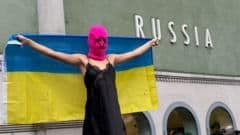
In a dramatic show of defiance, Russian feminist punk collective Pussy Riot joined forces with Ukrainian-founded activist group FEMEN to stage a powerful demonstration throughout the Biennale's iconic garden grounds. Clad entirely in black with vivid fluorescent pink balaclavas, the activists stormed toward the Russian national pavilion, igniting smoke flares and chanting "Russia kills! Biennale exhibits!" as security personnel scrambled to seal the entrance.
One banner carried by protesters read: "Curated by Putin, dead bodies included" — a stark and unambiguous message directed at the decision to reinstate Russia on such a globally visible stage.
Pussy Riot's Nadya Tolokonnikova spoke candidly about her group's motivations, framing Russia's cultural diplomacy as an extension of its broader military aggression. "It's not just tanks and drones, murder and rape in Ukraine," she said. "It's also culture, art, language — it's the way Russia tries to conquer the West, and you guys just opened the doors to them."
European Commission Threatens Funding Withdrawal
The backlash against Russia's reinstatement has reverberated well beyond the canals of Venice. The European Commission has issued a formal condemnation of the decision and placed a potential €2 million funding cut on the table. Brussels argues that providing Russia — an active aggressor nation — with a prestigious international platform violates the ethical standards attached to the grant.
Italy's own culture minister has declined to attend the public opening of the fair, signaling domestic disapproval. However, Deputy Prime Minister Matteo Salvini — who once famously paraded through Moscow's Red Square wearing a Vladimir Putin T-shirt — has refused to join the boycott, insisting that "no pavilion should be excluded." A Brussels source indicated that Italy's stance had done little to appease the European Commission.
Controversy Extends Beyond Russia
The political storm surrounding this year's Biennale stretches further than Russia's participation alone. In a remarkable development last week, the entire international jury resigned following a statement that referenced nations whose leaders face International Criminal Court warrants for suspected war crimes — a description that applies to both Russia and Israel.
Shortly afterward, a separate wave of protesters descended on the Israeli pavilion, blanketing its entrance with rain-soaked leaflets branding it a "Genocide Pavilion." Israel's foreign ministry had previously denounced what it described as a politically compromised jury turning the Biennale into a venue for "anti-Israeli political indoctrination."
Biennale President Breaks Silence
As the controversy intensified, Biennale president Pietrangelo Buttafuoco — a right-wing former journalist who has previously spoken in admiring terms about Vladimir Putin — initially avoided media scrutiny. He eventually broke his silence to accuse critics of building a "laboratory of intolerance," framing calls for Russia and Israel's exclusion as acts of censorship.
"If the Biennale began to select not works but affiliations, not visions but passports, it would cease to be what it has always been: the place where the world meets," Buttafuoco declared — before departing the press conference without taking questions.
His remarks drew sharp criticism for sidestepping the human cost of Russia's war. Posters plastered across Venice this week told a different story, advertising an "Invisible Pavilion" featuring Ukrainian artists and writers such as Volodymyr Vakulenko, who was shot dead when Russian forces occupied his village. Each poster bore a single, damning stamp: "Cancelled. Because the author was killed by Russia."
Inside the Russian Pavilion
In 2022, the Russian pavilion's own curators had walked out in protest at the invasion. The building was subsequently loaned to Bolivia for two years. This time, a Russian team has filled the space with an inverted tree installation and experimental sound performances.
When asked whether Russia had any rightful place at the Biennale while continuing its assault on Ukraine, official pavilion commissioner Anastasia Karneeva was dismissive. "This is our house, we come to our place," she said, declining further comment. Notably, Karneeva's father serves as deputy head of Rostec — Russia's sprawling state-owned weapons manufacturer currently under international sanctions — a topic she also refused to address.
A Partial and Uncertain Presence
Russia's participation at this year's Biennale is, in the end, only partial. Following the pre-opening events, the pavilion will close to the public — though whether this is a result of the protests or the practical weight of sanctions remains unclear. The performances staged inside will be recorded and broadcast externally for public viewing.
Meanwhile, just steps away near the main entrance, Ukraine's own contribution to the Biennale stands in quiet contrast: a concrete origami deer, suspended mid-air from a crane by heavy straps — a haunting and resilient symbol amid the noise of one of art's most turbulent years.