Rare T. Rex Skeleton 'Gus' Heads to Auction With a $30 Million Price Tag
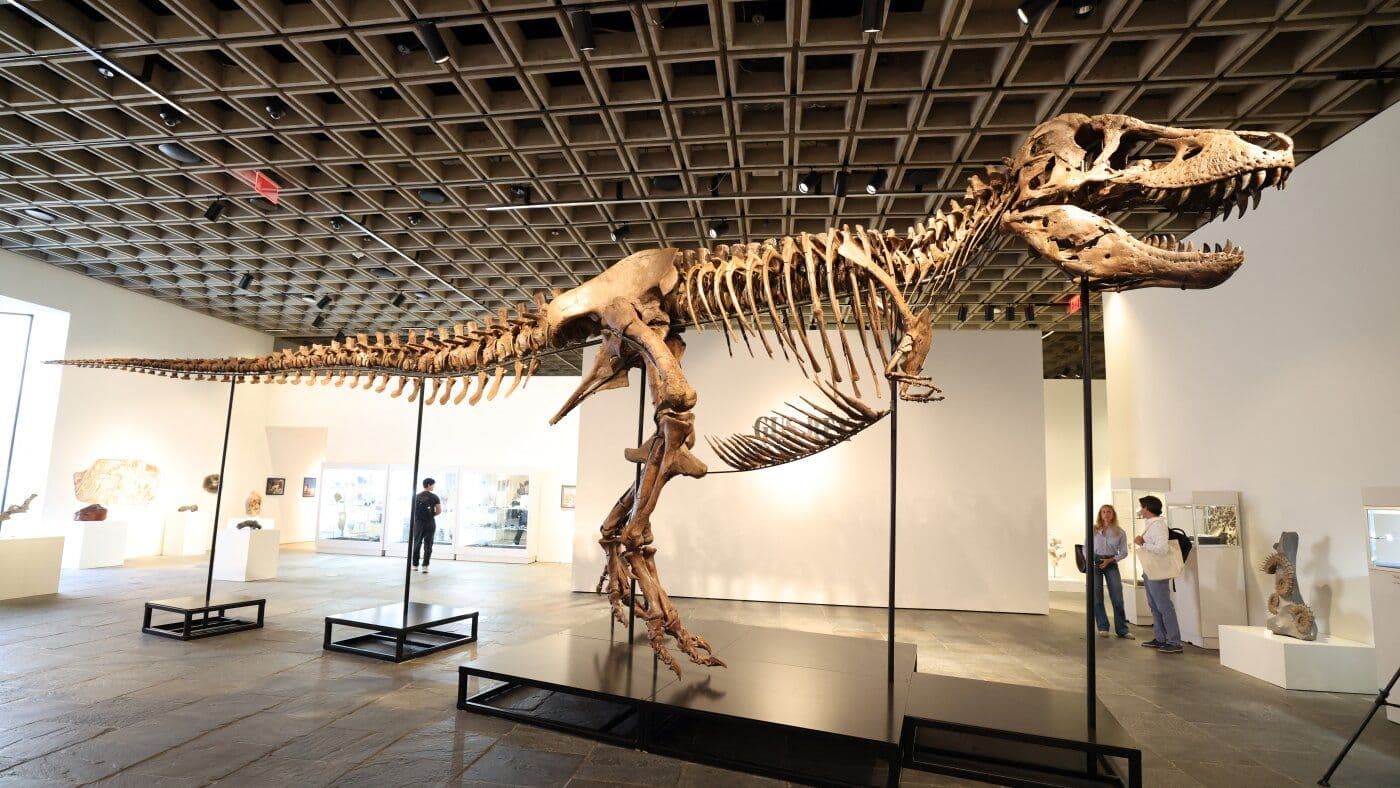
A massive Tyrannosaurus rex fossil nicknamed 'Gus' is hitting the auction block at Sotheby's, with bidding expected to reach up to $30 million.

A Real T. Rex Could Be Yours — If You Have $30 Million to Spare
For most people, owning a Tyrannosaurus rex means a plastic toy on a shelf. But for the ultra-wealthy, an extraordinary opportunity has emerged: the chance to acquire an actual T. rex skeleton, complete with tens of millions of years of natural history attached to its bones — and an eye-watering price tag to match.
A remarkably preserved T. rex fossil known as "Gus" went under the hammer at Sotheby's New York City auction house, with opening bids starting at $19 million. The auction house projected the final sale price could land anywhere between $20 million and $30 million, making it one of the most significant dinosaur auctions in recent memory.
The Story Behind 'Gus'
Unearthed in 2021 on private land in Harding County, South Dakota, Gus is an impressive specimen by any measure. The skeleton stretches 38 feet in length and stands 12.5 feet tall, placing it among the largest and most complete T. rex fossils ever recovered. Scientists believe the creature roamed the Earth during the late Cretaceous period, approximately 67 million years ago.
Experts who examined the remains concluded that Gus was no juvenile. "Judging from the overall size and degree of bone development, it can be determined that Gus' skeleton belonged to a very large, robust, adult individual," Sotheby's noted in its official listing.
Thomas Heitkamp, president of Theropoda Expeditions — the company responsible for excavating the site — revealed that the recovery process yielded nearly one thousand individual fossil pieces. The excavation continued through 2023, a painstaking effort that ultimately brought one of prehistory's most fearsome predators back into the light.
The Man Who Gave Gus His Name
The fossil takes its nickname from Gary "Gus" Licking, the rancher who owned the 6,500-acre property where it was discovered. According to Cassandra Hatton of Sotheby's, Gary had long suspected something significant lay beneath his land after years of stumbling upon T. rex teeth and scattered fossil fragments during his daily walks across the property.
Sadly, Gary passed away during the excavation process and never had the chance to see his namesake fully assembled — a poignant footnote to an otherwise remarkable discovery.
Dinosaur Auctions: A Growing and Controversial Market
This is far from the first time a dinosaur fossil has been sold to the highest bidder. Sotheby's itself pioneered the practice back in 1997, when a T. rex named Sue sold for $8.4 million. That sale was made possible through a consortium of major corporations, and the skeleton ultimately found a permanent home at the Field Museum in Chicago.
More recently, in 2024, a stegosaurus named Apex shattered all previous records when it sold for an astonishing $44.6 million — the highest price ever paid for a dinosaur fossil. Billionaire investor Ken Griffin acquired Apex and subsequently loaned it to the American Museum of Natural History in New York for a four-year period.
Scientists Raise Concerns Over Fossil Sales
Not everyone in the scientific community is celebrating these headline-grabbing sales. Paleontologist Scott Persons, who serves as curator of natural history at the South Carolina State Museum, describes the trend with clear frustration.
"More and more dinosaurs are being sold this way and at ridiculous prices," Persons told NPR, pointing to what he calls a sharp "increase in market demand" driving these astronomical figures.
Persons argues that the staggering sums being spent at auction could be put to far better use. A $30 million investment directed toward a public museum, he suggests, could fund an entire research program — covering decades of fieldwork, the discovery of entirely new species, and the public exhibition of those findings for generations to come.
The debate over private ownership of significant fossil specimens versus their preservation in public institutions shows no signs of slowing down, particularly as prices continue to climb into the stratosphere.