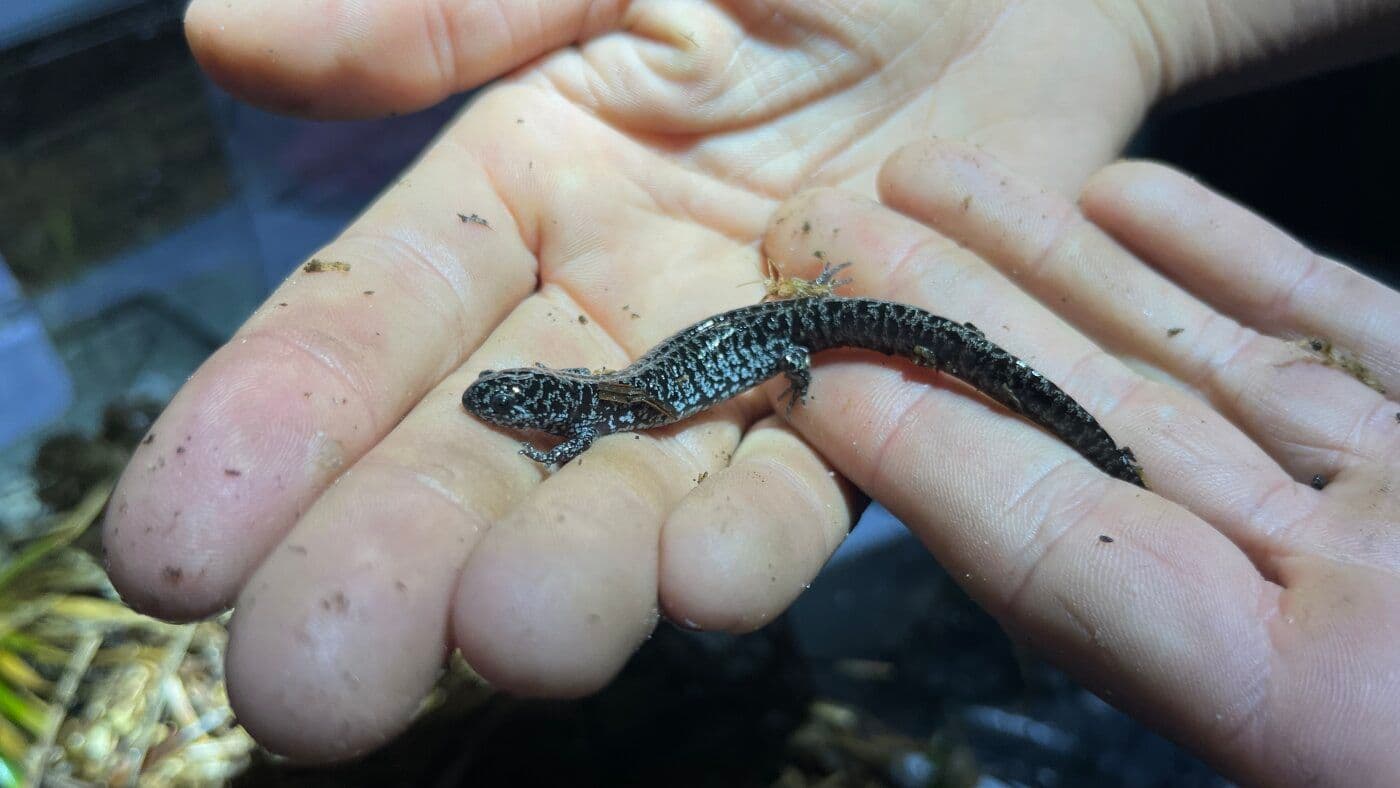
Racing Against Extinction: The Fight to Save America's Frosted Flatwoods Salamander
A tiny, secretive salamander is teetering on the edge of extinction. Meet the scientists risking everything to pull it back from the brink.

A Species on the Edge
Saving a species from extinction is never simple. It demands relentless dedication, significant resources, and an almost stubborn refusal to give up. Nowhere is that more evident than in the ongoing battle to protect the frosted flatwoods salamander — a small, elusive amphibian that many Americans have never heard of, yet one that scientists consider among the most endangered creatures on the continent.
Meet the 'Frosties'
Affectionately nicknamed "frosties" by those who know them best, frosted flatwoods salamanders are ground-dwelling creatures with a striking appearance. Their dark black or deep chocolate bodies are draped in intricate crisscrossing patterns of white and gray — resembling, as one conservationist describes it, "a dewy sparkly spiderweb laid over a black background."
Despite their beauty, these animals are in serious trouble. Scientists warn that the species has entered what biologists refer to as an extinction vortex — a critical threshold where a population becomes so small that its challenges begin to spiral fatally out of control, making recovery increasingly unlikely without direct human intervention.
Crawling Through the Bog
Near Tallahassee, Florida, Nicole Dahrouge of the Amphibian and Reptile Conservancy (ARC) spends her days hunched over in boggy terrain, carefully combing through low-lying grasses in search of salamander eggs. It's painstaking, uncomfortable work — rubber boots sinking into wet soil, hands brushing through itchy brush — but every clutch of eggs she finds represents a potential victory.
"It's just like the world's itchiest scavenger hunt interspersed with little periodic injections of serotonin when you find something fun," she says with a laugh.
The urgency behind her search is real. Frosted flatwoods salamanders lay their eggs each autumn in ephemeral ponds — shallow, seasonal wetlands that rely on winter rainfall to fill. The eggs must stay moist enough to develop but cannot flood until conditions are just right. If the pond dries up too soon, larvae are left stranded and will perish. As climate change continues to disrupt seasonal weather patterns, this annual reproductive gamble becomes harder and harder for the species to win.
Captive Rearing: A Critical Stop-Gap
Even under ideal conditions, the natural survival rate for frosted flatwoods salamander eggs is alarmingly low. Once the larvae hatch, they face a new set of threats. According to Dahrouge, predators are everywhere — the tiny larvae are essentially defenseless. "Everything eats them," she explains. "They're just like little protein gummy bears."
To improve their odds, Dahrouge collects eggs and raises hatchlings in a controlled captive environment before releasing them back into the wild. She acknowledges it's a massive undertaking with no clear endpoint in sight — a stop-gap measure designed to stabilize a population in freefall while longer-term solutions are pursued.
JJ Apodaca, ARC's executive director, puts it bluntly: "When we let species get to this point, it takes so much effort, so much work, and so many resources to bring them back. But we either do this now or we watch them go extinct."
A Troubled Federal Status
The frosted flatwoods salamander was first listed as a threatened species under the U.S. Endangered Species Act in 1999, alongside what was then believed to be a single species. By 2009, scientists had determined that two distinct species existed — the reticulated flatwoods salamander and the frosted flatwoods salamander. The reticulated was upgraded to endangered status; the frosted remained classified as threatened.
A 2019 status review conducted by the U.S. Fish and Wildlife Service (FWS) concluded that the frosted flatwoods salamander also warranted an endangered listing due to continued population declines. More than five years later, that reclassification has still not been officially enacted. The FWS maintains that the species still receives nearly equivalent protections under existing law, but conservation advocates argue the delay reflects a broader failure to confront the reality on the ground — particularly given recent efforts by the Trump administration to scale back certain protections for threatened species.
Restoring the Longleaf Pine Ecosystem
For conservationists working at the habitat level, federal classifications matter less than the actual work of restoring the landscapes these animals depend on. Frosted flatwoods salamanders are native to the longleaf pine forests of the southeastern United States — open, fire-adapted woodlands that once stretched across the coastal plains from southern Virginia to eastern Texas.
Decades of industrial logging, agricultural conversion, suburban development, and aggressive fire suppression have reduced this once-vast ecosystem to a shadow of its former self. Today, only about 3% of original longleaf pine forest remains intact, leaving the frosties, reticulateds, and dozens of other imperiled species clinging to isolated, fragmented patches of suitable habitat.
"It's a globally imperiled ecosystem sitting on top of a global biodiversity hotspot," says Houston Chandler, science director at the Orianne Society, a nonprofit focused on amphibian and reptile conservation. "Not a great combination."
Habitat Restoration in Action
Chandler has been leading hands-on habitat restoration efforts at Eglin Air Force Base in Florida, home to the largest remaining stand of old-growth longleaf pine forest. His team manually removes encroaching undergrowth and works to rehabilitate wetland areas that salamanders use for breeding. The work is physically grueling — often carried out during the brutal heat of summer — but the results speak for themselves. The number of sites occupied by reticulated flatwoods salamanders at the base has reached record highs.
"It took decades of fire suppression, poor habitat management, and land conversion to push them to the edge," Chandler notes. "So this isn't going to be an overnight fix."
The Broader Lesson
The effort to save the frosted flatwoods salamander is more than just one conservation story. It is a reflection of a larger truth about how humanity manages — and mismanages — the natural world. When ecosystems are degraded and species are pushed to the brink, the cost of recovery is exponentially greater than the cost of prevention would have been.
The people doing this work know the odds are steep. But as Apodaca reminds us, the alternative is simply watching these animals disappear forever. For now, the frosties have advocates willing to get their boots muddy on their behalf — and that, at least, is reason for cautious hope.

