Polymarket's Washington Debut Turns Into a High-Profile Embarrassment
Prediction market platform Polymarket staged an ambitious DC pop-up event meant to signal its political arrival — but technical chaos stole the spotlight.

Polymarket's Washington Debut Turns Into a High-Profile Embarrassment
Prediction market platform Polymarket arrived in Washington, DC with grand ambitions and a flashy pop-up bar concept — but what was supposed to be a landmark moment for the crypto-powered betting industry quickly unraveled into an evening of technical failures, early closures, and confused guests.
A Bold Entrance That Stumbled Out of the Gate
Neil Kumar, Polymarket's chief legal officer and a former counsel at the Commodity Futures Trading Commission (CFTC), set the tone early. Standing before a crowd of reporters, Hill staffers, and curious onlookers, he declared the event the company's official "coming-out party" in the nation's capital. The setting — a purpose-built bar just blocks from the CFTC itself — was chosen deliberately, designed to project confidence and legitimacy.
But the night didn't go as planned. The pop-up opened late due to persistent technical problems, leaving guests stranded outside for nearly ninety minutes. Bartenders, to their credit, ventured out to take drink orders from the damp and restless crowd waiting in line.
The Man Behind the Marketing Machine
The event was conceived by Joshua Tucker, who joined Polymarket as head of growth in November and previously led viral marketing campaigns for YouTube megastar MrBeast. Tucker's fingerprints were all over the concept: a live, immersive betting experience where attendees could wager on real-world geopolitical events — including the prospect of a US war with Iran — while sipping cocktails with friends.
The centerpiece of the experience was supposed to be dozens of large monitors streaming Bloomberg terminal data, live X feeds, and cable news coverage. The idea was to give bettors a real-time information edge right there at the bar. Instead, Tucker was forced to announce that none of the screens would be operational that evening.
Screens Dark, Bets on Hold
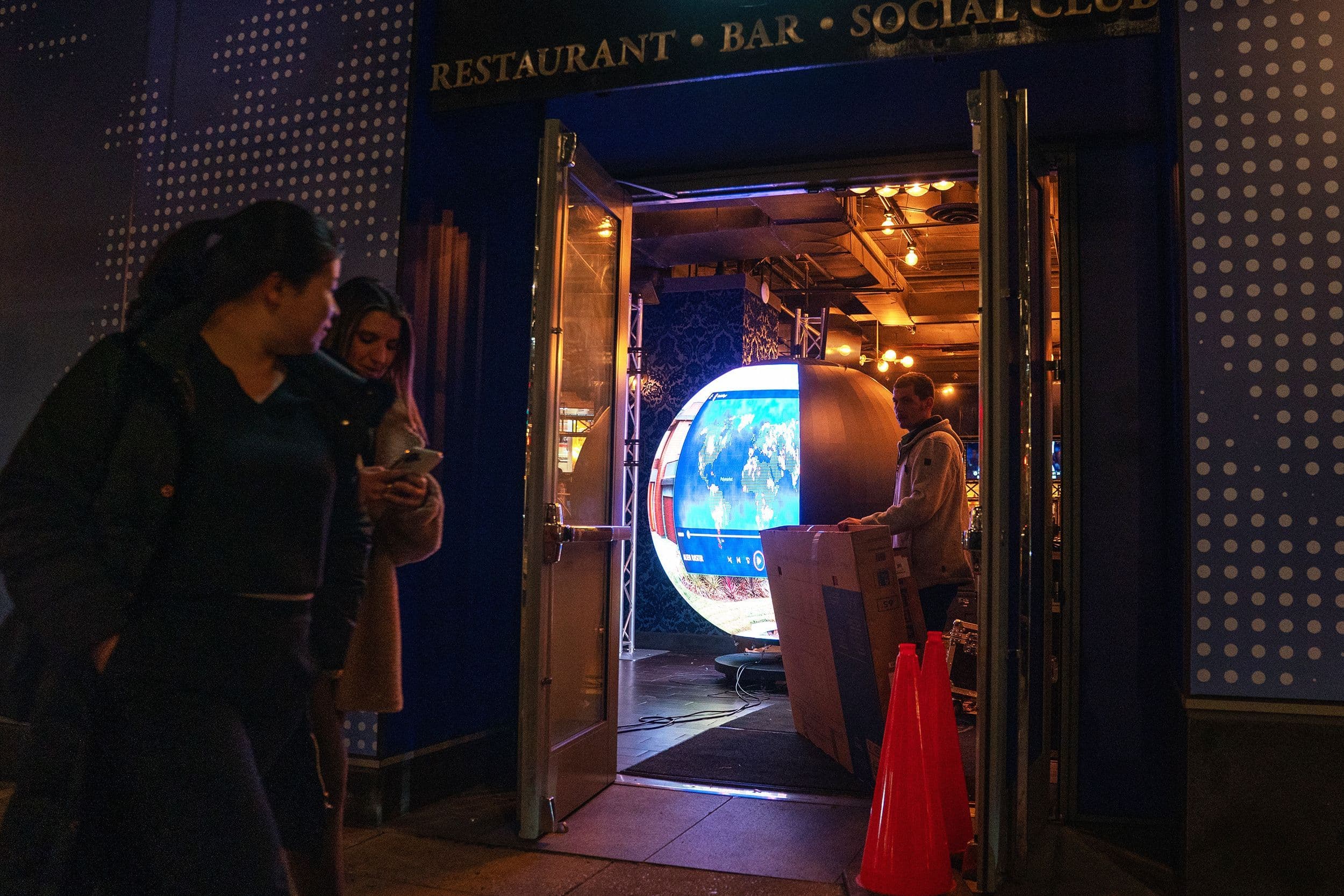
The only display that functioned was an interactive globe — styled after a miniature version of the Las Vegas Sphere — that rotated with a world map and showed live bets being placed on Polymarket's platform. Questions like "Russia x Ukraine ceasefire by end of April?" and "Will the US confirm that aliens exist before 2027?" floated across its surface, offering a glimpse of what the full experience was meant to look like.
For content creator Nick O'Neill, who flies under the handle @chooserich on X, the evening was a wasted trip. He had flown in from Miami with his media team specifically to film a competitive betting video, using the live data feeds as a backdrop. Without the screens, there was nothing to film. O'Neill said he would return the following day to try again.
By 9:00 pm — hours earlier than originally scheduled — Tucker announced the bar was closing so staff could address the ongoing technical failures. Most guests, reluctant to leave the free drinks behind, stayed until the end.
More Than a Marketing Stunt
Beneath the spectacle, the event carried real strategic weight. For three years, Polymarket was effectively banned from operating in the United States after the CFTC fined the company $1.4 million for offering unregistered event-based binary options contracts. American users were blocked from the platform until July of last year, when Polymarket acquired a holding company tied to QCEX, an already-regulated trading platform.
The Washington pop-up was intended to mark a new chapter — positioning Polymarket as a serious, government-aligned player in the prediction market space. Reports from The Washington Post and other outlets noted that administration officials were present at the event, lending the evening a degree of political credibility the technical problems threatened to overshadow.
The morning after opening night, Polymarket addressed the chaos with characteristic cheekiness, posting on X: "There may or may not have been a situation in the Situation Room last night. Reports remain unconfirmed. However, the situation monitors are now on… and ready to be monitored."
Day Two: Improvement, Then More Outages
Saturday brought modest progress. The screens came on, though the Bloomberg terminals and X feeds that were central to the original pitch were still absent. In their place, CNN, Fox News, and — in a touch of odd charm — a Pentagon pizza delivery tracker filled the monitors.
Around 5:30 pm, all the screens cut out again due to the same recurring power issue. Bar staff distributed glasses of champagne as an apology. O'Neill, who had returned as promised, ended up filming what amounted to a promotional clip for the bar itself — a far cry from the high-stakes betting showdown he had originally envisioned.
Who Was Actually There?
For all the ambition behind the event, the crowd itself revealed an interesting reality: most attendees were not Polymarket users. A military servicemember named William, who uses rival platform Kalshi and had wandered in off the street, said he had wagered roughly $1,000 of his tax refund on college basketball and political markets. When asked whether the bar's screens would have helped him make better bets, he was straightforward: "No, not really."
A college senior named Dylan, who had invested around $100 in gold and crypto markets, was equally candid. "When you're in the bar, it's more fun for like a laugh and a look-around with your buddies," he said. "When you're trying to make money, you're trying to do some kind of analysis."
Most guests spent the evening scrolling their own social media feeds and filming the spectacle rather than placing any bets. For many, it was simply a party — an unusual, meme-worthy night out in DC. As one woman put it to her friend between bites of Pentagon Pizza–themed pie: "Girl, when will we ever be in the Polymarket bar eating pizza again?"