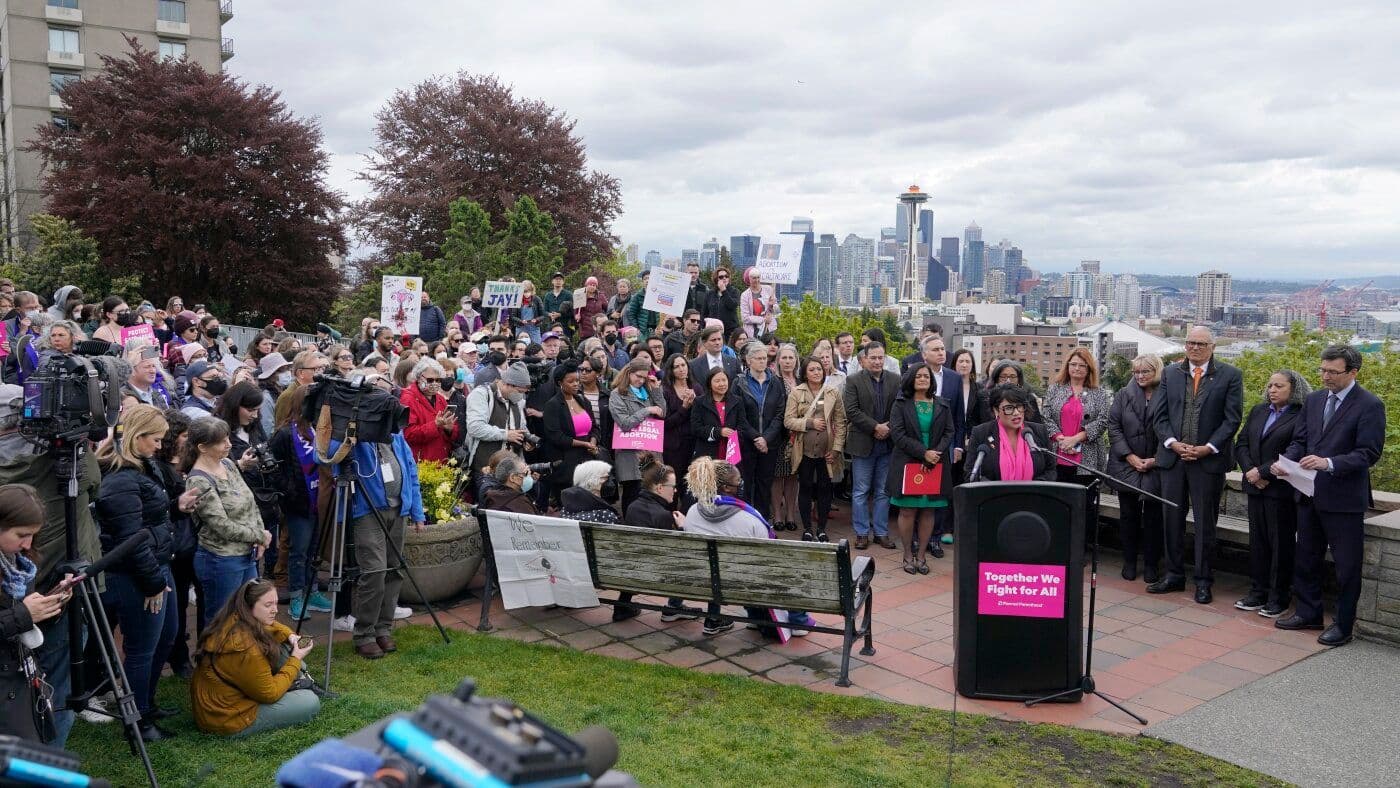
Planned Parenthood Launches 'Just In Case' Abortion Pill Program in Washington and Hawaii
For the first time, a Planned Parenthood affiliate is offering abortion pills in advance to residents in two states who want to have them on hand for future use.

Planned Parenthood Introduces Advance Abortion Pill Program in Two States
Residents of Washington state and Hawaii now have access to a groundbreaking new initiative from Planned Parenthood — the option to obtain abortion medications, mifepristone and misoprostol, ahead of time to keep at home in case they need them in the future.
The program, known as "Just In Case Abortion Pills," marks the first time a Planned Parenthood affiliate has offered what medical providers call "advance provision" of abortion medication. The initiative was launched Thursday and was initially shared exclusively with NPR.
What Is Advance Provision and Why Does It Matter?
Advance provision allows individuals to obtain abortion pills before they are pregnant, storing them for potential use during an early pregnancy. Several telehealth organizations have been offering this service for years, but Planned Parenthood's entry into this space carries significant weight due to its widespread name recognition and the trust patients place in the organization.
"Having a group like Planned Parenthood — one that carries such trust and name recognition — add these services is really important," said Elisa Wells, co-founder of Plan C, a website dedicated to information about medication abortion.
Rebecca Gibron, president and CEO of Planned Parenthood Great Northwest, Hawai'i, Alaska, Indiana and Kentucky, explained the reasoning behind the timing: "As evidence supporting this model of care has continued to grow, and with supportive policy environments in Washington and in Hawai'i, this really is the right time for us to step into this space."
Access Options and Pricing
Unlike most other advance provision services, which operate exclusively online, Planned Parenthood patients in Washington and Hawaii can obtain the medications either through telehealth or in person at any of the organization's 16 health centers across both states.
For patients attending an existing appointment — such as a routine wellness visit or STI screening — the cost to add the abortion pills is $100. A standalone appointment runs $150, though financial assistance programs are available for those who cannot afford those fees.
Dr. Colleen McNicholas, chief of medical affairs at the same Planned Parenthood affiliate, emphasized that patients would have continued support even long after receiving the pills. "If a patient gets the pills and then goes to use them 11 months later, we are still available to them as their provider to answer those questions," she said.
Real Experiences: One Woman's Story
Whit, a 29-year-old now living in the Chicago area, first obtained abortion pills in advance four years ago following news about potential restrictions on reproductive rights. She asked NPR to use only her first name due to the personal nature of her decision.
"It kind of all started when the draft of the Roe decision was leaked in May of '22," she recalled. After learning she could order the pills proactively, she obtained them through an international organization called Aid Access.
About a year after storing them, she ended up using the medication shortly after missing her period. "It was literally like a period," she said. "I'm just like, 'Wow, everybody should be able to have that experience. It doesn't have to be this big, treacherous thing.'" She has since reordered and currently keeps a fresh supply at home. The medication typically has a shelf life of approximately two years, with expiration dates printed on the packaging.
Safety, Legality, and Medical Consensus
Anna Fiastro, a research scientist at the University of Washington School of Medicine, affirmed the strong safety record of the two medications. "These medicines are available over the counter in other countries, and they're very safe, very effective, and can be self-managed," she said, noting that the World Health Organization provides guidance for self-managed use through the first trimester.
Elisa Wells added that it is currently legal for patients to have abortion medication on hand in 49 states. Louisiana is the sole exception, having classified the medications as controlled substances in 2024.
Opposition and Political Pushback
Not everyone views this development favorably. Republican Senator Cindy Hyde-Smith of Mississippi, who chairs the Senate Pro-Life Caucus, raised objections during a 2024 congressional hearing. "American women are stockpiling the abortion pills through advanced prescribing from abortion companies and providers," she said, questioning the lack of mandatory physician oversight.
Then-FDA Commissioner Robert Califf responded that physicians have discretion in prescribing decisions, stating: "We don't advocate stockpiling as a method, but we don't regulate the practice of medicine."
Thus far, the Trump administration's FDA has taken limited action to restrict abortion medication access, a point of frustration for anti-abortion advocates. While Congress did temporarily cut Planned Parenthood from Medicaid funding, that funding is set to be reinstated in July unless new legislation is enacted.
A Growing Trend Amid Legal Uncertainty
Ongoing legal challenges surrounding mifepristone — including a case brought by Louisiana against the FDA over remote prescription rules — have prompted more people to seek abortion pills in advance. The Supreme Court has temporarily paused any immediate changes to access while the case continues through lower courts, but the issue remains unresolved.
Wells of Plan C reports that news of the Louisiana case has triggered a noticeable spike in website traffic and an increase in advance provision requests. "We don't know what the outcome will be, so it might make sense to get pills now in case there is a bad decision in that court case," she said.
Despite the uncertain legal landscape, Wells remains confident in the trajectory of abortion pill access. "Abortion pills are everywhere, they're safe, they're effective, and they're pretty much unstoppable," she said. "The genie is out of the bottle."