Ordinary Glass Is Now a Cutting-Edge Quantum Security Device — Here's How
Scientists have transformed everyday borosilicate glass into a powerful quantum communication chip capable of ultra-secure encryption and record-breaking data protection.
Scientists Have Turned Glass Into a Quantum Security Powerhouse
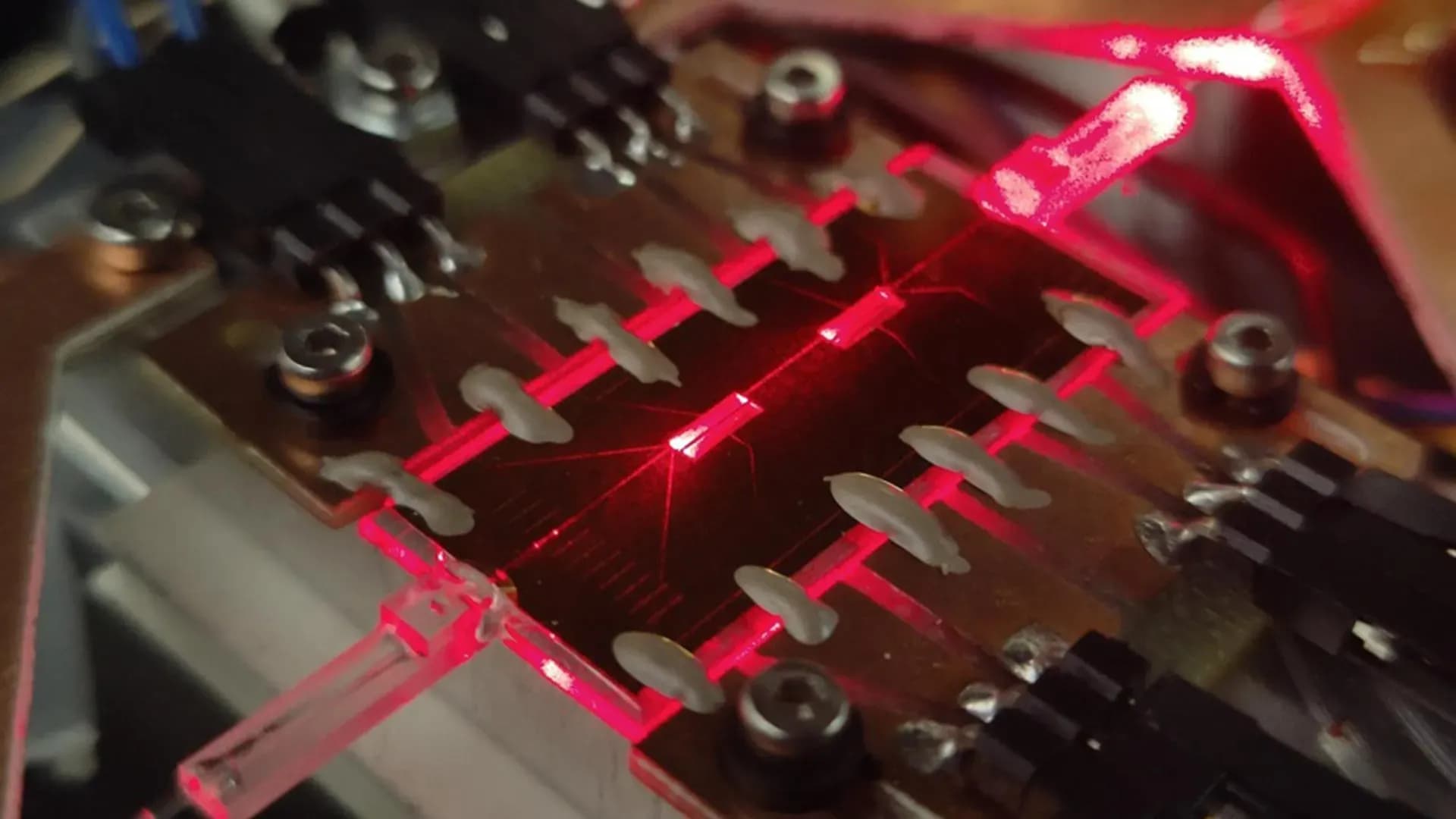
A team of researchers has accomplished something remarkable: they have transformed ordinary borosilicate glass into a high-performance quantum communication device capable of defending sensitive data against the looming threat of future quantum computing attacks. This compact chip delivers an impressive combination of speed, stability, and versatility — handling both ultra-secure encryption and record-setting random number generation within a single, elegant system.
Why Quantum Security Is Becoming Urgent
As quantum computers continue to advance at a rapid pace, many of the encryption methods that currently protect our digital lives are at growing risk of being compromised. Quantum cryptography has emerged as one of the most promising defenses, relying on fundamental laws of physics rather than complex mathematics to secure information. However, bringing quantum communication into practical, everyday use demands small, reliable devices capable of accurately detecting the fragile quantum signals carried by light.
Researchers from the University of Padua, Politecnico di Milano, and the CNR Institute for Photonics and Nanotechnologies have now introduced an innovative solution. Their findings, published in Advanced Photonics, describe a high-performance quantum coherent receiver built directly inside glass using a technique called femtosecond laser writing. The result is a device with low optical loss, consistent performance, and seamless compatibility with existing fiber-optic infrastructure.
Why Glass Beats Silicon for Quantum Applications
Most quantum receivers in use today are built on silicon platforms. While silicon is a proven and widely adopted material, it comes with notable drawbacks in quantum applications — particularly its sensitivity to light polarization and its tendency toward higher optical losses, both of which can undermine performance and reliability.
Glass, by contrast, offers several compelling advantages for quantum photonics:
- Polarization insensitivity — Glass does not distort quantum signals based on light orientation
- Three-dimensional waveguide capability — Light-guiding paths can be written in three dimensions within the material
- Minimal signal loss — The femtosecond laser writing process creates highly efficient optical circuits
- Natural stability — Glass maintains consistent performance across varying environmental conditions
Using femtosecond laser micromachining, researchers can etch precise light-guiding pathways directly inside the glass, producing compact photonic circuits without the manufacturing complexity associated with semiconductor production.
Inside the Glass Quantum Receiver
The research team engineered a fully tunable heterodyne receiver — a critical component for continuous-variable quantum key distribution (CV-QKD) and quantum random number generation (CV-QRNG) — by inscribing the entire optical circuit within borosilicate glass.
Continuous-variable quantum information processing works by measuring the amplitude and phase of light waves. The coherent receiver merges a weak quantum signal with a stronger reference beam, then analyzes the interference patterns between them. The glass chip's design enables simultaneous measurement of two conjugate quadratures, a feature essential for advanced quantum communication protocols.
The device's performance metrics are striking, matching or surpassing many silicon-based counterparts across multiple key benchmarks.
Record-Breaking Quantum Random Number Generation
When configured as a heterodyne detector within a source-device-independent quantum random number generation (SDI-QRNG) system, the chip achieved a secure random bit generation rate of 42.7 Gbit/s — a record for this category of system. Crucially, this setup remains secure even when the incoming optical signal itself cannot be fully trusted, adding an extra layer of robustness.
Secure Quantum Key Distribution Over Fiber
The same chip was deployed in a QPSK-based CV-QKD protocol, where quantum information is encoded across a four-point constellation of quantum states. Tested over a simulated 9.3-kilometer fiber link, the system delivered a secret key rate of 3.2 Mbit/s — demonstrating that glass-based photonic technology can support sophisticated quantum encryption without the limitations inherent to silicon platforms.
A Practical Path to Real-World Quantum Networks
Beyond its impressive performance numbers, this research highlights the broader practical advantages that glass photonics brings to quantum communication:
- Cost-effectiveness — Glass is an affordable and widely available material
- Environmental resilience — It withstands harsh conditions better than many semiconductor alternatives
- Long-term durability — Glass maintains structural and optical integrity over extended periods
- Space-readiness — Its stability makes it a candidate for space-based quantum communication systems
These characteristics are vital for transitioning quantum communication technology out of controlled laboratory environments and into real-world infrastructure. The researchers believe glass-based photonics can play a central role in bridging the gap between experimental quantum systems and deployable quantum networks.
The Road Ahead for Quantum Communication
This breakthrough represents a significant step toward scalable, global quantum communication networks. By demonstrating two major quantum applications — record-speed random number generation and secure key distribution — on a single glass chip, the team has shown that this platform is not just a scientific curiosity but a genuine candidate for next-generation quantum infrastructure.
As quantum threats to conventional encryption grow more serious, innovations like this glass-based quantum receiver offer a compelling, physically grounded path to keeping the world's data secure well into the future.
