OpenAI Supercharges Codex with Desktop Control and New AI Features to Challenge Anthropic
OpenAI has rolled out a sweeping upgrade to its Codex coding tool, adding desktop automation, browser control, memory, and over 100 app integrations.
OpenAI Levels Up Codex in Its Battle Against Anthropic
The rivalry between OpenAI and Anthropic over AI-powered coding tools is intensifying, and OpenAI is making its boldest move yet. The company has announced a comprehensive overhaul of Codex, its automated coding assistant, loading it with a range of powerful new capabilities designed to make it a serious contender in the enterprise AI space.
Codex Can Now Work in the Background on Your Mac
Perhaps the most significant addition is Codex's newfound ability to operate silently in the background on a user's Mac. The tool can now open desktop applications, move a cursor, click buttons, and type — essentially mimicking the actions of a human user.
What makes this particularly useful is that multiple Codex agents can run simultaneously on your machine without disrupting whatever you happen to be working on at the same time. OpenAI describes it as having a dedicated coding assistant handling secondary tasks while you focus on higher-priority work. Practical use cases cited by the company include iterating on frontend design changes, testing applications, and working within software that doesn't offer an API.
This development is notable for another reason: it closely mirrors functionality that Anthropic introduced for Claude Code last month, when it announced the ability to remotely control a Mac desktop on behalf of users who step away from their keyboards. The timing suggests OpenAI is actively tracking and responding to its rival's feature rollouts.
Built-In Browser and Expanded Web Capabilities
Codex also now comes equipped with an integrated in-app browser, enabling users to issue commands that the tool will carry out directly within specific web applications. OpenAI sees this as particularly valuable for front-end development and game creation. The company has also indicated plans to extend this functionality further, eventually allowing Codex to take full control of the browser beyond locally hosted web applications.
Memory, Image Generation, and 111 New Integrations
Several other updates round out this release. A new preview feature called Memory enables Codex to retain information from past work sessions, building contextual awareness of how individual users prefer to operate. This could significantly improve the tool's usefulness over time as it adapts to specific workflows.
Codex has also gained image generation capabilities, which OpenAI says can be used to produce product concept visuals, presentation graphics, UI mockups, and placeholder assets — making it a more versatile tool for teams working across design and development.
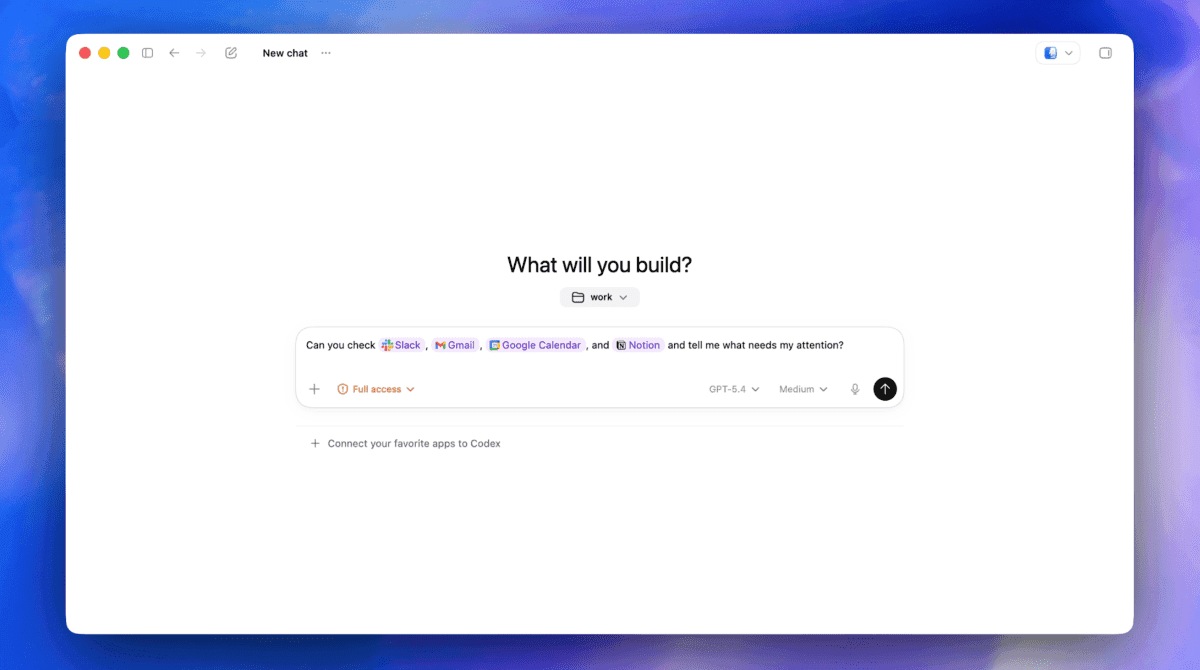
To further extend its reach, OpenAI has introduced 111 third-party plug-in integrations, including connections with platforms like CodeRabbit and GitLab Issues. These integrations allow Codex to interact with external tools and handle routine organizational tasks. For instance, users can now ask Codex to scan their Slack channels and Google Calendar and generate a personalized daily to-do list — a small but meaningful step toward functioning as a genuine digital assistant.
Flexible Pricing for Enterprise Users
Alongside these feature updates, OpenAI has introduced a pay-as-you-go pricing model for Codex, available to ChatGPT Enterprise and Business subscribers. This move gives corporate customers greater flexibility in how they access and pay for the tool, potentially lowering the barrier to adoption for teams evaluating AI coding solutions.
OpenAI Sharpens Its Enterprise Focus
For much of its history, OpenAI has been viewed as the dominant force in the AI industry. However, Anthropic has steadily gained ground, particularly in the enterprise coding segment, where Claude Code has earned a strong reputation among businesses. OpenAI appears to be recalibrating its strategy — pulling back from some consumer-facing projects and doubling down on tools designed for professional and corporate environments.
The Codex upgrades reflect a clear intent: to position the tool not just as a coding assistant, but as a fully integrated productivity platform capable of handling a wide range of tasks within modern business workflows. Whether these enhancements are enough to shift enterprise preference away from Claude Code remains to be seen, but OpenAI has made a compelling case that it is not ready to concede that ground.
