One Fuel, Two Engines: MIT's Breakthrough Could Send Mini Satellites All the Way to Mars
MIT engineers have developed a dual-mode propulsion system powered by a single fuel, potentially giving small satellites the range and flexibility to reach Mars.
MIT Engineers Crack the Code on Dual-Mode Spacecraft Propulsion
A team of researchers at the Massachusetts Institute of Technology has achieved a significant milestone in small satellite technology — demonstrating that a single fuel source can simultaneously power two fundamentally different types of spacecraft engines. The advancement could redefine what compact satellites are capable of, opening the door to deep-space missions that were once reserved for much larger and more expensive spacecraft.
The research, published in the Journal of Propulsion and Power, was led by former postdoctoral researcher Amelia Bruno and co-authored by Professor Paulo Lozano of MIT's Department of Aeronautics and Astronautics.
The Problem With Traditional Spacecraft Propulsion
Historically, spacecraft have relied on two distinct propulsion technologies that each serve very different purposes — and each requires its own dedicated fuel supply.
Chemical thrusters deliver rapid, powerful bursts of thrust, allowing a spacecraft to accelerate quickly, change altitude, or reposition itself in a short amount of time. Electric thrusters, on the other hand, are far more fuel-efficient and excel at providing slow, steady propulsion over long distances — ideal for extended interplanetary travel.
The challenge has always been that combining both systems on a small satellite meant carrying two separate fuel tanks and two sets of hardware, adding significant weight and complexity to an already size-constrained platform.
A Single Propellant That Does It All
The MIT team's solution centers on a specialized ionic liquid fuel developed by the U.S. Air Force called ASCENT — short for Advanced SpaceCraft Energetic Non-Toxic propellant. Originally engineered as a greener, safer replacement for hydrazine — a highly toxic chemical traditionally used in spacecraft propulsion — ASCENT was designed exclusively for chemical thrusters.
But the MIT researchers noticed something important: ASCENT is an ionic liquid, the same class of materials already used in electric propulsion systems.
"ASCENT happens to be an ionic liquid mixture," said Bruno. "And we said, hey, that's the stuff we typically use. Theoretically, this should work. Let's go figure out how."
That instinct proved correct.
How Electrospray Thrusters Work
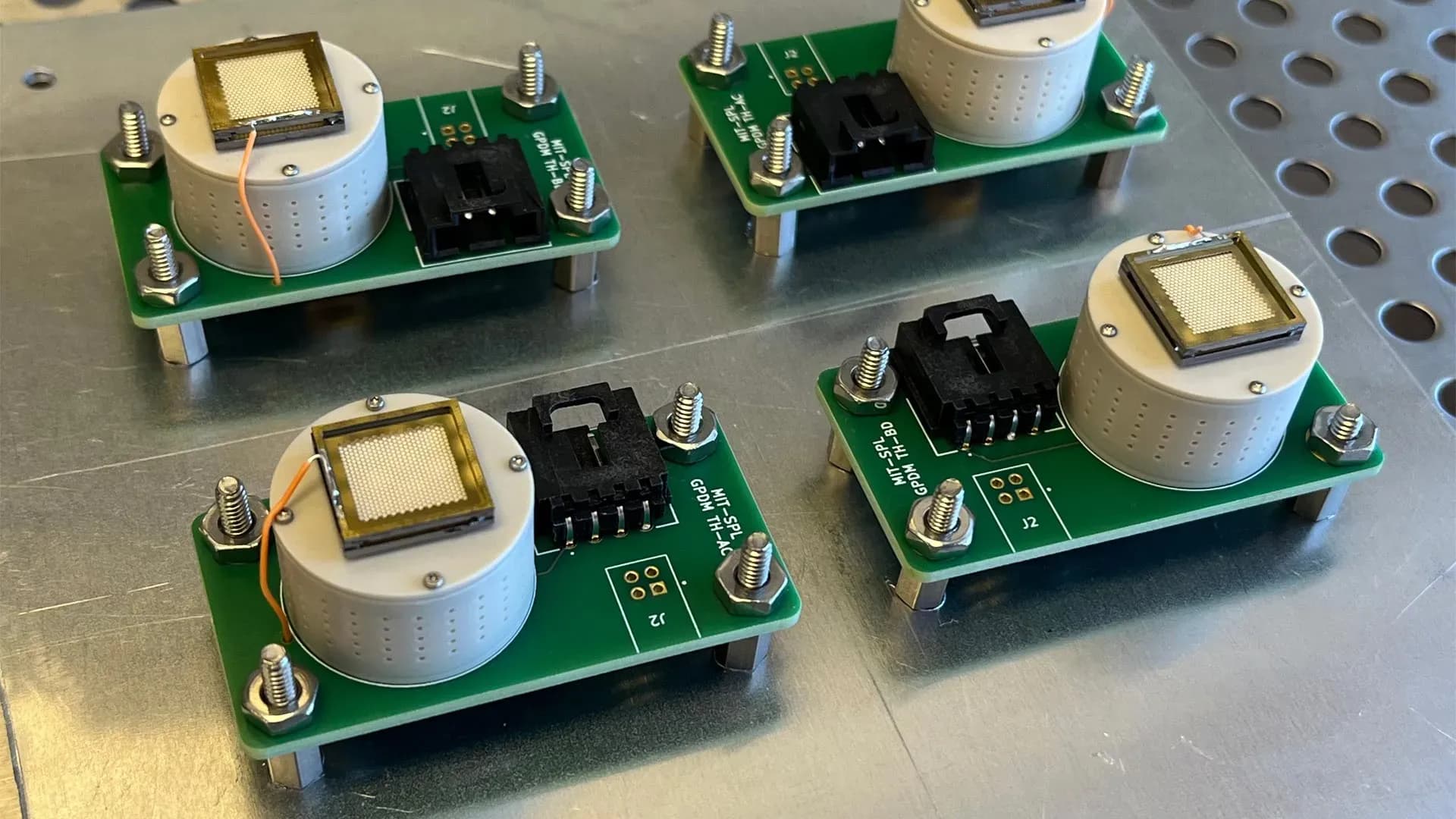
Electrospray thrusters are miniature rocket engines — roughly the size of a dime — that use electric fields to strip charged particles from a liquid propellant and accelerate them into space, generating thrust in the process. They are exceptionally fuel-efficient and well-suited for the kind of gradual, precise adjustments required during long-duration missions.
Lozano's laboratory at MIT has spent over a decade developing and refining these devices. The thrusters produced by his team are approximately thumbnail-sized and sit atop small reservoirs of ionic liquid propellant. When a voltage is applied, ions within the liquid are charged and expelled through microscopic openings, producing a continuous and controllable thrust.
Putting ASCENT to the Test
To validate their hypothesis, Bruno, Lozano, and former graduate student Matthew Corrado conducted a rigorous series of laboratory experiments. Each electrospray thruster was connected to a LEGO brick-sized reservoir containing just one gram of ASCENT — a liquid with a consistency similar to baby oil.
The thrusters were mounted on opposite sides of a small CubeSat positioned on a magnetic levitation test platform, known as the MagLev, housed inside a large vacuum chamber designed to simulate the conditions of outer space.
Researchers remotely adjusted the voltage delivered to the thrusters and observed the results. The electrospray generated sufficient force to rotate the CubeSat like a spinning top in a weightless environment. By running the thrusters continuously for sessions lasting up to 100 hours, the team was able to thoroughly evaluate ASCENT's performance and fuel efficiency.
The verdict was clear: ASCENT powered the electrospray thrusters just as effectively as conventional ionic liquid propellants, delivering comparable levels of thrust and efficiency.
"Compared to our normal electrospray propellants, ASCENT can provide similar performance in terms of thrust," Bruno noted. "Now that we know our thrusters work with ASCENT, we can start thinking of all the ways we can make them even better."
A NASA Mission Will Prove the Concept in Orbit
With laboratory results in hand, the team is now preparing for a real-world orbital demonstration. In collaboration with NASA, MIT engineers are developing the Green Propulsion Dual Mode mission — a briefcase-sized CubeSat equipped with one chemical thruster and four electrospray thrusters, all drawing from a single shared fuel tank.
This will mark the first time a dual-mode propulsion system of this kind has been tested aboard a small spacecraft in actual space conditions.
Opening the Solar System to Small Satellites
If the mission succeeds, the implications for small satellite exploration could be profound. Compact, affordable CubeSats — which are far cheaper to launch than traditional spacecraft — could gain the propulsion versatility needed for ambitious deep-space missions.
"We could send CubeSats to Mars, or the asteroid belt, where they could make the journey slowly, using electrospray thrusters," said Professor Lozano. "You could then use your chemical thrusters to quickly move to look at interesting features. You could have a lot more flexibility to do a lot more things."
For Bruno, the excitement goes beyond any single mission. "If you can have chemical and electrical propulsion in one small package, it's the best of both worlds," she said. "This opens the door for small satellites to do even more science, more observations, and more interesting missions — all on a smaller and cheaper platform."
With a NASA-backed orbital test on the horizon, that door may be closer to opening than ever before.