No Magnets, No Battery: Scientists Discover a New Way to Control Electrons
A physics breakthrough using tiny atomic vibrations could transform computing forever — no magnets, no electricity required.
A Quiet Revolution in Physics Could Change Computing Forever
A remarkable discovery in physics may be about to rewrite the rules of modern computing. Scientists have demonstrated that microscopic atomic vibrations — known as chiral phonons — can directly transfer motion to electrons, enabling them to carry information without the need for magnets, batteries, or electrical current. The finding opens up an entirely new discipline called orbitronics, where data is processed through the orbital movement of electrons rather than conventional electrical charge or spin.
Why the World Needs a Smarter Way to Compute
As global demand for data processing continues to climb, researchers are turning to the quantum realm in search of more efficient solutions. Orbitronics has emerged as one of the most promising frontiers in this search. The concept revolves around harnessing the orbital angular momentum of electrons — essentially, the way electrons orbit an atom's nucleus — to store and transmit information more efficiently than current methods allow.
The problem, until now, has been control. Influencing electron orbital motion has traditionally depended on magnetic materials like iron, which are heavy, expensive, and difficult to integrate into small-scale devices. A new study published in the journal Nature Physics has changed that picture dramatically.
The Role of Chiral Phonons
What Makes a Material Chiral?
To understand the breakthrough, it helps to understand chirality. Most solid materials have symmetrical atomic structures — their mirror image looks identical to the original. Chiral materials are fundamentally different. In substances like quartz, atoms are arranged in a spiral pattern, much like the threading of a screw. This twisted structure can be either left- or right-handed, and crucially, it cannot be overlaid on its own mirror image. Human hands offer a familiar everyday example of this property.
Atoms inside solids are never completely still — they vibrate constantly. In symmetrical materials, this vibration is generally a simple back-and-forth motion. In chiral materials, however, the spiral atomic arrangement causes atoms to move in circular or spiral paths instead.
How Phonons Carry Angular Momentum
When these circular vibrations travel through a material as collective waves, they form what scientists call chiral phonons. A useful analogy is the ripple effect at a concert, where one person begins swaying and the movement gradually spreads through the crowd.
Because the atoms trace circular paths, they carry angular momentum. The researchers proved that this momentum can be transferred directly to electrons — giving electrons orbital angular momentum without any involvement from magnets or external electrical sources.
The Breakthrough: Orbital Seebeck Effect
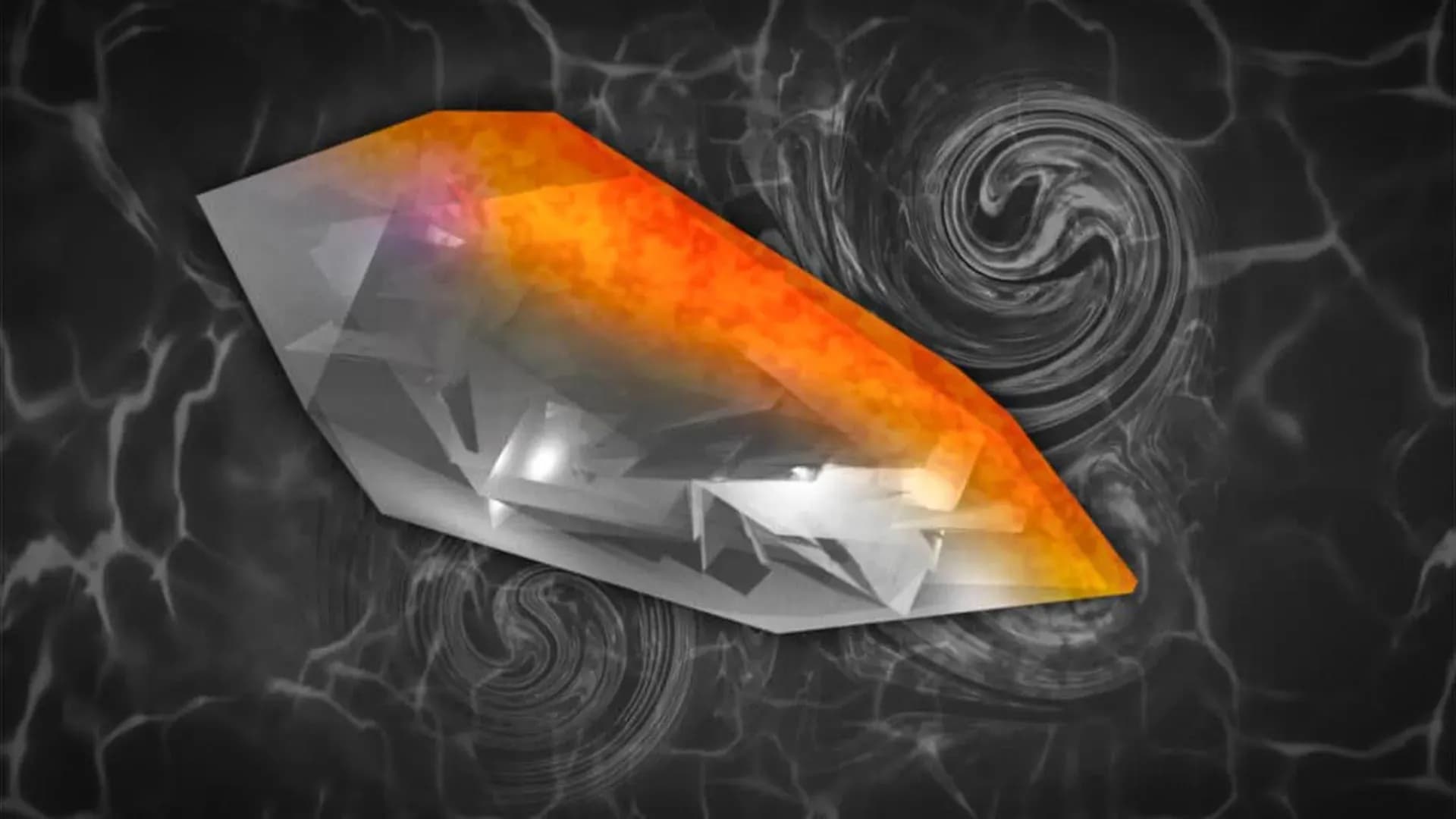
The research team, led by North Carolina State University in collaboration with the University of Utah and several other institutions, used α-quartz — a crystal with a naturally chiral structure — to test their theory.
Under normal conditions, chiral phonons in a material exist in a mix of left- and right-handed states. By briefly applying a magnetic field, the team was able to align these phonons. Once a sufficient number were aligned, their collective rotational motion transferred to the electrons — and this transfer persisted even after the external magnetic field was switched off.
The researchers named this phenomenon the orbital Seebeck effect, drawing a deliberate parallel to the spin Seebeck effect, which describes a related process involving electron spin. To measure the effect, they layered metals — specifically tungsten and titanium — on top of the quartz crystal. This setup converted the orbital motion of electrons into a detectable electrical signal.
For the first time, scientists at the University of Utah also directly measured the internal magnetism generated by chiral phonons in quartz, using specialized equipment at the National High Magnetic Field Lab in Florida. By firing lasers through the material and analyzing changes in the reflected light, they confirmed that chiral phonons produce a meaningful magnetic field — even in a material that is not itself magnetic.
What Scientists Are Saying
"The generation of orbital currents traditionally necessitates the injection of charge current into specific transition metals, and many of these elements are now classified as critical materials," said Dali Sun, physicist at North Carolina State University and co-author of the study. "There are other ways to generate orbital angular momentum, but this method allows for the use of cheaper, more abundant materials."
Valy Vardeny, distinguished professor in the Department of Physics & Astronomy at the University of Utah, put it even more directly: "We don't need a magnet. We don't need a battery. We don't need to use voltage. We just need a material with chiral phonons. Before, it was unimaginable. Now, we've invented a new field, so to speak."
Doctoral candidate Rikard Bodin of the University of Utah added a broader perspective on the discovery's long-term potential: "When we talk about discovering things like the orbital Seebeck effect — I can't tell you that your TV is going to run on it, but it's creating more levers that we can pull on to do new things. Now that it's here, someone else can push it forward, and before you know it, it's ubiquitous. That's how technology is."
Beyond Quartz: A Versatile Platform
One of the most significant aspects of the discovery is that it is not limited to quartz alone. The same principles can be applied to a range of other chiral materials, including tellurium, selenium, and hybrid organic-inorganic perovskites. Compared to existing orbitronics approaches, this method requires fewer raw materials, involves simpler processes, and allows orbital motion to persist for considerably longer periods.
This combination of accessibility, efficiency, and scalability positions the technology as a genuinely viable path toward next-generation computing devices that are faster, smaller, and far less energy-hungry.
A Wide Collaborative Effort
The study was the product of an extensive multi-institutional collaboration involving researchers from North Carolina State University, the University of Utah, Nanjing Normal University, the Air Force Research Laboratory, the University of Washington, the University of North Carolina at Chapel Hill, the National High Magnetic Field Laboratory, the University of Illinois at Urbana-Champaign, the University of South Carolina, and Pennsylvania State University.
The full findings were published in the journal Nature Physics.
