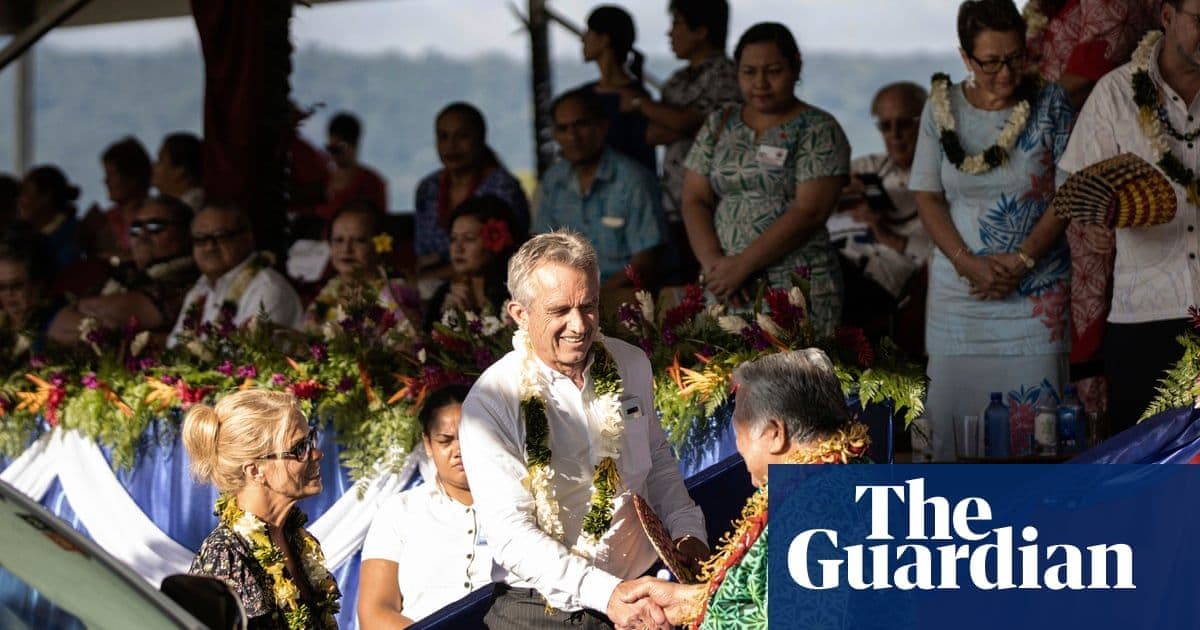
Newly Surfaced Emails Contradict RFK Jr.'s Senate Claims About His 2019 Samoa Visit
Emails obtained from government records suggest RFK Jr.'s 2019 Samoa trip was tied to vaccines — directly contradicting his sworn Senate testimony.

Emails Undermine Kennedy's Senate Testimony on Samoa Trip
Fresh documentary evidence is calling into question statements made by US Health Secretary Robert F. Kennedy Jr. during his Senate confirmation hearings, suggesting his 2019 visit to Samoa was directly connected to vaccines — despite his repeated insistence to the contrary.
Records reviewed by journalists reveal that Kennedy's colleague described their joint trip to Samoa as a vaccine-related "mission" in communications with local officials, a characterization that sharply contradicts Kennedy's sworn testimony before the Senate.
What the Emails Actually Say
Dr. Michael Graven, who served as chief information officer for Children's Health Defense — the anti-vaccine advocacy nonprofit Kennedy led at the time — wrote to Samoan officials outlining the purpose of their visit in considerable detail.
"The mission involves health informatics evaluation from medical record data from all hospitals and clinics in Samoa to evaluate outcomes associated with the recent discontinuity in vaccinations," Graven wrote in a May 2019 email, noting that he was sending it "after discussion with" Kennedy.
Graven, a pediatrician who passed away in 2022, outlined plans to visit every hospital and clinic across the island nation, collect data, and conduct a full statistical analysis. He framed the work as a study of health outcomes connected to a prolonged gap in the country's vaccination program — a pause that had lasted nearly 10 months.
Background: Samoa's Vaccination Crisis
Samoa's immunization program was halted in 2018 after two infants died following injections of an improperly prepared measles, mumps, and rubella vaccine. The government suspended all vaccinations until April 2019, causing rates to collapse across the island.
This period drew significant attention from anti-vaccine groups in the United States, including Kennedy's Children's Health Defense, which began contacting Samoan officials during the suspension, according to previously obtained correspondence.
Kennedy has long advocated for studies comparing the health of vaccinated children against unvaccinated children. Samoa's vaccination pause represented precisely the kind of "natural experiment" he had been seeking, and Graven's emails suggest that studying those outcomes was a central purpose of the trip.
Kennedy's Conflicting Senate Testimony
During his confirmation hearings, Kennedy told senators on multiple occasions that his trip to Samoa had absolutely nothing to do with vaccines.
When pressed by Senator Ron Wyden of Oregon, Kennedy stated: "I went there, nothing to do with vaccines. I went there to introduce a medical informatics system with digitalized records in Samoa and make health delivery much more efficient."
The following day, responding to questioning from Senator Edward Markey of Massachusetts, Kennedy again maintained: "My purpose in going down there had nothing to do with vaccines."
Kennedy also claimed that Children's Health Defense held a $6 million grant to digitize Samoa's health records, framing this as the sole reason for his visit.
The Reality on the Ground
A US State Department official stationed in Samoa, Antone Greubel, sent an internal email to colleagues on June 4, 2019 — shortly after Kennedy and Graven's departure — that offered a sobering assessment of the visit.
"Based on conversations with my contacts, RFK and Dr. [Graven] fell far short of their goal to influence Samoan government vaccination policy," Greubel wrote.
The email suggests that influencing vaccination policy was indeed an objective of the mission, directly contradicting Kennedy's claims about the trip's purpose.
By the time Kennedy arrived on May 30, 2019, Samoa had resumed vaccinations, but coverage rates remained dangerously low. Months later, a devastating measles outbreak swept through the country, infecting thousands and killing 83 people — the majority of whom were children under the age of five.
Samoan officials subsequently acknowledged that Kennedy's visit had lent credibility to anti-vaccine voices within the country.
Political Fallout and Ongoing Scrutiny
The revelations have intensified calls from Democratic lawmakers for accountability. Senator Wyden responded forcefully to the new findings, stating that they "offer more proof that Robert Kennedy is a liar on a mission to take vaccines away from kids who need them."
"Republicans have turned a blind eye to Kennedy's anti-vaccine crusade and abdicated their responsibility to hold those who lie to Congress accountable," Wyden added.
This is not the first time Kennedy's Samoa visit has drawn scrutiny. Earlier reporting by the Guardian and the Associated Press had already surfaced emails from US government and UNICEF officials that undermined his stated rationale for the trip, prompting two Democratic senators and a House member to accuse Kennedy of lying under oath.
A Pattern of Pro-Unvaccinated Research
The Samoa episode fits within a broader pattern of Kennedy's longstanding advocacy for research comparing vaccinated and unvaccinated populations — studies that mainstream medical experts say are deeply problematic from an ethical standpoint.
Kennedy's 2023 book, Vax-UnVax: Let the Science Speak, explicitly called for such comparative studies. Reports this year indicate that in his current role as health secretary, Kennedy has urged government scientists to pursue this line of research, which he believes will demonstrate harm from vaccines.
In a related development, the US Centers for Disease Control and Prevention last year funded a study in Guinea-Bissau that would have compared health outcomes in children vaccinated against hepatitis B with those who had not received the vaccine. The World Health Organization's director-general and other global health authorities condemned the study as unethical, and it was ultimately suspended.
Scientific consensus remains clear: vaccines are safe, rigorously tested, and have saved hundreds of millions of lives worldwide. Kennedy's continued push to cast doubt on that consensus — and the evidence that his Samoa mission was part of that effort — has placed his credibility as the nation's top health official under intense and growing scrutiny.

