Nature-Inspired Seawall Upgrades Are Reviving Marine Life Along South Florida's Forgotten Shorelines
A new wave of eco-conscious coastal design is transforming barren seawalls into thriving marine habitats — one mangrove planter at a time.

South Florida's Seawalls Are Getting a Nature-Inspired Makeover
Seawalls have long served a singular purpose: keeping water away from property and people. But a growing movement in coastal design is challenging that one-dimensional approach, pushing for infrastructure that works for marine wildlife just as effectively as it works for homeowners.
In a quiet residential canal in Pompano Beach, Florida, that vision is taking shape in a very tangible way.
Drilling Into a New Idea
Arthur Tiedeman, who runs a marine construction company, is standing on a floating barge as his crew drills into the face of a freshly installed seawall. The wall itself represents the modern standard — reinforced concrete wrapped in vinyl, smooth and featureless, engineered to hold back tides and protect real estate values.
But Tiedeman is quick to acknowledge what that polished surface sacrifices. "It's not a natural shoreline like mangroves and sand," he says. "It's just a straight giant wall."
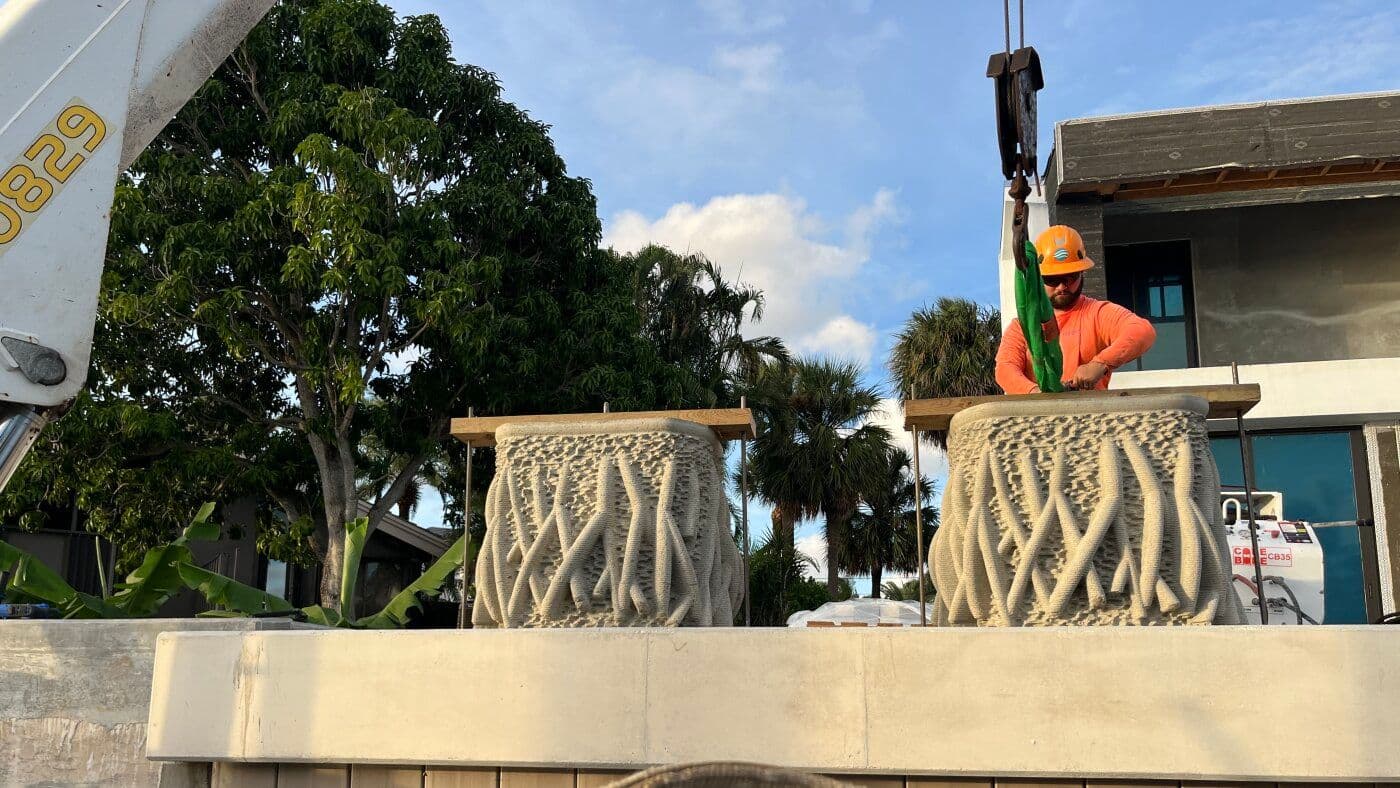
To address that, his crew is mounting two specially designed mangrove planters onto the wall — a first-of-their-kind installation intended to introduce living trees and functional marine habitat to an otherwise sterile stretch of coastline.
The Designer Behind the Planters
The planters were conceived by Keith Van de Riet, an architecture professor at the University of Kansas and a lifelong fishing enthusiast. Their surfaces are deliberately rough and irregular — etched with grooves and pockmarks designed to replicate the complex textures of oyster reefs and mangrove root systems.
"Even these tiny little pores you get, those are little pockets that tiny organisms will start to take up residence in," Van de Riet explains.
For more than a decade, Van de Riet has been focused on reimagining seawalls — what he describes as a "forgotten edge" of coastal ecosystems. His reasoning is straightforward: in many developed areas, seawalls are the only shoreline that remains. Natural mangrove forests and tidal wetlands have been dredged away and replaced with hardened edges that offer little to no ecological value.
"This all would have been meandering mangroves, maybe a mangrove creek here that people just blew out," he says, surveying the canal.
From Intertidal Zone to Vertical Wall
The ecological cost of that transformation is significant. What was once a rich, horizontal intertidal zone — home to oysters, crabs, fish, and shorebirds — has effectively been compressed into a flat vertical surface. Marine life, Van de Riet points out, thrives on complexity.
"The more texture the better," he says.
Oysters, in particular, are a keystone species in coastal marine ecosystems, playing a critical role in filtering water and supporting biodiversity. Traditional concrete seawalls, which have dominated South Florida's shoreline for over a century, at least offered some rough surface texture where small oyster colonies could cling and grow.
But that modest foothold is now under threat. As aging post-World War II seawalls reach the end of their lifespan — a wave of replacement that Tiedeman calls the "seawall pandemic" — they are increasingly being swapped out for steel or vinyl structures. These newer materials are far smoother, offering virtually no surface for marine organisms to colonize.
"We're taking that last 1% of habitat that they're clinging to and changing the material," Van de Riet warns. "We're pulling the rug out from under these oysters."
A Growing Commercial Market for Eco-Friendly Coastal Solutions
Van de Riet's mangrove planters are part of a broader surge of nature-inspired products entering the coastal infrastructure market. Property owners can now purchase artificial reef balls or install vertical oyster gardens. Miami Beach has unveiled its first "living seawall" — a wide panel etched with mangrove root patterns designed to support habitat and buffer against storm surge. A similar wall panel created by Van de Riet has been submerged in southwest Florida waters since 2016.
Rachel Gittman, a coastal ecologist at East Carolina University, sees genuine promise in these innovations — though she urges measured expectations. Replicating the complexity of natural ecosystems is no simple feat.
"But in places where the habitat has already been lost or someone's just going to put in a regular seawall, I think it's a better option," she says. "Even a small little oyster reef can support a lot of organisms."
Scaling Up Is the Real Challenge
The bigger obstacle, Gittman notes, is scale. A 2021 study found that only approximately 15% of the world's coastal regions remain ecologically intact. Reversing that trend will demand more than innovative products — it will require meaningful policy reform at both the local and national level.
In South Florida specifically, where coastal infrastructure is being overhauled to keep pace with rising sea levels and where the overwhelming majority of shoreline is privately owned, the success of these efforts will also hinge on convincing individual homeowners to embrace a more ecologically responsible approach.
Tiedeman believes that argument is easier to make than people might think. "That's what makes all these properties worth what they're worth," he says, gesturing toward the canal-front mansions nearby. "The water. And the enjoyment of the water."
Protecting marine life, in other words, may ultimately be one of the smartest investments a coastal homeowner can make.