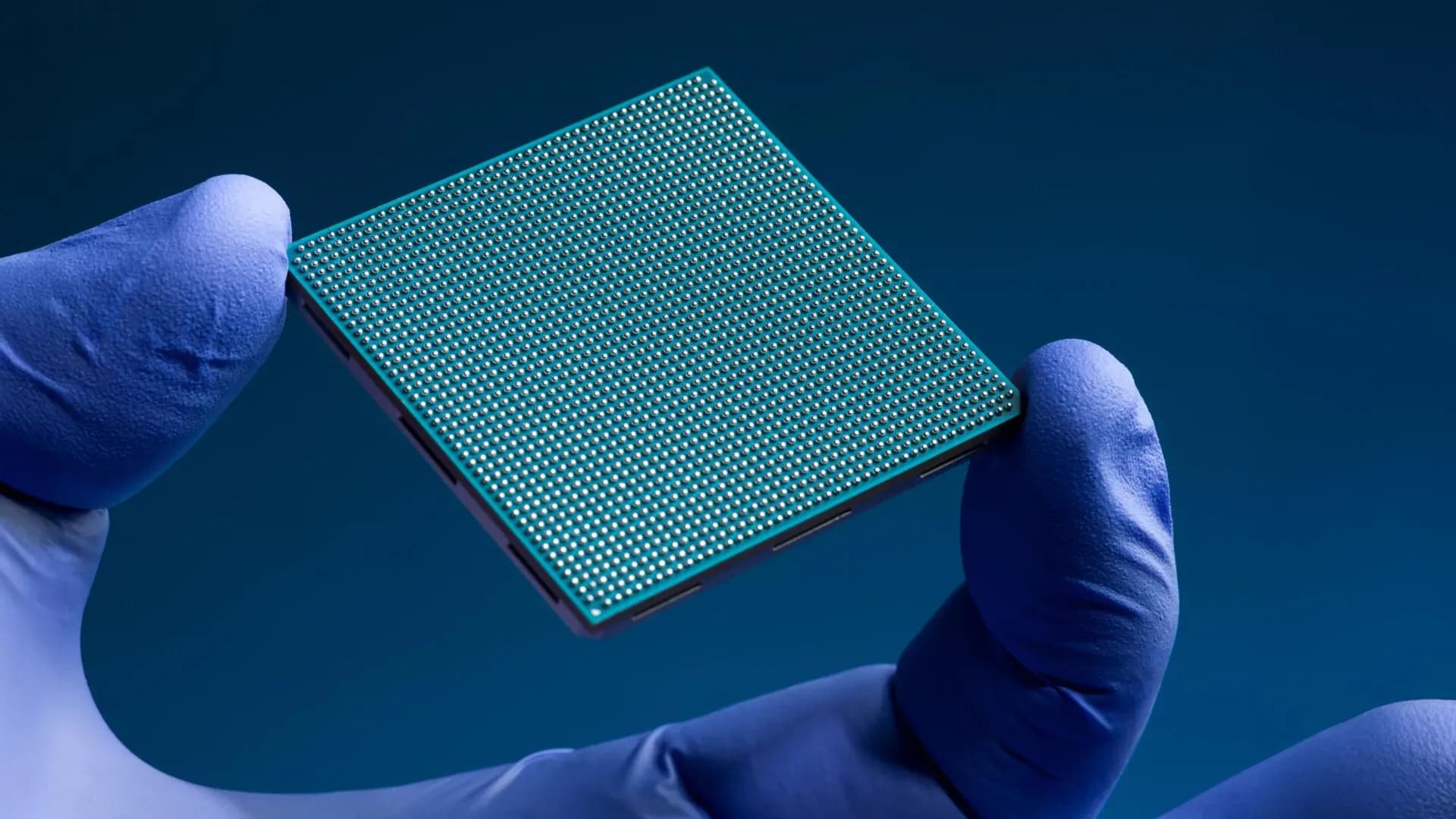
NASA's Revolutionary AI Chip Could Make Spacecraft Think for Themselves
NASA is testing a groundbreaking radiation-hardened processor 500x more powerful than current space chips, potentially enabling AI-driven autonomous spacecraft.
NASA's Revolutionary AI Chip Could Make Spacecraft Think for Themselves
A cutting-edge computer chip under development by NASA could fundamentally transform how spacecraft operate in deep space — giving them the ability to make independent decisions, process scientific data on the fly, and respond to unexpected situations without waiting for instructions from Earth.
The radiation-hardened processor is currently undergoing rigorous testing and has already demonstrated performance levels approximately 500 times greater than the chips currently powering spacecraft today. If successfully certified for spaceflight, the technology could redefine autonomous space exploration and accelerate humanity's reach toward the Moon, Mars, and beyond.
The Push for Smarter Spacecraft
NASA's High Performance Spaceflight Computing project was created to address a growing gap between what future missions demand and what existing hardware can deliver. Today's spacecraft rely on older processors chosen primarily for their durability in extreme environments — not their computing muscle. While these chips hold up well in space, they simply aren't powerful enough to support the next generation of ambitious exploration goals.
As missions grow more complex and destinations grow more distant, the need for onboard intelligence becomes critical. Communication delays between Earth and deep space probes can stretch from minutes to hours, making real-time human control nearly impossible. Smarter onboard computing could fill that gap, allowing spacecraft to handle emergencies, analyze data, and make navigational decisions autonomously.
"Building on the legacy of previous space processors, this new multicore system is fault-tolerant, flexible, and extremely high-performing," said Eugene Schwanbeck, program element manager in NASA's Game Changing Development program at Langley Research Center in Hampton, Virginia. "NASA's commitment to advancing spaceflight computing is a triumph of technical achievement and collaboration."
Pushing the Chip to Its Limits
Engineers at NASA's Jet Propulsion Laboratory (JPL) in Southern California are subjecting the new processor to an extensive battery of tests designed to simulate the brutal realities of space travel. These include exposure to intense electromagnetic radiation, extreme temperature swings, and physical shock — all conditions that can wreak havoc on conventional electronics.
High-energy particles from the Sun and cosmic rays are a particular concern, as they can trigger computing errors that force spacecraft into "safe mode," temporarily disabling non-critical systems until ground teams can intervene. The new chip must prove it can withstand such events without compromising mission integrity.
"We are putting these new chips through the wringer by carrying out radiation, thermal, and shock tests while also evaluating their performance through a rigorous functional test campaign," said Jim Butler, High Performance Space Computing project manager at JPL.
Engineers are also testing the chip's ability to handle the intense data demands of planetary landings — one of the most computationally taxing phases of any space mission.
"To simulate real-world performance, we are using high-fidelity landing scenarios from real NASA missions that would typically require power-intensive hardware to process huge volumes of landing-sensor data," Butler added. "This is an exciting time for us to be working on hardware that will enable NASA's next giant leaps."
Testing kicked off in February and is expected to run for several more months. Early results have exceeded expectations, with the processor performing as designed and delivering that remarkable 500x performance advantage over current radiation-hardened alternatives. In a nod to computing history, the team celebrated the start of testing by sending an internal email with the subject line "Hello Universe" — a playful tribute to the iconic introductory messages of early programming.
A Tiny Chip With Enormous Potential
The processor is classified as a system-on-a-chip (SoC) — a compact design that integrates all essential computing components into a single unit, including central processing units, networking systems, memory, and input/output interfaces. The same architecture is found in modern smartphones and tablets, prized for its efficiency and small footprint. NASA's version, however, is engineered to endure years of operation in the harshest environments imaginable, potentially traveling billions of miles from Earth with no opportunity for physical maintenance.
The chip is being co-developed by JPL and Microchip Technology Inc., headquartered in Chandler, Arizona. NASA selected Microchip as its commercial partner in 2022, and the company has since funded its own research and development efforts on the project. Sample chips have already been distributed to defense and commercial aerospace partners for evaluation.
Enabling AI-Powered Deep Space Exploration
Perhaps the most transformative application of the new processor is its potential to support artificial intelligence onboard spacecraft. With sufficient computing power, AI systems could allow a probe to respond intelligently to unexpected discoveries or system failures — all in real time, without waiting for a signal from Earth that might take hours to arrive.
The chip could also dramatically improve how deep space missions handle scientific data — collecting, processing, and transmitting far larger volumes of information back to researchers on Earth than is currently possible.
NASA envisions the processor eventually supporting crewed missions to the Moon and Mars, as well as a broad range of robotic missions including Earth-orbiting satellites, planetary rovers, and deep space probes.
Benefits Beyond Space
The innovation isn't limited to space exploration. Microchip Technology plans to adapt the processor for use in terrestrial industries including aviation and automotive manufacturing, where its combination of high performance, compact design, and resilience could prove equally valuable.
The project is overseen by NASA's Space Technology Mission Directorate through its Game Changing Development program at Langley Research Center, with JPL — managed by Caltech in Pasadena, California — playing a central role in development and testing from early mission planning through final hardware delivery.