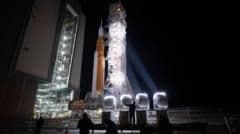
NASA's Artemis II Moon Rocket Returns to Launch Pad Ahead of Historic April Mission
NASA's massive Space Launch System has rolled out to its Florida launch pad again, setting the stage for a crewed lunar flyby not seen since the Apollo era.
NASA Gears Up for First Crewed Lunar Mission in Over Half a Century
For the first time in more than 50 years, NASA is on the verge of sending a human crew on a journey around the Moon. The agency's towering Space Launch System rocket has made its way back to the launch pad at Kennedy Space Center in Florida, marking a significant milestone in the Artemis program's push toward crewed deep-space exploration.
A Four-Mile Journey Through the Florida Night
Just after midnight local time — 12:20 AM Eastern (04:20 GMT) — the 98-meter-tall SLS rocket and its attached Orion spacecraft emerged from the iconic Vehicle Assembly Building, one of the largest structures on Earth, and began a slow, deliberate crawl toward Launch Pad 39B along Florida's Atlantic coast.
The combined rocket and launch platform tip the scales at roughly 5,000 tonnes and were transported by Crawler-Transporter-2, a massive, track-driven vehicle originally constructed by NASA back in 1965 to haul Saturn V rockets to the pad during the Apollo program. The crawler's top speed barely reaches 1 mph (1.6 km/h), and it moves even more cautiously around curves and up inclines — meaning the four-mile trip can stretch across a full 12 hours.
Why So Slow?
The unhurried pace is entirely deliberate. Moving what is essentially a mobile skyscraper worth billions of dollars requires extreme care. The gradual motion minimizes structural stress on the rocket and gives launch teams time to detect and respond to any unexpected shifts in the vehicle during transit.
What Caused the Delay?
This is not the first time the Artemis II rocket has made the journey to the pad. In March, NASA was forced to halt a planned launch attempt after engineers detected an interruption in helium flow to the rocket's upper stage during a fueling test. Rather than attempting a fix while the vehicle sat exposed on the launch pad, mission managers made the cautious decision to roll the SLS back indoors.
Inside the Vehicle Assembly Building, technicians raised work platforms around the upper stage to gain full access to the affected area. They replaced suspect components within the helium circuit, swapped out batteries in several critical systems, and conducted repeat testing to verify the fault had been fully resolved. Helium plays a vital role in pressurizing propellant tanks, and any malfunction in that system could compromise upper stage engine performance or complicate fuel drainage procedures.
Following a thorough data review, NASA managers gave the green light for the second rollout.
What Happens Next at the Pad
Now that the rocket has arrived at Pad 39B, engineers will spend several days running a comprehensive series of checks. These include verifying that all VAB repairs remain intact after the journey, reconnecting the launch tower to the vehicle, and conducting pressure tests on the helium system that previously caused the abort.
Flight controllers will also rehearse portions of the launch countdown — issuing commands through the same computers and communication networks that will be active on launch day — though propellant will not be loaded into the tanks during these drills.
Once all pad testing is complete, NASA's mission management team will convene a few days before the earliest available launch opportunity to evaluate the results and make a final go or no-go decision.
Meet the Artemis II Crew
The four astronauts assigned to this historic mission have already entered pre-flight quarantine. Commander Reid Wiseman, pilot Victor Glover, mission specialist Christina Koch, and Canadian Space Agency astronaut Jeremy Hansen will travel to Florida closer to launch day to participate in various pre-launch rehearsals, including suit-up procedures and a formal visit to the launch pad.
Launch Windows and Mission Profile
NASA is targeting an initial launch attempt at 6:24 PM Eastern Daylight Time on April 1st (11:24 PM UK time). Should that opportunity be missed, backup windows are available on April 2nd, 3rd, 4th, 5th, and 6th, with a final opportunity for the month falling on April 30th.
The Artemis II mission is planned to last approximately ten days. The crew will travel around the far side of the Moon before looping back toward Earth — a trajectory not flown by any human crew since the final Apollo missions of the early 1970s.
A Stepping Stone to Landing on the Moon
If Artemis II succeeds, it will mark the first crewed spaceflight in the Artemis program and lay the groundwork for what comes next. Artemis III, currently scheduled for 2027, will place astronauts in Earth orbit as an additional test flight. That mission will then be followed by Artemis IV in 2028, which carries the ambitious goal of returning humans to the lunar surface for the first time in over five decades.