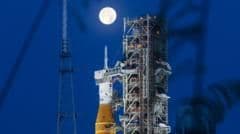
NASA Sets April Launch Window for Artemis II Moon Mission
NASA confirms the Artemis II mission is back on schedule for early April, marking humanity's return to lunar orbit for the first time in over five decades.
NASA Clears Artemis II for April Launch After Technical Repairs
NASA has announced that its long-anticipated Artemis II mission is targeting an early April liftoff, bringing humanity closer to returning astronauts to the vicinity of the Moon for the first time since the Apollo era — more than 50 years ago.
Helium Leak Pushes Launch from March to April
The mission had originally been scheduled for a March departure, but a helium leak discovered in the rocket forced engineers to wheel the vehicle back to the Vehicle Assembly Building at Cape Canaveral, Florida. After completing the necessary repairs, NASA expressed full confidence that the issue has been resolved.
The agency is now planning to roll the rocket back out to the launchpad on March 19, with April 1 representing the earliest available launch opportunity.
Meet the Artemis II Crew
Four astronauts have been selected for this historic mission. Three are American — Reid Wiseman, Victor Glover, and Christina Koch — joined by Canadian astronaut Jeremy Hansen. Together, they will become the first crew to fly aboard NASA's powerful Space Launch System (SLS) rocket and travel inside the Orion spacecraft.
Over the course of a 10-day mission, the crew is scheduled to loop around the far side of the Moon — the hemisphere permanently hidden from Earth's view — before making their return journey home.
Risk Assessment and Mission Confidence
During a recent press briefing, NASA leadership openly addressed the inherent dangers associated with flying a brand-new rocket system with astronauts aboard.
"We want to be sure that we're thinking about everything that can possibly go wrong, and have we assessed and adjudicated all the risks to put us in the best posture to be successful," said John Honeycutt, chair of the Artemis II Mission Management Team.
Honeycutt also put the mission's risk profile in broader context, noting that historically, new rocket programs achieve success roughly 50 percent of the time — but suggested NASA's rigorous preparation places this mission in a significantly stronger position.
"We do an outstanding job of understanding the risk, buying down the risk, mitigating the risk, and putting together controls to manage the risk," he added.
No Additional Wet Dress Rehearsal Planned
NASA officials confirmed they will not conduct another wet dress rehearsal — a pre-launch procedure in which the rocket is loaded with propellant and run through the full countdown sequence — once the vehicle returns to the launch site.
"The next time we tank the vehicle will be when we're attempting to launch," said Lori Glaze, acting associate administrator for the Exploration Systems Development Mission Directorate.
Glaze also noted that while April 1 is being targeted as the first launch opportunity, some preparatory work remains before an official date is confirmed.
"I am comfortable and the agency is comfortable with targeting April 1 as our first opportunity, just keep in mind we still have work to go," she said. "We will launch when we're ready."
Mounting Pressure to Launch
Artemis II has already faced a two-year delay, stemming from issues identified with the heat shield on Artemis I — an uncrewed test flight that sent the SLS rocket and Orion capsule on a successful loop around the Moon. In December 2024, NASA established a firm deadline, committing to launch Artemis II before the close of April 2026.
With that deadline looming and repairs now complete, all eyes at the agency are firmly fixed on the spring launch window. "At this point, we're very focused on April," Glaze confirmed.