‘My ideas are a little revolutionary’: ecologist Suzanne Simard on intelligent forests, the climate and her critics
Her research popularised the idea of the wood wide web, but the scientific backlash was brutal. As the author of The Mother Tree returns to the forest in a new book, she discusses her battle to reimag

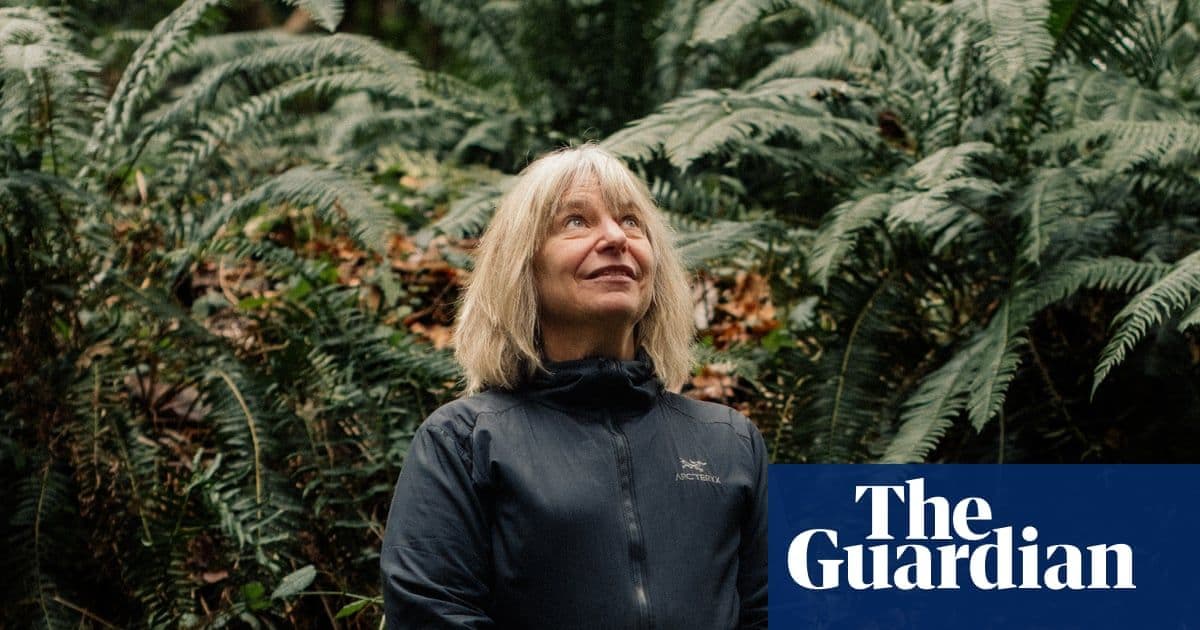
Suzanne Simard Photograph: Alana Paterson/The Guardian View image in fullscreen Suzanne Simard Photograph: Alana Paterson/The Guardian Interview ‘My ideas are a little revolutionary’: ecologist Suzanne Simard on intelligent forests, the climate and her critics Sophie McBain Her research popularised the idea of the wood wide web, but the scientific backlash was brutal. As the author of The Mother Tree returns to the forest in a new book, she discusses her battle to reimagine our relationship with nature
I n 2018, the ecologist and writer Suzanne Simard was conducting research in the forested Caribou Mountains of western Canada when a thunderstorm rolled in. She was with her two teenage daughters and her close friend and colleague, Jean Roach. They saw flashes of lightning, heard a loud rumble and then they smelled smoke. They were forced to run the half kilometre back to Simard’s truck as the trees behind them caught alight and the air grew thick. As they ran, animals burst out of the forest: a deer, a rabbit, a grey wolf. They reached the truck with no time to spare, all four of them covered in soot and dirt. Overhead, helicopters began circling the orange-black air, dropping water on the flames below.
Wildfires have become an ever bigger problem in Canada. The 2018 wildfires were the biggest in British Columbia’s history, but this record was broken in 2021, and then again in 2023, when fires consumed an area three times the size of the Canadian province of Nova Scotia and the smoke travelled as far as New York City. The cause is not only global heating, which has brought hotter, dryer summers, but also the changing makeup of the forest. When logging companies clear forest, they replant it with fast-growing conifer species, but these trees are much more flammable than Canada’s diverse, native forest.
The country’s forests are so huge that for decades policymakers assumed that human activity would make little impact. “The rationale was that it will all come out in the wash: the trees will recover, the forests will grow back, and we’ll all be fine,” Simard says, speaking on a video call from Vancouver. But deforested areas do not fully recover, and thanks to logging, the wildfires and a devastating pine beetle outbreak, Canada’s forests, once a vast carbon sink, have since 2001 been a net emitter of carbon.
For four decades, Simard, a professor of forest ecology at the University of British Columbia in Vancouver, has been trying to convince foresters and policymakers that it doesn’t have to be this way. “What we’re doing by taking down forests is we’re undercutting our ability to solve, and to provide natural solutions to, climate change,” she says. Billions of dollars are being invested in carbon capture and storage technology, “but we actually have highly evolved organisms like trees and plants and algae that do this very thing much more effectively than anything we can possibly create ourselves. And yet, we’re cutting these creatures down.”
Her use of “creatures” is not a slip. Simard’s research, outlined in her bestselling 2021 book, Finding the Mother Tree , has suggested that trees are perceptive, collaborative, able to communicate with one another and to recognise kin. While scientists have traditionally viewed forests as a collection of individual trees competing for resources, Simard argues that they are better thought of as complex, interdependent communities, connected by an underground network of fungi known as mycorrhiza, through which nutrients are exchanged.
She names the oldest, biggest, most connected trees the “mother trees” (although trees are both male and female), to reflect their role in nurturing the surrounding forest. “I came up with the idea with a group of my students and colleagues in a bar, actually,” she says. “Everyone has a mother. Everybody knows they were nurtured and cared for and that they needed a boost up.” It turned out to be a better metaphor than she imagined, she says, because many cultures already speak of mother trees.
Simard is 65, with bobbed, grey-blond hair and a thick Canadian accent, all soft vowels and generous, round “r”s. She is friendly but seems guarded on our call, and she keeps her video background blurred. One senses she’d be much more comfortable trampling through the forest, sharing a beer on the bed of a pickup truck or, frankly, even hiding up a tree from a territorial mama grizzly – something she has actually had to do, bears being a common field hazard.
She describes herself as a “person of the forest”, having grown up in the Monashee Mountains of British Columbia, where her grandfathers and uncles worked as loggers, and where you can find a creek and a mountain named after her family. Simard followed her relatives into the industry by studying forest management at the University of British Columbia and taking seasonal work at a logging company in the early 1980s, when she was the only woman on staff. Later, she completed a master’s and a PhD in forest ecology at Oregon State University while working for the Canadian forest service as a research scientist.
Then, as now, logging companies clear-cut swathes of forest and replanted them with a fast-growing, single species of tree. They used herbicides to kill other plants that intruded on replanted forest, so that the conifers would not be outcompeted. Simard noticed, however, that replanted forests were often sickly. She observed that, contrary to received wisdom, seedlings seemed to fare better when they grew alongside other plants, and she came to suspect that the mycorrhiza that colonised the soil in diverse forests played a role.
View image in fullscreen Suzanne Simard Photograph: Alana Paterson/The Guardian Simard recorded that up to 10% of newly planted Douglas firs would get sick and die whenever nearby aspen or paper birch were removed. As part of her doctorate thesis, she demonstrated that fir and birch trees, which often grow together in the wild, trade nutrients. When a birch tree shades a fir, it transfers more carbon to it, via mycorrhiza. When the birch tree loses its leaves in autumn, the flow of carbon is reversed. In 1997, Simard published a landmark paper in the scientific journal Nature, outlining her findings. Nature ran it as a cover story, under the catchy title “The wood wide web”, referencing the underground network of mycorrhiza that enables trees to exchange nutrients. To be published in such a prestigious journal was a remarkable achievement for a forest service scientist, and the paper garnered international media attention because it suggested a new way of understanding how forests work, and what trees are: intelligent, perceptive beings. In 2002, she left the forest service for full-time academia.
While foresters have traditionally adopted the “masculine” lens of dominance and competition, Simard says her research helped introduce the missing “feminine perspective”. “The forest has got all of these connections and relationships, which women understand really well, and we nurture and honour these things. Men are sometimes, you know, blind to that.” She says that while the scientific community has often had a “harder time” absorbing her ideas, her work aligns with indigenous wisdom on how forests work and tends to make intuitive sense to lay people, too. People often write to her to tell her how her work resonates with them because, “they understood from their hearts that of course forests are social places … so it’s their intuition, their deep wisdom,” she says.
In 2016, Simard gave a TED Talk, “ How trees talk to each other ”, that has been viewed more than 8m times online. Her research turned her into a cult figure, inspiring a character in Richard Powers’s Pulitzer prize-winning 2018 novel, The Overstory , and paving the way for other popular science books such as Peter Wohlleben’s The Hidden Life of Trees and Merlin Sheldrake’s Entangled Life .
But, after the publication of The Mother Tree, Simard’s work was met with forceful scientific backlash. This was not limited to critiques in academic journals. One critic wrote a letter to her university accusing her of lacking scientific integrity, and emailed newspapers and magazines asking them to remove profiles of her. This seems to go beyond the realm of scientists debating the research, I say. “Yes, I agree,” Simard says. “I don’t know how unusual that kind of backlash is. I think it happens, and it’s kind of unfortunate. But I look back, and I think history repeats itself.” She cites the resistance faced by the primatologist Jane Goodall, because she named the chimps she studied, and James Lovelock, who first proposed the Gaia hypothesis, the idea that the Earth is a self-regulating system. Backlashes happen, she says, “when you have an idea that is a little revolutionary, that is not following the mainstream, that threatens the structure of the scientific method”.
Simard’s initial reaction was to retreat. She started keeping her camera off in Zoom calls. “It was really hard, that whole period,” she says. “Because my training is in science. My degrees are in science. My job is about science … It’s so hurtful because it’s your peers – it’s a rejection.” The forest ecology community is small, and some of those publicly criticising her work were former collaborators and co-authors. Did it seem personal? “I don’t know the answer to that question. You could ask them, but I hadn’t been in contact with them for a while, so I don’t know,” she says.
There are specific points of contention, over questions such as whether fungi are the prime way that nutrients pass between plants, or whether Simard underplays the role of competition in forests, and she sends me a paper in which she responds to these points. An overarching theme, however, is that there still isn’t enough evidence for Simard’s assertions. “That’s such a common refrain in science, and who can argue with that?”
Simard says she sometimes feels straitjac

