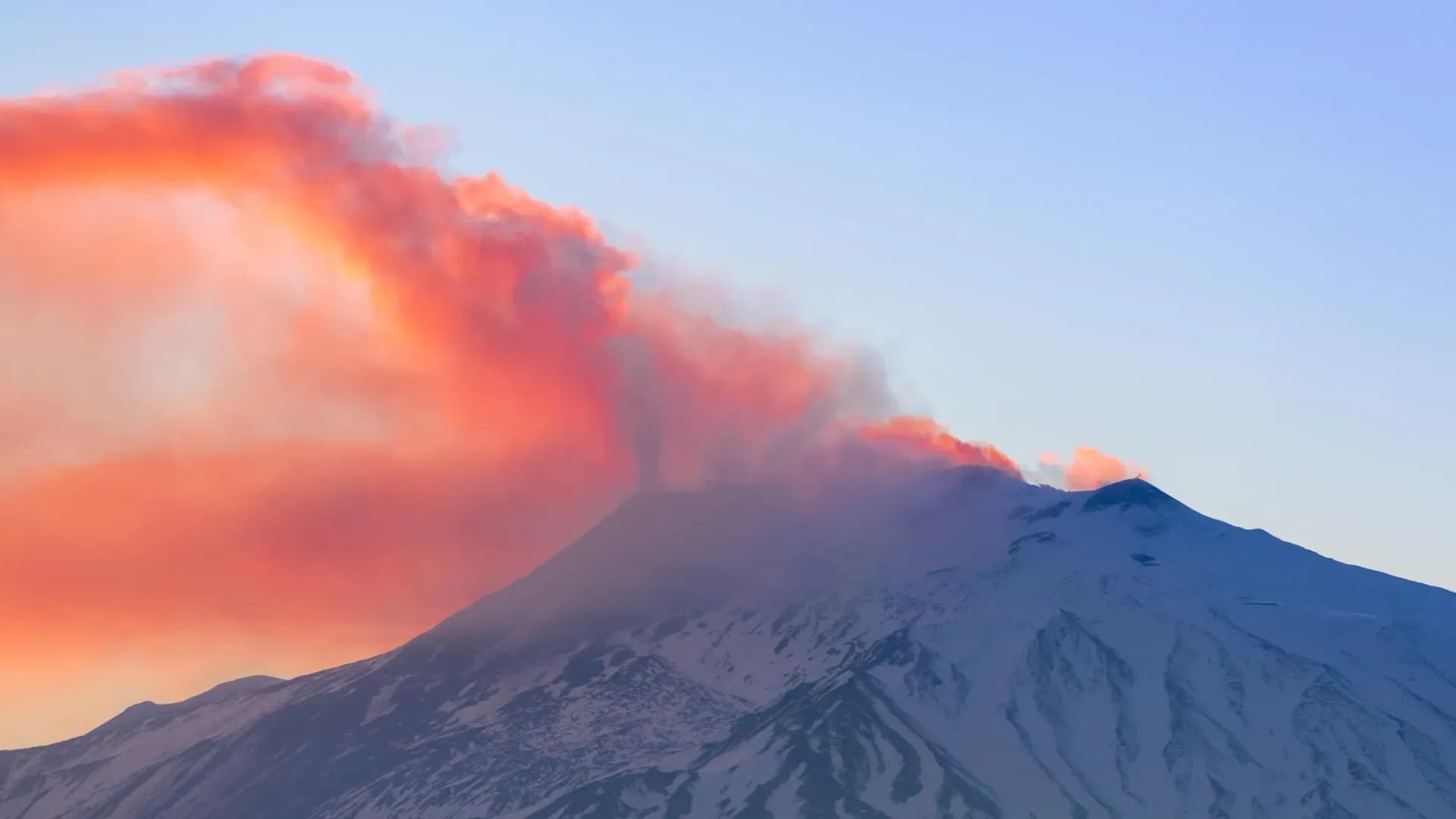
Mount Etna May Belong to a Rare Fourth Volcano Category, Scientists Say
Europe's most active volcano has baffled geologists for decades. A groundbreaking new study suggests Mount Etna formed through a process unlike any other large volcano on Earth.
Mount Etna's Mysterious Origins May Finally Have an Answer
For decades, Mount Etna has been a geological enigma. Perched on the Italian island of Sicily, this towering giant erupts multiple times each year, making it the most active volcano in Europe. Yet despite centuries of observation and study, scientists have never been able to fully explain how it came to be — until now.
A new study from researchers at the University of Lausanne (UNIL) proposes a bold explanation that could fundamentally reshape our understanding of volcano formation. Their findings suggest Mount Etna may have originated through a volcanic process never before linked to any large volcano on Earth, potentially placing it in a category entirely its own.
Why Mount Etna Has Always Defied Explanation
Volcanoes generally form in one of three well-established ways: through subduction zones where one tectonic plate slides beneath another, at hotspots where plumes of heat rise from deep within the mantle, or along diverging tectonic boundaries where plates pull apart. Each category produces a recognizable chemical signature in the lava it generates.
Mount Etna, however, does not align cleanly with any of these categories. While the volcano sits in a region associated with subduction activity, the chemical composition of its lava bears a much stronger resemblance to hotspot volcanoes — even though no known hotspot exists beneath Sicily. This contradiction has frustrated geologists for generations and left a significant gap in our understanding of one of the world's most studied volcanoes.
A Deep, Ancient Magma Source
The UNIL research team, working in collaboration with Anna Rosa Corsaro of the Istituto Nazionale di Geofisica e Vulcanologia in Catania, offers a compelling new hypothesis to fill that gap.
According to the study, published in the Journal of Geophysical Research — Solid Earth, Mount Etna is likely fed by ancient pockets of magma that have been sitting in the upper mantle approximately 80 kilometers (50 miles) below the surface. Unlike the magma beneath most volcanoes, which typically forms in the lead-up to eruptions, this material may have accumulated over long periods before being pushed toward the surface.
The mechanism driving this upward movement is the ongoing collision between the African and Eurasian tectonic plates. As these massive plates press against one another near the subduction zone, the bending and fracturing of the rock creates pathways through which the pre-existing magma can migrate upward — functioning, in essence, like liquid being squeezed out of a saturated sponge.
A Rare Fourth Category of Volcano
The team believes this process links Mount Etna to a poorly understood class of volcanoes known as "petit-spot" volcanoes. First described by Japanese geologists in 2006, petit-spot volcanoes are small underwater structures that form when pre-existing pockets of magma near the top of the mantle are released through fractures in the oceanic crust. The concept that such magma reservoirs exist in the upper mantle was actually first proposed in the 1960s but remained largely theoretical for decades.
What makes the new findings so striking is the scale. Petit-spot volcanoes are typically tiny, rising only a few hundred meters from the seafloor. Mount Etna, by contrast, stands more than 3,000 meters (9,800 feet) above sea level and has been erupting for approximately 500,000 years.
"Our study suggests that Etna may have formed through a mechanism similar to the one that generates petit-spot submarine volcanoes," said Sébastien Pilet, Professor at the Faculty of Geosciences and Environment at UNIL and lead author of the study. "This is unexpected, as such processes had previously only been observed in very small volcanic structures. Mount Etna, by contrast, is a large stratovolcano whose activity began around 500,000 years ago."
500,000 Years of Volcanic History Under the Microscope
To test their hypothesis, the researchers analyzed rock samples collected from across Mount Etna's 500,000-year eruptive history. By carefully reconstructing the chemical evolution of the volcano's lava and cross-referencing it with experimental data, the team discovered something remarkable: the magma's composition has remained unusually consistent over time, even as the surrounding tectonic environment has shifted and changed.
This stability strongly supports the idea that the magma feeding Etna originates from a long-standing reservoir in the upper mantle, rather than being generated fresh in response to changing surface conditions. Furthermore, the volume of magma reaching the surface appears to be governed primarily by tectonic plate movement, lending additional support to the petit-spot mechanism.
What This Means for Volcanology
If the hypothesis holds up to further scrutiny, the implications extend well beyond Sicily. It would mean that the processes responsible for creating small submarine volcanoes are also capable of producing large, highly active stratovolcanoes — a discovery that could prompt scientists worldwide to reexamine other volcanoes that have similarly resisted classification.
The research may also have practical benefits. A better understanding of Etna's magma source and behavior could help scientists at INGV in Catania and elsewhere develop more accurate volcanic hazard assessments, ultimately improving safety for the millions of people who live in the shadow of this ancient giant.
Mount Etna has always been extraordinary. Now, science may finally be catching up to just how extraordinary it truly is.