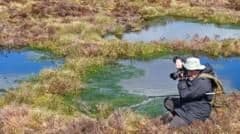
Meet The Bogfather: The Scientist Restoring Wales' Peatlands to Combat Climate Change
Dr Peter Jones has devoted 30 years to peatland restoration, earning a legendary nickname while offering nature-based solutions to some of our biggest environmental crises.

A Lifelong Obsession Born in a Bog
For most eight-year-olds, a rainy day trip to a nature reserve would be forgettable. For Dr Peter Jones, a drizzly childhood visit to Cors Caron — a national nature reserve near Tregaron in Wales — changed the entire course of his life. That early encounter with boggy, waterlogged terrain sparked a passion that has now spanned more than three decades, earning him an unlikely yet fitting nickname along the way: The Bogfather.
"I certainly wouldn't have come up with that myself," Jones laughs, explaining that a group of younger colleagues first coined the title. But with the sheer volume of peatland restoration work he has accomplished, few people in his field would dispute it.
Why Peatlands Matter More Than Ever
Peatlands might not inspire the same awe as rainforests or coral reefs, but their importance to the planet is staggering. In Wales alone, these landscapes store approximately 30% of all land-based carbon, despite occupying just 4% of the country's total surface area. The problem is that around 90% of Wales' peatland has been degraded — meaning instead of locking carbon away, these habitats are actively leaking greenhouse gases into the atmosphere.
The implications stretch far beyond carbon storage. Healthy peatlands naturally slow water runoff, reducing the risk of flooding in nearby communities. They also serve as natural firebreaks, helping contain wildfires — a threat expected to intensify as global temperatures continue to rise. In short, peatlands offer a rare, nature-based solution capable of addressing climate change, flooding, wildfire risk, and biodiversity loss simultaneously.
It is precisely this multi-layered value that has made Jones's work so compelling to policymakers — an offer, as he frames it, that is becoming increasingly difficult to turn down.
What Lies Beneath: The Science of Peat
Jones's fascination is not only with what grows on peatlands, but with what lies hidden beneath the surface.
"A peat soil is essentially made up of the partially decomposed remains of plants," he explains. As layers of peat accumulate over centuries, they trap everything that falls on the surface — pollen grains, dust particles, volcanic ash, and in some remarkable cases, even human remains.
This slow accumulation process gives peatlands an extraordinary quality: they function as natural archives, preserving a detailed record of environmental history stretching back thousands of years.
Peat builds at a rate of roughly one millimetre per year, meaning a single metre of peat can represent up to 1,000 years of accumulation. It is a process that demands patience — and respect.
How Wales' Peatlands Became So Damaged
Historically, peatlands were viewed as wastelands with little agricultural or economic value. As a result, vast areas were drained to make way for farming and forestry, with trees planted across boggy terrain that was never suited to support them.
Yet peatlands were far from worthless to the communities that once lived alongside them. For rural Welsh communities in past centuries, peat served as a vital source of fuel at a time when both money and firewood were scarce. Jones acknowledges that these landscapes played "an immensely important part in the cultural and social history of Wales."
The legacy of that degradation is visible today. Damaged peatlands are far more susceptible to erosion, with wind and rain gradually stripping away exposed layers until only bare bedrock remains — forming what Jones describes as striking "peat cliffs."
Spotting the Signs of a Healthy Bog
So how does an expert like Jones distinguish a thriving peatland from a damaged one? The answer lies largely in the plants.
Healthy peatland is typically characterised by grasses, sedges, and heathers. But the most critical indicator, according to Jones, is the presence of sphagnum moss — a remarkable plant capable of holding up to 20 times its own weight in water. This moss is, as Jones puts it, "really good at building peat," playing a central role in the formation and preservation of healthy bog ecosystems.
Biodiversity Hiding in Plain Sight
Beyond its carbon and water management functions, healthy peatland supports a remarkable variety of wildlife. Jones and his team work alongside farmers and landowners to restore these habitats, which provide a home for numerous scarce and threatened invertebrate species.
Jones's personal favourite? The fly orchid, found in the fens of Anglesey, where he lives. Despite its name and appearance — the flowers bear a striking resemblance to flies — this clever plant actually attracts digger wasps rather than flies. It releases a chemical scent that mimics female pheromone signals, luring male wasps that attempt to mate with the flower. In doing so, the wasps become dusted with pollen, which they unwittingly carry to the next flower, continuing the pollination cycle.
It is the kind of intricate, surprising relationship that makes peatland ecosystems endlessly captivating — and worth protecting.
Restoring What Has Been Lost
The good news is that damaged peatland can be restored. Jones and his colleagues employ more than 100 different restoration techniques, ranging from blocking drainage ditches to actively re-establishing native bog vegetation. Some peatlands in Wales have been under active conservation management for over 50 years.
Public and political awareness of peatland's importance has grown considerably in recent years, and Jones remains cautiously optimistic. For a scientist who started his journey as a bird-watching child captivated by a rainy Welsh bog, the recognition that these landscapes are central to our survival on this planet feels long overdue.
"They're quite wild," he says of wetlands, "with a lot of the characteristics of genuinely natural habitat." And in a world increasingly shaped by human intervention, that wildness — and the carbon it quietly holds — may prove to be one of our most valuable assets.